
Reduce Word Count in an Essay: 7 Easy Ways That Work
Reduce word count in an essay without losing quality by removing unnecessary words, improving sentence clarity, and focusing on the ideas that directly support your argument. Many students struggle with essay word limits, but careful editing can make writing shorter while keeping its meaning and evidence intact.
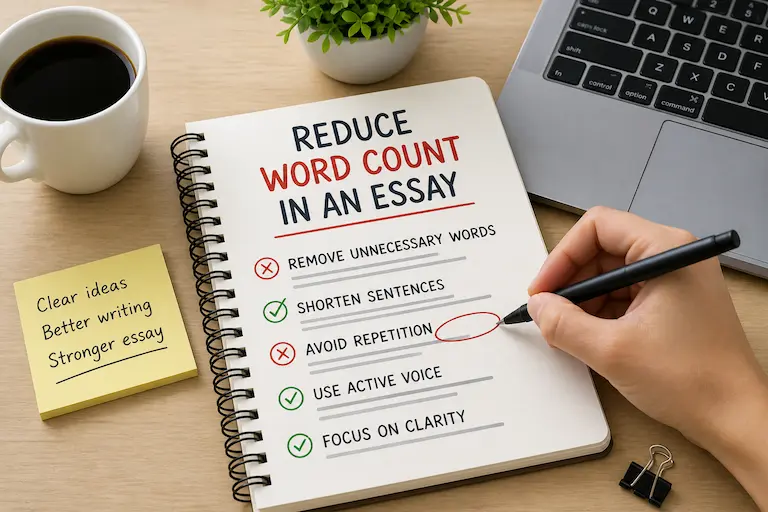
How to Reduce Word Count in an Essay Quickly
To reduce word count in an essay efficiently:
- Remove filler words and unnecessary phrases
- Replace wordy expressions with concise alternatives
- Delete repeated ideas
- Shorten sentences where meaning is preserved
- Combine closely related ideas when appropriate
- Remove background information that does not support the assignment
- Check your final word count after editing
The goal is not to delete random sentences. A better approach is to identify words, phrases, and repeated ideas that do not add useful meaning. This can make an essay more concise without weakening the argument.
If you need to know how to reduce word count without reducing content, focus first on wording that repeats an idea or adds little value rather than cutting evidence, explanation, or analysis.
When editing, protect your main argument first. Your thesis, strongest evidence, relevant examples, and necessary analysis should remain. The material to cut is usually repetition, unnecessary background, filler language, and wording that can be expressed more directly.
If your essay is substantially over the required limit, first identify the sections that contribute least to the assignment. Then work from larger sections down to individual sentences and words.
Why Word Count Matters in Academic Writing
Word limits give students a defined scope for an assignment and help instructors set expectations for the amount of work required. Staying within the stated limit can also encourage you to prioritize relevant evidence and explanation.
If an essay is substantially over the required limit, you may need to remove repetition or material that does not directly answer the assignment. However, the exact consequences of exceeding a word limit depend on the specific assignment or institution.
The ability to write concisely is useful because it helps you communicate an argument without unnecessary wording. Purdue OWL similarly recommends eliminating filler, repetition, and other language that does not contribute meaningfully to a sentence.
For additional guidance on understanding an assignment before editing, see the Harvard College Writing Center guide to reading assignment prompts.
When Should You Start Reducing Word Count?
In most cases, it is easier to reduce word count after you have completed a workable first draft. Writing the full argument first gives you a clearer view of which ideas are essential and which sections can be shortened or removed.
A practical editing process has two stages. First, remove larger problems such as repeated ideas, weak examples, and unnecessary background. Second, improve sentence-level issues such as filler words, wordy phrases, and unclear constructions.
When deciding how to cut words from an essay, start with sections and sentences that contribute least to your main argument before making smaller word-level edits.
This approach helps you reduce word count in an essay without cutting important information simply because you need to remove a certain number of words.
How to Reduce Word Count in an Essay Step by Step
1. Remove Filler Words
Filler words can increase word count without adding useful meaning. Look for words or phrases that can be removed without changing the point of the sentence.
Before: This is very important.
After: This is important.
Do not remove every descriptive word automatically. Keep words that add precision or meaning.
2. Replace Long Phrases
Some phrases can be replaced with shorter alternatives without changing the meaning.
- In order to → To
- Due to the fact that → Because
- At this point in time → Now
- A large number of → Many
- In the event that → If
Use the shorter version when it fits the sentence naturally. Concise writing is not about making every sentence as short as possible; it is about removing wording that does unnecessary work.
3. Delete Repeated Ideas
Read each paragraph and ask whether the same point has already been made elsewhere in the essay. If two sentences communicate essentially the same idea, keep the clearer or stronger version.
A reverse outline can help you identify repeated points at the paragraph level. Harvard College Writing Center recommends using a reverse outline to examine what each paragraph contributes and whether ideas are repeated or missing.
Read the Harvard College Writing Center guide to organizing an essay for more guidance.
4. Use More Direct Sentence Structures
Some sentences become shorter and clearer when the person or subject performing the action is placed directly in the sentence.
Before: The research was conducted by students.
After: Students conducted the research.
Active constructions are not automatically shorter in every case, so focus on clarity and concision rather than changing every passive sentence.
5. Combine Closely Related Sentences
If two short sentences express closely related ideas, combining them may reduce repetition and improve flow.
Before: The study included 100 students. The students completed a writing task.
After: The study included 100 students who completed a writing task.
Do not combine sentences simply to make them longer. Preserve readability and make sure the relationship between the ideas remains clear.
6. Remove Unnecessary Background Information
Background information can help readers understand a topic, but not every general statement needs to remain in the final essay.
Ask whether each background sentence helps answer the assignment question or supports your argument. If it does not, consider removing or shortening it.
This is particularly useful when you need to reduce a draft by a substantial number of words because removing entire low-value sections can be more effective than cutting individual words throughout the essay.
7. Check Your Word Count
After each major editing pass, check your essay’s word count. This tells you whether the changes have brought the draft within the required range.
Use the Word Counter for Essays to check your current length and measure your progress after editing.
Need to Check Your Essay Word Count?
If you are trying to reduce your essay to a specific word limit, checking the exact count before and after editing is more useful than estimating how many words you removed.
Use the Word Counter for Essays to check your draft and see whether you have reached the required length.
If you need to understand the expected length before editing, read How Many Words Should an Essay Be?.
Common Mistakes When Reducing Word Count
- Removing important arguments
- Deleting useful evidence or examples
- Cutting sentences without checking their role in the argument
- Removing words that provide necessary precision
- Changing clear sentences simply to make them shorter
- Cutting content randomly instead of editing systematically
To reduce word count in an essay effectively, focus on removing unnecessary language rather than removing useful ideas.
Tips to Reduce Word Count in an Essay Faster
Use these quick checks during your editing process:
- Read each paragraph and ask whether it supports your main point.
- Remove sentences that repeat information already explained.
- Replace wordy phrases with concise alternatives.
- Keep strong examples and remove weaker or repetitive ones.
- Check your word count after each major editing pass.
- Read the final version aloud to identify awkward or unnecessary wording.
These steps can make the editing process more systematic and help you reduce word count in an essay while preserving clarity.
If you are looking for how to reduce words in an essay, use these checks in order: remove repetition, shorten wordy phrases, and then review individual sentences for unnecessary wording.
For additional guidance on concise writing, see Purdue OWL’s guide to avoiding common problems in concise writing.
Best Method to Reduce Word Count
First Pass: Remove Larger Problems
Start with repeated ideas, unnecessary sections, weak examples, and background information that does not directly support the assignment.
Second Pass: Improve Sentences
Next, shorten wordy phrases, remove filler language, and revise sentences that can communicate the same idea more directly.
Third Pass: Check the Final Length
Use a word counter to confirm that the revised essay meets the required word count. Then read the final draft once more to make sure the cuts have not affected the argument.
Example of Reducing Word Count
Before:
In order to understand the importance of education, it is very necessary to look at the ways in which education helps people improve their future opportunities.
After:
To understand education’s importance, we must examine how it improves future opportunities.
The revised version removes unnecessary wording while preserving the main idea.
Helpful Tools for Essay Editing
Different tools can support different stages of the editing process. The Word Counter for Essays is the primary tool for this topic, while the other tools provide secondary checks after you have shortened the draft.
Word Counter for Essays
The Word Counter for Essays is the most relevant tool because the main purpose of this article is to reduce an essay to a required word count. Use it before and after editing to measure your progress.
Sentence Counter
The Sentence Counter is a moderate secondary tool for reviewing sentence distribution. After shortening an essay, it can help you see whether sections contain unusually long or short sentence patterns that may deserve another editing pass.
Remove Extra Spaces
The Remove Extra Spaces tool is a secondary formatting aid. After repeated editing and copying, an essay may contain accidental double spaces or unwanted spacing. Clean these issues after the content and word count are settled.
Reading Time Calculator
The Reading Time Calculator provides an estimated reading time for your revised essay. It is not a replacement for the required word count, but it can give you another perspective on the length of the finished draft.
Text Case Converter is not included here because capitalization is not directly related to reducing essay length.
How to Maintain Quality While Reducing Word Count in an Essay
When you reduce word count in an essay, the main goal should be clarity rather than simply deleting as many words as possible. Cutting words without considering their role can make an argument incomplete or harder to understand.
Protect your thesis, necessary evidence, important examples, and analysis. Remove repetition, unnecessary background, filler language, and phrases that do not add meaning.
It can also help to read the revised essay aloud. This may reveal awkward sentences, repeated wording, or places where a shorter construction would be clearer.
To condense an essay effectively, keep the ideas that support your argument and make the language around those ideas more direct.
For more guidance on organizing an essay and checking whether each paragraph contributes to the argument, see Harvard College Writing Center’s essay organization guide.
Manual Editing vs. Using a Word Counter
Manual editing and word-count checking serve different purposes. Manual editing helps you improve meaning, structure, clarity, and concision. A word counter helps you measure the result.
For best results, use both. First, edit the essay for clarity and relevance. Then use the Word Counter for Essays to check whether the draft is within the required limit.
If the essay is still too long, return to the sections that contribute least to your argument and continue editing rather than deleting important evidence at random.
Need to Make Your Essay Longer Instead?
If your essay is below the required length, do not add filler simply to increase the number of words. Instead, develop explanations, add relevant evidence, and expand important analysis.
Read How to Increase Word Count Without Fluff for practical ways to expand an essay while keeping the added content relevant.
Essay Still Over the Word Limit?
If your essay remains substantially above the required limit after the first editing pass, use a more systematic approach to remove repetition, unnecessary explanations, and low-value sections.
For a focused step-by-step guide, read Essay Over Word Limit? 7 Easy Ways to Fix It.
FAQs
How can I reduce word count in an essay without losing meaning?
Remove filler words, repeated ideas, unnecessary phrases, and background information that does not support the assignment. Keep your thesis, important evidence, relevant examples, and necessary analysis.
What is the fastest way to reduce word count in an essay?
Start with repeated ideas, unnecessary sections, and wordy phrases. These changes can reduce the length more efficiently than deleting individual words at random.
Should I remove examples to reduce word count?
Only remove examples that are weak, repetitive, or unrelated to your argument. Keep examples that provide important evidence or clarification.
Can a Word Counter help reduce essay length?
Yes. A Word Counter for Essays helps you track the draft’s length before and after editing so you can see whether you have reached the required limit.
Can Sentence Counter help with essay editing?
Yes. A Sentence Counter can provide another measurement when reviewing sentence distribution after shortening an essay. It should be used as an editing aid rather than a target.
Can I remove extra spaces from an essay after editing?
Yes. The Remove Extra Spaces tool can help clean accidental double spaces and unwanted spacing created during copying, pasting, and editing.
Can reading time help me review essay length?
Yes. A Reading Time Calculator can estimate how long the revised essay may take to read. It is an additional editing measurement and does not replace the assignment’s stated word-count requirement.
How Can I Reduce Word Count Without Reducing Content?
Reduce unnecessary wording rather than removing important ideas. Cut filler, repetition, and wordy phrases while keeping your thesis, evidence, examples, and analysis intact.
How Do I Cut Words From an Essay?
Start by removing repeated ideas and unnecessary background, then replace long phrases with concise alternatives and shorten sentences where the meaning remains clear.
How Much Can I Cut From an Essay Without Losing Substance?
There is no fixed percentage that applies to every essay. Cut until each remaining sentence contributes to the argument, evidence, explanation, or clarity, and keep essential substance even when you need to meet a strict word limit.
Final Tip
To reduce word count in an essay effectively, focus on clarity and relevance. Remove unnecessary words, repeated ideas, and wordy phrases while protecting the evidence and analysis your argument needs.
Then check your final length with the Word Counter for Essays before submitting your essay.