
Sentence Counter
Use this free sentence counter to count sentences, words, paragraphs, characters, and average words per sentence instantly. This online sentence counter is useful for essays and articles, as well as blog posts, academic writing, editing, readability checking, and text analysis. See every sentence with its word count and spot the long ones.
Table of Contents
Use these quick links to understand how this sentence counting tool works.
What is a Sentence Counter?
A sentence counter is an online tool that counts the number of sentences in a piece of text. It helps you analyze writing structure, sentence length, paragraph balance, and overall readability. You can use it for essays, assignments, blog posts, articles, reports, scripts, academic writing, and other written content.
This sentence count tool also shows word count, paragraph count, total characters, and average words per sentence. These extra writing statistics help you understand whether your text is too short, too long, too dense, or difficult to read.
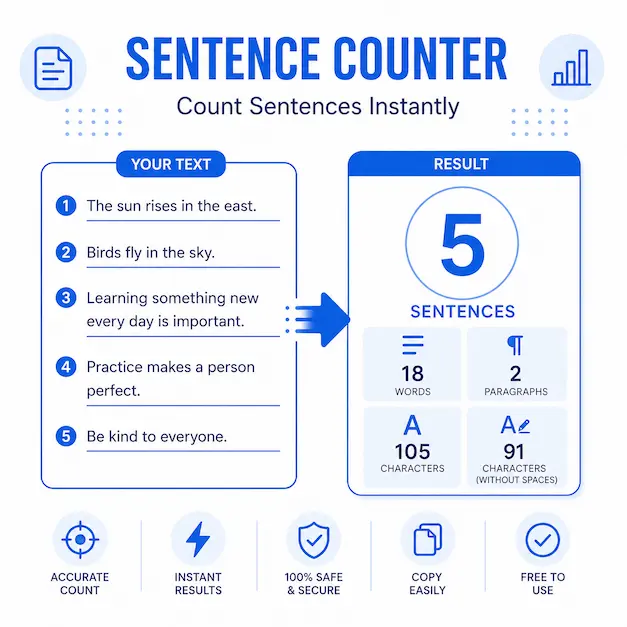
The tool works instantly in your browser. Paste your text into the box and it will update the sentence count and related statistics automatically. You do not need to upload a file, install software, create an account, or click a calculate button.
How to Use This Sentence Counter
Paste Your Text
Copy your paragraph, essay, article, blog post, script, or document and paste it into the text box above.
Check Sentence Count
The tool instantly counts sentences and shows related text statistics like words, paragraphs, characters, and sentence length.
Edit Your Writing
Use the results and the sentence breakdown to improve sentence length, readability, paragraph structure, and writing flow.
Scroll below the results to see every sentence with its word count. Sentences longer than the limit in the count options (25 words by default) are marked Long, and you can sort the list from longest to shortest. If your text is a list or has headings without end punctuation, tick the line-break option so each line counts as its own sentence.
Features of This Sentence Count Tool
Sentence Count
Count the total number of sentences in your text instantly while you type or paste content.
Word Count
Check total words to understand text length and compare sentence density.
Paragraph Count
Count paragraphs to review document structure and writing organization.
Character Count
See total characters for quick text analysis and formatting checks.
Average Sentence Length
This sentence length checker measures average words per sentence to identify long, dense, or hard-to-read writing.
Instant Browser Tool
Use the sentence counter online without signup, upload, installation, or payment.
Sentence-Length Breakdown
Analyze sentence length with average, median, longest, shortest, and range statistics.
Sentence-by-Sentence List
See every sentence with its word count and sort the list from longest to shortest.
Long Sentence Flags
Set your own word limit and see which sentences go over it, so you know where to edit.
Smart Sentence Detection
Titles, abbreviations, initials, decimals, web addresses, ellipses, and quotes are handled so they do not add false sentences.
Words to Sentences Converter
Estimate how many sentences a word count makes, or how many words a number of sentences makes.
Line-Break Option
Count each line as a sentence when you are checking lists, headings, captions, or poetry.
How This Sentence Counter Counts Sentences
A sentence counter has to decide which periods really end a sentence. These are the exact rules this tool follows, so you know what to check in your own text.
- Sentence endings: a sentence ends at a period, question mark, exclamation mark, or ellipsis that is followed by a space, a line break, or the end of the text. Closing quotation marks and brackets stay with the sentence they close. The Chinese and Japanese end marks (。!?), the Urdu and Arabic full stop and question mark (۔ ؟), and the Hindi danda (।) also end a sentence.
- Periods that do not end a sentence: titles and short forms such as Mr., Mrs., Dr., Prof., St., Inc., Co., vs., e.g., and i.e.; initials such as J. K. Rowling; decimals such as 3.14; web addresses and email addresses; and list numbers such as 1. at the start of a line.
- Short forms that depend on the next word: etc., a.m., p.m., no., fig., and month and weekday short forms such as Jan. or Mon. end a sentence when a capital letter follows, but not when a number or a lowercase word follows. So "I said no. Then he left." is two sentences, while "No. 5 is here." is one.
- Acronyms such as U.S. or Ph.D.: these end a sentence only when the next word is a common sentence opener such as The, He, or It. "The U.S. economy grew." is one sentence. "He lives in the U.S. He likes it." is two.
- Ellipses: an ellipsis followed by a lowercase word is a pause inside the sentence, so "Wait... what happened?" is one sentence. An ellipsis followed by a capital letter ends the sentence, so "I was thinking... Then I left." is two. This works for both three dots and the single ellipsis character.
- Quotes and dialogue: "Why?" she asked. counts as one sentence, because a lowercase word follows the closing quote. He said "Hi." Then she left. counts as two.
- Line breaks: by default a line break does not end a sentence, so a heading with no end punctuation joins the text after it. Tick the line-break option to count every line as its own sentence.
- Punctuation with no words: a stray ... or ?! with no words next to it is not counted as a sentence.
- Words: a word is any group of characters separated by spaces or line breaks that contains at least one letter or number. Hyphenated words, contractions, numbers such as 3.5, and abbreviations such as U.S. each count as one word. This is the same rule used by our word counter for essays.
- Sentence-length numbers: average words per sentence is total words divided by sentences. The median is the middle sentence length. The range is the longest sentence minus the shortest. Long sentences are those with more words than the limit in the count options. Average sentences per paragraph is sentences divided by paragraphs, where a paragraph is any block of text on its own line.
- Known limits: no tool can read grammar. A period with no space after it (end.Start) is not split. Short forms such as Inc. or St. at the very end of a sentence are not split. Languages written without spaces, such as Chinese and Japanese, are not split into words, so the word-based numbers are not meaningful for them. Check text that contains many abbreviations.
- Privacy: counting happens in your browser. The tool does not store your text or send it to our server.
What Is a Good Sentence Length?
There is no single correct sentence length. It depends on your reader and your subject. The Federal Plain Language Guidelines advise short sentences and one idea in each sentence, but they do not set a number.
If you want a starting point, plain English guidance such as the University of Kent plain English guide suggests an average sentence length of around 15 to 20 words. Academic writing often runs longer, and your instructor or style guide has the final say.
This tool marks sentences over 25 words by default. That is a starting point we chose for checking, not a rule, so change the limit in the count options to suit your work. A long sentence is not always a problem. What matters is whether your reader can follow it, and a mix of short and long sentences usually reads more naturally than a page of sentences with the same length.
For more help, read about the average sentence length in academic writing, learn how to write shorter sentences, or see how many sentences are in a paragraph.
Words to Sentences Converter
To estimate how many sentences a word count makes, divide the words by your average words per sentence. To go the other way, multiply the sentences by the average. The starting value of 20 is a middle value, so change it to match your writing, or paste your text above to find your real average.
| Word count | At 15 words per sentence | At 20 words per sentence | At 25 words per sentence |
|---|---|---|---|
| 100 words | 7 sentences | 5 sentences | 4 sentences |
| 250 words | 17 sentences | 13 sentences | 10 sentences |
| 500 words | 33 sentences | 25 sentences | 20 sentences |
| 1,000 words | 67 sentences | 50 sentences | 40 sentences |
| 1,500 words | 100 sentences | 75 sentences | 60 sentences |
| Sentences | At 15 words per sentence | At 20 words per sentence | At 25 words per sentence |
|---|---|---|---|
| 3 sentences | 45 words | 60 words | 75 words |
| 5 sentences | 75 words | 100 words | 125 words |
| 8 sentences | 120 words | 160 words | 200 words |
| 10 sentences | 150 words | 200 words | 250 words |
| 15 sentences | 225 words | 300 words | 375 words |
| 20 sentences | 300 words | 400 words | 500 words |
Why Sentence Count Matters in Writing
Sentence count matters because it gives a clearer view of how your writing is structured. Too many long sentences can make content difficult to read. Too many short sentences can make writing feel choppy. A balanced sentence structure improves readability, flow, and user engagement.
Students can use a sentence counter to review essays and assignments before submission. Bloggers can use it to improve article readability. Editors can use it to check writing rhythm. Teachers can use it to review student work. Marketers can use it to make copy clearer, shorter, and easier to understand.
Sentence statistics are also useful when you want to simplify dense paragraphs. If your average words per sentence is high, your writing may need shorter sentences, clearer transitions, or better paragraph breaks. This makes content more readable for online users.
When Should You Count Sentences?
Essays
Count sentences in essays and review sentence balance in school essays, college assignments, admission essays, and academic papers.
Blog Posts
Improve blog readability by identifying long sentence patterns and dense paragraphs.
Articles
Count sentences in articles and analyze article structure before publishing guides, news content, or long-form writing.
Scripts
Review sentence flow in YouTube scripts, speeches, presentations, and podcast notes.
Marketing Copy
Make landing page copy, product descriptions, and emails easier to read.
Readability Checks
Use sentence statistics to make writing clearer, shorter, and more reader-friendly.
FAQs About Sentence Counter
What is a sentence counter?
A sentence counter is an online tool that counts how many sentences are in a piece of text. It can help with writing analysis, editing, readability checking, and document review.
How does this tool count sentences?
The tool looks for sentence-ending punctuation (periods, question marks, exclamation marks, and ellipses) followed by a space, a line break, or the end of the text. It skips periods in titles such as Dr., abbreviations such as e.g., initials, decimals, web addresses, and email addresses. The full rules and known limits are in the section How This Sentence Counter Counts Sentences.
Can I use this sentence counter for essays?
Yes, you can use it for essays, assignments, research summaries, articles, blog posts, reports, speeches, and scripts.
Does this tool also count words and paragraphs?
Yes, the tool counts sentences, words, paragraphs, characters, and average words per sentence. It also shows the median, longest, shortest, and range of sentence length, the number of long sentences, and the average number of sentences per paragraph.
How many sentences is 250 words?
At 20 words per sentence, 250 words is about 13 sentences. At 15 words per sentence it is about 17, and at 25 words per sentence it is 10. Paste your text into the tool to see your real average.
How many words is 8 sentences?
At 20 words per sentence, 8 sentences is about 160 words. The range runs from 120 words at 15 words per sentence to 200 words at 25. Use the converter above for any other number.
How many sentences are in a paragraph?
There is no fixed rule. Many writing guides suggest about 3 to 8 sentences, with shorter paragraphs for blogs and web writing. See how many sentences are in a paragraph for more detail.
How many sentences should an essay have?
There is no fixed number. It depends on your word limit and your average sentence length. A 500-word essay with 20 words per sentence has about 25 sentences. Use the word counter for essays to track your word limit.
Why is average words per sentence useful?
Average words per sentence helps you understand sentence length. Very long sentences may reduce readability, while balanced sentence length can make writing clearer.
What is a good average sentence length?
There is no single right answer. Plain English guidance often suggests an average of around 15 to 20 words for general readers, and academic writing is often longer. See the section What Is a Good Sentence Length? for more.
How can I check my sentence length?
Paste your text into the tool to see average, median, longest, shortest, and sentence-length range statistics. The sentence breakdown below the results lists every sentence with its word count, marks long sentences, and can sort them from longest to shortest.
How do I find my longest sentence?
Check the Longest Sentence number for its word count, then sort the sentence breakdown by Longest first to read it. Sentences over your word limit are marked Long.
Does the tool count Dr., e.g., and U.S. as sentence endings?
No. It recognizes common titles, abbreviations, initials, decimals, web addresses, and email addresses and does not end a sentence there. Short forms such as Inc. or St. at the very end of a sentence may not be split, so check text that has many abbreviations.
Does a line break count as a new sentence?
Not by default. A line break does not end a sentence unless punctuation comes before it. Tick "Count each line break as the end of a sentence" in the count options for lists, headings, and poetry.
What is the difference between a sentence counter and a word counter?
A word counter totals the words in your text. A sentence counter finds where sentences end and then measures sentence length. This tool shows both. If you are working to an essay word limit, the word counter for essays also tracks how many words you have left.
Is my text saved or sent anywhere?
No. Counting happens in your browser, and this tool does not store or upload your text. Because nothing is saved, keep your own copy of your writing.
Is this sentence counter free?
Yes, this sentence counter is free to use and works instantly in your browser without signup or installation.
Count Sentences Instantly
Paste your text above and get sentence count, word count, paragraph count, character count, average sentence length, and sentence-length analysis in seconds.
Use Sentence Counter