
Best Title Case Format for Headlines
Best Title Case Format for Headlines: 9 Powerful Tips
Choosing the Best Title Case Format for Headlines comes down to one question: which style guide are you following? If nobody has told you which style to use, use the everyday default: capitalize the first word, the last word and every major word, and keep articles, coordinating conjunctions and short prepositions in lowercase.
Quick answer: which format should you use?
- School essay, journal article or book (APA, Chicago or MLA): use title case for titles and headings in the text, and check how your guide treats longer prepositions (see the preposition table below). One exception: APA reference lists use sentence case for article and book titles.
- News headline in AP style, or help-center and app text in Microsoft or Google style: use sentence case.
- No required style guide: use the everyday default in this article and apply it to every headline on your site.
Capitalization will not turn a weak headline into a strong one, but a correct and consistent style makes your titles look careful and easy to scan. This guide gives you nine rules, a worked example, a side-by-side comparison of AP, APA, Chicago and MLA, a fix-it table for common mistakes and a short checklist. Free text tools near the end help you apply the rules quickly.
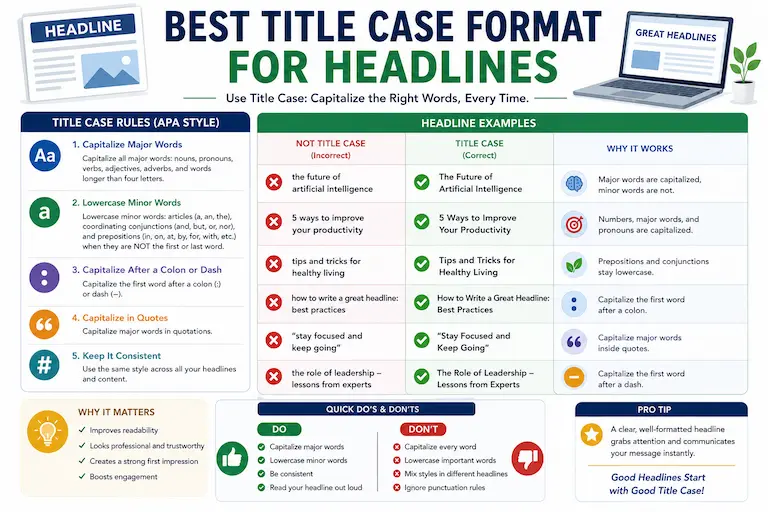
What Is Title Case in Headlines?
Title case is a capitalization style where the major words in a headline start with a capital letter and the minor words stay lowercase. Chicago style used to call this “headline style” and, since its 18th edition in September 2024, calls it title case.
Example of Title Case
- Best Strategies for Content Marketing Success
In title case:
- Nouns are capitalized
- Verbs are capitalized
- Adjectives and adverbs are capitalized
- Pronouns are capitalized
- Short articles, conjunctions and prepositions are usually lowercase
The result is a headline with a formal, traditional look. The exact list of “minor” words changes from one style guide to another, which is why the rules and tables below matter.
Why the Best Title Case Format for Headlines Matters
Using a correct, consistent title case format helps with:
- headline readability
- content presentation
- professional appearance
- consistency across all your pages
- fewer corrections later, because everyone follows one rule
Capitalization mistakes are easy to spot, and a mix of styles on one site looks careless. Capitalization will not make people click by itself; a clear, specific headline matters more. What a correct format does is keep a good headline from looking sloppy.
Example
Incorrect:
- best title case format for headlines
Correct:
- Best Title Case Format for Headlines
The second version looks cleaner and more professional.
Core Rules for the Best Title Case Format for Headlines
Understanding capitalization rules is essential for mastering headline formatting. The nine rules below are the tips behind the title of this guide. They are written as the everyday default, which is based on the points Chicago style and Microsoft’s title-style guidance share for ordinary headlines.
The 9 rules at a glance
- Capitalize the first word.
- Capitalize the last word, even if it is a short preposition.
- Capitalize nouns, pronouns, verbs, adjectives and adverbs.
- Lowercase the articles: a, an, the.
- Lowercase the coordinating conjunctions: and, but, or, nor, for.
- Lowercase short prepositions such as of, in, on, at, to and by, and check your style guide for longer ones.
- Capitalize the first word after a colon.
- Capitalize both parts of a hyphenated major word, such as Long-Term.
- Keep acronyms and brand names as they are normally written, and stay consistent.
Capitalize Major Words
Always capitalize:
- nouns
- verbs
- adjectives
- adverbs
- pronouns
Example
- Powerful Techniques for Writing Better Headlines
Lowercase Minor Words
Usually lowercase in the middle of a headline:
- a, an, the
- and, but, or, nor, for
- of, in, on, at, to, by
Example
- The Importance of Headlines in SEO
The words “of” and “in” remain lowercase. The first word, “The,” is capitalized because it begins the headline.
Capitalize the First and Last Word
Always capitalize the first and final word in a title, even when they are small words that would normally stay lowercase.
Example
- How to Improve Readability Fast
- What Is This Headline About
In the second example, “about” is a short preposition, but it is the last word, so it takes a capital letter.
Capitalize Words After Colons
Correct:
- Headline Writing Tips: Proven SEO Strategies
Both APA and the Microsoft style guide capitalize the first word after a colon in a title.
Capitalize Short Verbs Such as Is, Are, and Be
Short does not mean minor. “Is,” “Are,” “Be,” “Was” and “Am” are verbs, and the major style guides capitalize verbs whatever their length.
Incorrect:
- Why Title Case is Confusing
Correct:
- Why Title Case Is Confusing
Handle Hyphenated Words Carefully
In a hyphenated major word, capitalize both parts. Small words inside the compound, such as “by,” stay lowercase.
- Long-Term Content Marketing Strategy
- A Step-by-Step Guide to Title Case
APA and the Microsoft style guide both capitalize the second part of a hyphenated major word. Rules for words with prefixes, such as “anti-” or “mid-,” differ between guides, so check yours.
Longer Prepositions: Where Style Guides Disagree
Words such as “with,” “from” and “about” are prepositions, but they are longer than the tiny ones. This is the point where the major style guides give different answers. Chicago changed its rule in its 18th edition (September 2024): it now capitalizes prepositions of five or more letters, where earlier editions lowercased every preposition.
| Preposition length | Example words | AP (titles of works) | APA 7th | Chicago 18th | MLA 9th |
|---|---|---|---|---|---|
| 1 to 3 letters | of, in, on, to, by, for | lowercase | lowercase | lowercase | lowercase |
| 4 letters | with, from, over, into | Capitalize | Capitalize | lowercase | lowercase |
| 5 or more letters | about, between, through, around | Capitalize | Capitalize | Capitalize | lowercase |
In every style, a preposition is capitalized when it is the first or last word of the title. Last checked: October 2026.
Acronyms, Brand Names, and Numbers
- Keep acronyms in capitals: SEO, USA, PDF.
- Keep brand names as the brand writes them: iPhone, eBay, YouTube.
- Numbers can stay as numerals, as in “10 Tips for Writing Better Headlines.”
Which Words to Capitalize in a Title: Quick Chart
| Type of word | Examples | Rule |
|---|---|---|
| Nouns, pronouns, verbs, adjectives, adverbs | headline, it, is, better, quickly | Capitalize |
| Articles | a, an, the | Lowercase, unless first or last word |
| Coordinating conjunctions | and, but, or, nor, for | Lowercase, unless first or last word |
| Short prepositions | of, in, on, at, to, by | Lowercase, unless first or last word |
| Longer prepositions | with, from, about, between, through | Depends on the style guide (see the table above) |
| First word after a colon | Headline Tips: How to Write Better Titles | Capitalize |
How to Capitalize Titles Correctly: A Step-by-Step Example
To capitalize titles correctly, choose your style first, then apply the same checks in the same order every time. Here is the process on one headline, using the everyday default.
As typed: how to write better headlines for your blog: a guide to capitalization for beginners
- Pick the style. No guide is required here, so the everyday default applies.
- Capitalize the first and last words. “How” and “Beginners” get capitals.
- Capitalize every major word. “Write,” “Better,” “Headlines,” “Your,” “Blog,” “Guide” and “Capitalization” are nouns, verbs, adjectives or pronouns.
- Lowercase the minor words. “To” and “for” each appear twice in this headline, and all four stay lowercase.
- Capitalize the first word after the colon. The “a” right after the colon becomes “A.”
- Check the special cases. There are no acronyms, brand names or hyphenated words in this headline, so nothing else changes.
Finished headline: How to Write Better Headlines for Your Blog: A Guide to Capitalization for Beginners
If your school or publisher requires APA, Chicago or MLA, repeat step 4 with that guide’s preposition rule from the table above. For headlines like this one, where the only prepositions are “to” and “for,” the result is the same in every title-case style.
Best Title Case Format for Headlines in SEO
SEO headlines need both readability and keyword optimization.
Google’s guidance on title links asks for titles that are descriptive and concise, avoid keyword stuffing and are different on every page. It does not ask for title case or sentence case, so the capitalization style is your choice. What matters is that you pick one and use it consistently. Google also notes that a title element has no length limit, but search results cut long titles to fit the device width.
Effective SEO headlines should balance:
- search intent
- relevance
- clarity
- compelling wording
SEO Best Practices
- Keep SEO titles concise enough to display clearly in search results
- Describe the page honestly and avoid repeating keywords
- Use one capitalization style consistently
- Avoid excessive capitalization
- Make titles easy to read on mobile devices
A Character Counter Without Spaces gives you a count that leaves out spaces, so it will be lower than the real length of a title. Because search results shorten titles to fit the screen rather than at a fixed number of characters, use any count only as a rough guide and check how the title looks in search results.
Sentence Case vs Title Case: The Main Difference
Sentence case and title case are the two main ways to capitalize a headline. In sentence case, only the first word, proper nouns and proper adjectives are capitalized, plus the first word after a colon. In title case, the first and last words and the major words in between are capitalized, following your style guide. Neither is “wrong.” They belong to different style guides.
| Feature | Sentence case | Title case |
|---|---|---|
| What gets a capital letter | First word, proper nouns, first word after a colon | First and last words plus major words, per your style guide |
| Example | How to write a headline that readers finish | How to Write a Headline That Readers Finish |
| Used by | AP (news headlines), Microsoft, Google developer documentation | APA, Chicago and MLA (titles of works in the text) |
| Typical feel | Direct and conversational | Formal and traditional |
| Effect on Google ranking | Google’s title-link guidance does not ask for either style | Google’s title-link guidance does not ask for either style |
The Microsoft Writing Style Guide uses sentence-style capitalization for titles and headings, including blog post titles. Google’s developer documentation style guide also uses sentence case for document titles and headings. AP style capitalizes only the first word and proper names in news headlines. Last checked: October 2026.
What Is Sentence Case?
Sentence case treats a headline like an ordinary sentence. Examples:
- Why sentence case suits help-center articles
- Best writing tips for students
- Headline tips: How to write for Google
In the last example, “How” is capitalized because it follows a colon, and “Google” is a proper noun.
Title Case vs Sentence Case for Headlines
Many writers debate whether sentence case or title case is more appropriate for different types of headlines. The answer depends on your style guide, your audience and where the headline appears.
Title Case Example
- Best Title Case Format for Headlines in SEO
Sentence Case Example
- Best title case format for headlines in SEO
Title case is commonly used for:
- blog headlines
- YouTube titles
- book titles and academic titles (APA, Chicago, MLA)
- marketing campaigns
- some newspaper and magazine headlines (practice varies from publication to publication)
Sentence case is often preferred for:
- UX writing
- app interfaces
- documentation and help-center articles
- news headlines written in AP style
- conversational brands
Quick Decision Guide
| Your situation | Use | Why |
|---|---|---|
| Paper, article or book in APA, Chicago or MLA | Title case | These guides use title case for titles of works in the text; check the preposition table for your guide |
| News headline in AP style | Sentence case | AP headlines capitalize only the first word and proper names |
| Documentation, help center or app interface in Microsoft or Google style | Sentence case | Both guides specify sentence case for titles and headings |
| Blog post titles with no required guide | Either one | Choose one, write it down and use it on every post |
| Email subject lines, YouTube titles, ad copy | Either one | Follow your brand style, and test both if you want your own data |
Common Title Case Formatting Mistakes
Even professional writers make capitalization mistakes.
Capitalizing Every Word
Incorrect:
- Best Title Case Format For Headlines
Correct:
- Best Title Case Format for Headlines
Small prepositions like “for” usually remain lowercase.
Using All Caps
Incorrect:
- BEST TITLE CASE FORMAT FOR HEADLINES
All-uppercase text can reduce readability and may feel aggressive in many contexts. The Microsoft style guide also advises against all uppercase for emphasis.
Want to learn when uppercase and lowercase each make sense?
Uppercase vs Lowercase in Writing
Inconsistent Formatting
Incorrect:
- Best title Case Format For Headlines
Correct:
- Best Title Case Format for Headlines
Consistency improves professionalism.
Forgetting the Last Word
Incorrect:
- What Is This Headline about
Correct:
- What Is This Headline About
The first and last words are always capitalized, whatever their part of speech.
Mixing Up Style Guides
A title that is correct in one guide can be wrong in another. Take this title:
- A Guide From Start to Finish (correct in APA and for AP titles of works)
- A Guide from Start to Finish (correct in Chicago and MLA)
Always check which guide your teacher, publisher or client requires before you format the title.
How Professional Editors Format Headlines
Professional editors follow recognized style guides.
Popular headline capitalization standards include:
- AP Style
- Chicago Style
- APA Style
- MLA Style
- Microsoft Writing Style Guide
Not every guide uses title case for headlines. The table below runs the same headline, “how to write a headline that works with readers from around the world,” through each guide so you can see the differences. Last checked: October 2026.
| Style guide | Short rule | Same headline in this style |
|---|---|---|
| AP Stylebook (news headlines) | Sentence case: capitalize only the first word and proper names | How to write a headline that works with readers from around the world |
| AP Stylebook (titles of works) | Title case: capitalize words of four letters or more, including prepositions and conjunctions | How to Write a Headline That Works With Readers From Around the World |
| APA, 7th edition | Title case: capitalize major words and any word of four letters or more; lowercase minor words of three letters or fewer | How to Write a Headline That Works With Readers From Around the World |
| Chicago Manual of Style, 18th edition (2024) | Title case: lowercase articles, “and,” “but,” “for,” “nor,” “or” and prepositions of four letters or fewer; capitalize prepositions of five or more | How to Write a Headline That Works with Readers from Around the World |
| MLA Handbook, 9th edition | Title case: lowercase articles, prepositions of any length, coordinating conjunctions and the “to” in infinitives | How to Write a Headline That Works with Readers from around the World |
| Microsoft Writing Style Guide | Sentence case for titles and headings, including blog post titles | How to write a headline that works with readers from around the world |
Style guides are revised from time to time. Chicago’s 2024 change to its preposition rule is one example, so check the edition your school or publisher requires.
Want a closer look at one guide? Read the full APA rules with examples.
APA Title Case Rules Explained
Trusted resources include:
- Associated Press Stylebook
- The Chicago Manual of Style
- APA Style: Title Case Capitalization
- Microsoft Writing Style Guide: Capitalization
These resources are widely used by publishers, editors and writers to keep style and capitalization consistent.
Best Title Case Format for Headlines in Blogging
Many bloggers use title case because it is a familiar, consistent presentation for post titles. Others prefer sentence case. Either works if you apply it the same way on every post.
- consistent presentation across posts
- a familiar look for readers
- one simple rule for guest writers and editors
- readability
Blog Headline Example
- 15 Powerful SEO Tips That Increase Website Traffic
This format combines:
- title case
- a number
- a clear promise
- clarity
Some sites use title case for post titles and sentence case for subheadings. That is fine, as long as the rule is written down and every writer follows it. A one-line site rule, such as “Chicago-style title case for post titles, sentence case for subheadings,” is enough.
Best Tools for Formatting Headlines
Professional writers can use targeted text tools to improve headline formatting accuracy and efficiency. A tool applies one general rule, so always read the result against your style guide, especially for four- and five-letter prepositions, brand names and acronyms.
Text Case Converter
For the main formatting task, the Text Case Converter can quickly convert headlines into title case, sentence case, uppercase, lowercase, and other text formats.
- lowercase to title case
- sentence case to title case
- uppercase to proper formatting
This is the most directly relevant TextToolPro tool for creating consistently formatted headlines.
Character Counter Without Spaces
After formatting a headline, the Character Counter Without Spaces can help you check its character count without counting spaces, which is useful when a form or an assignment asks for a letters-only count. For SEO titles, remember that the visible title includes spaces, so a count without spaces will be lower than the real length.
Sentence Counter
Capitalization is only one part of readable writing. After correcting title formatting, the Sentence Counter can help you review sentence length and paragraph structure in the surrounding content so the finished writing remains easy to read.
Word Counter for Essays
For students applying capitalization rules to academic assignments, the Word Counter for Essays can help verify the final word count after formatting and editing are complete.
Psychological Impact of Title Case Headlines
Title case gives a headline a more formal, traditional look, while sentence case reads as more conversational. These are presentation effects, not proven psychological rules.
The USAGov content team looked for a definitive answer on whether sentence case or title case is easier to read and found the opinions mixed. They noted that older users tend to be more used to title case on websites, while younger users may be more used to sentence case from commercial sites and social media. After weighing the evidence, they chose sentence case for their new English website.
Treat any claim that one style always gets more clicks with caution. The safest approach is to choose the style that fits your audience and style guide, apply it consistently and, if performance matters, test your own headlines.
A consistent style can:
- create a consistent visual style
- support a professional presentation
Best Title Case Format for Headlines on Social Media
Social platforms reward clarity and readability.
Best Practices
- Match the capitalization style you use on your website
- Keep capitalization consistent
- Avoid all caps
- Maintain readability on mobile devices
Consistent formatting makes your content look the same in search results, on social media and in email, and makes it easier to scan.
Real Examples of Strong Title Case Headlines
SEO Blog Example
- How to Improve Google Rankings Quickly
Marketing Example
- Proven Strategies for Increasing Email Open Rates
Educational Example
- Best Study Techniques for College Students
Fix-It Table: Before and After
These seven headlines show the mistakes that appear most often. The fixed versions use the everyday default.
| As typed | What is wrong | Fixed |
|---|---|---|
| 10 TIPS FOR WRITING BETTER HEADLINES | All capitals | 10 Tips for Writing Better Headlines |
| how to write a headline that gets read | No capitals at all | How to Write a Headline That Gets Read |
| How To Write A Headline For Your Blog | Every word capitalized | How to Write a Headline for Your Blog |
| Why Title Case is Confusing | Short verb “is” left lowercase | Why Title Case Is Confusing |
| A Long-term Plan for Content Marketing | Second part of the hyphenated word | A Long-Term Plan for Content Marketing |
| Headline Tips: how to write better titles | First word after the colon | Headline Tips: How to Write Better Titles |
| What Is This Headline about | Last word left lowercase | What Is This Headline About |
How to Instantly Improve Headline Formatting
Use this quick checklist before you publish any headline:
- Write your headline naturally first.
- Choose your style: the everyday default, APA, Chicago, MLA or sentence case.
- Apply the nine rules by hand, or run the headline through a converter.
- Check the five trouble spots: the first word, the last word, short verbs such as “is,” the word after a colon and hyphenated words.
- Read it once more for brand names and acronyms, then publish.
Want to format a headline instantly?
Final Thoughts on the Best Title Case Format for Headlines
Mastering the Best Title Case Format for Headlines helps improve readability, presentation, and consistency across different types of content.
Whether you are creating:
- blog posts
- marketing headlines
- YouTube titles
- email subject lines
- academic headings
- news headlines (check whether your publication uses sentence case)
a correct, consistent format creates a stronger first impression and makes your headlines easier to scan.
The most effective headline formatting balances:
- the style guide you are required to follow
- readability
- a descriptive, honest headline
- consistency across every page
Consistent title case formatting remains one of the easiest ways to improve writing quality and presentation.
Instantly Optimize Headlines With a Text Case Converter
Want a faster way to create consistently formatted headlines?
Use our free Text Case Converter to:
- Convert text into title case instantly
- Fix capitalization errors
- Switch between title case and sentence case
- Save editing time
- Create consistently formatted titles
It is one of the most useful tools for bloggers, marketers, editors, students, and content creators who need consistent headline formatting.
FAQs About the Best Title Case Format for Headlines
What is the Best Title Case Format for Headlines?
The Best Title Case Format for Headlines is the one your style guide requires. If none is required, capitalize the first and last words and all major words, and keep short articles, conjunctions, and prepositions lowercase unless they appear at the beginning or end of the title.
How do you capitalize titles correctly?
Pick a style first. Then capitalize the first and last words, every noun, pronoun, verb, adjective and adverb, and the first word after a colon. Lowercase articles, coordinating conjunctions and short prepositions. Check longer prepositions against your style guide.
What is the difference between sentence case and title case?
Sentence case capitalizes only the first word, proper nouns and the first word after a colon. Title case also capitalizes the last word and the major words in between, following the rules of a style guide.
Why is title case important for headlines?
Title case can improve readability, professionalism, and consistency for blog posts, marketing content, and other types of headlines, as long as you apply the same style everywhere.
Is title case better than sentence case for SEO?
There is no universal SEO rule that makes title case better than sentence case. Google’s guidance on title links asks for descriptive, concise, unique titles and does not ask for either style. Choose the capitalization style that fits the publication, audience, and style guide while keeping the headline clear and readable.
Is AP style title case or sentence case?
AP style uses sentence case for news headlines, which means only the first word and proper names are capitalized. For titles of works such as books and films, AP uses title case and capitalizes words of four letters or more.
Do you capitalize “is” in a title?
Yes. “Is” is a verb, and the major style guides capitalize verbs whatever their length. The same goes for “are,” “be,” “was” and “am.”
Do you capitalize the word after a colon in a title?
Yes. In title case, the first word after a colon is capitalized, even if it is a small word such as “a” or “the.” Sentence-case guides such as Microsoft’s also capitalize the first word after a colon.
Do you capitalize prepositions in a title?
It depends on length and on the style guide. Short prepositions such as “of,” “in” and “to” stay lowercase in every major guide. Longer ones such as “with,” “from” and “about” follow the table above. A preposition is always capitalized when it is the first or last word.
Which tool helps create the Best Title Case Format for Headlines?
A Text Case Converter can quickly format headlines into title case and other capitalization styles. Read the result against your style guide before you publish.
Should every word be capitalized in title case?
No. Small words like “and,” “for,” and “of” are usually lowercase unless positioned at the beginning or end of the title.
How do professional writers format headlines?
Professional writers follow the style guide that applies to their publication or assignment. AP style, for example, uses sentence case for news headlines, while APA, Chicago, and MLA use title case, each with its own rule for longer prepositions.
Sources and Further Reading
Style-guide facts on this page were last checked in October 2026.
- APA Style: Title Case Capitalization
- APA Style: Sentence Case for Titles in References
- CMOS Shop Talk: Announcing The Chicago Manual of Style, 18th Edition
- CMOS Shop Talk: Is “Is” Always Capitalized in Titles?
- Douglas College Library: MLA 9 title capitalization (quotes the MLA Handbook, 9th edition)
- Microsoft Writing Style Guide: Capitalization
- Google Developer Documentation Style Guide: Capitalization
- Google Search Central: Influencing Your Title Links in Search Results
- Grammarly: Title Case vs. Sentence Case (AP headlines use sentence case)
- USAGov: Making the Case for Sentence Case