
APA Title Case Rules
7 Powerful APA Title Case Rules for Better Academic Writing
Understanding APA Title Case Rules is important for students, researchers, editors, and academic writers who want consistent and professional formatting. Incorrect capitalization in headings and titles can reduce readability, create formatting inconsistencies, and make academic work look less polished.
Quick answer: In APA title case, capitalize the first word, every noun, verb (including short ones like “is” and “be”), pronoun, adjective, and adverb, and every word of four letters or more. Lowercase only articles, short conjunctions, and short prepositions of three letters or fewer. The exception: always capitalize the first word of a title, a subtitle, or the first word after a colon, em dash, or end punctuation in a heading.
Whether you are writing in APA 7th edition style or preparing academic content for university, understanding APA Title Case Rules can help you present your work consistently and professionally.
In this complete guide, you will learn the key APA Title Case Rules, capitalization examples, formatting standards, common mistakes, and practical writing tips for academic writing.
You will also discover tools that can help automate title formatting and reduce manual capitalization errors.
What Are APA Title Case Rules?
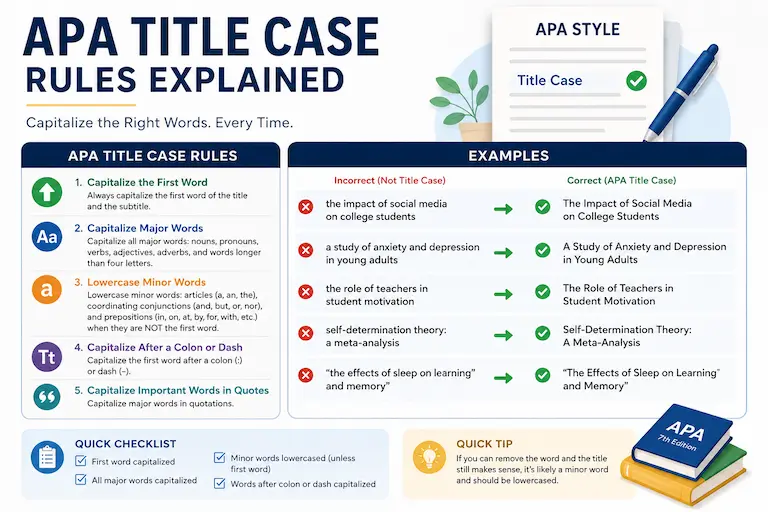
APA Title Case Rules are the capitalization guidelines used by the American Psychological Association (APA) for titles and headings in academic writing.
In APA title case:
- Major words such as nouns, pronouns, verbs (including linking verbs), adjectives, and adverbs are capitalized.
- Words of four letters or more are generally capitalized, even when they are prepositions or conjunctions.
- Minor words such as articles, short conjunctions, and short prepositions are generally lowercase unless they fall under an APA capitalization exception.
- The first word of a title or heading, the first word of a subtitle, and the first word after a colon, em dash, or end punctuation in a heading are capitalized.
Example of APA Title Case
Correct:
- The Effects of Social Media on Student Performance
Incorrect:
- The Effects Of Social Media On Student Performance
Notice how the short preposition “on” remains lowercase because it is a minor word within the title.
Why APA Title Case Rules Matter
Proper title capitalization supports:
- Academic professionalism
- Readability
- Formatting consistency
- Clear research presentation
- Professional academic presentation
Universities and academic journals often require consistent APA formatting standards, making APA Title Case Rules important when APA style is required.
Incorrect title capitalization can result in:
- Requests for formatting corrections
- Formatting penalties
- Editorial corrections
- Reduced credibility
That is why understanding APA Title Case Rules can help you meet academic formatting requirements and present your work professionally.
Core APA Title Case Rules Explained
Here are the most important APA capitalization rules every writer should know.
Capitalize Major Words
Capitalize major words such as:
- Nouns
- Pronouns
- Verbs (including linking verbs)
- Adjectives
- Adverbs
Example
- Understanding Human Behavior in Digital Marketing
Capitalize Words of Four Letters or More
APA title case generally capitalizes words that contain four or more letters, even when they are prepositions or conjunctions.
- With
- From
- Between
Lowercase Minor Words
Minor words are generally lowercase when they appear within a title or heading. APA treats only words of three letters or fewer as minor words.
- Articles (a, an, the)
- Short conjunctions (and, as, but, for, if, nor, or, so, yet)
- Short prepositions (as, at, by, for, in, of, off, on, per, to, up, via)
Example
- The Role of Art in Education
The words “of” and “in” remain lowercase because they are minor words in the title.
Capitalize the First Word of a Title and Subtitle
The first word of a title, heading, or subtitle is always capitalized, even when it is a minor word such as “The” or “A.”
- A Review of Study Habits Among First-Year Students
Capitalize the First Word After a Colon
In APA title case, capitalize the first word after a colon in a title or heading. The same applies to the first word after an em dash or after end punctuation (such as a question mark) in a heading.
Example
- Academic Writing Skills: Practical Tips for Students
Capitalize Hyphenated Major Words
In APA title case, capitalize the major words in hyphenated compounds, including the second part when it is also a major word.
For example, “Evidence-Based Learning Strategies” is correctly capitalized when both parts of the hyphenated compound are major words. APA’s own example is “Self-Report,” not “Self-report.”
Remember That Short Verbs and Pronouns Are Major Words
Short words are not automatically lowercase. Verbs (including linking verbs such as “is,” “are,” and “be”) and pronouns (such as “it,” “we,” and “they”) are major words, so they are capitalized. The adverb “not” is capitalized too.
- Why Sleep Is Important for Students
- When It Is Not Enough to Memorize
APA Title Case Rules Quick Reference
Use this table when you are unsure about a single word. The word lists follow the official APA Style guidance (last checked: October 2026).
| Type of word | In APA title case | Examples |
|---|---|---|
| Nouns, pronouns, adjectives, adverbs | Capitalize | Learning, They, Effective, Quickly, Not |
| Verbs, including linking verbs | Capitalize | Study, Is, Are, Be |
| Any word of four letters or more, even a preposition or conjunction | Capitalize | With, From, Between, About, Through, Than |
| Articles | Lowercase | a, an, the |
| Short conjunctions (three letters or fewer) | Lowercase | and, as, but, for, if, nor, or, so, yet |
| Short prepositions (three letters or fewer) | Lowercase | as, at, by, for, in, of, off, on, per, to, up, via |
| First word of a title, subtitle, or heading; first word after a colon, em dash, or end punctuation | Always capitalize | The, A, or any word that starts the part |
APA Title Case Rules in Action: Before and After Examples
Here is one title converted word by word. This is the same method you can use for any title.
Starting title: is screen time linked to poor sleep? a review of teen studies
| Word | Result | Why |
|---|---|---|
| is | Is | Linking verb (major word) and first word |
| screen, time | Screen Time | Nouns |
| linked | Linked | Verb |
| to | to | Short preposition (three letters or fewer) |
| poor, sleep | Poor Sleep | Adjective and noun |
| a | A | Article, but it is the first word after a question mark |
| review | Review | Noun |
| of | of | Short preposition |
| teen, studies | Teen Studies | Adjective and noun |
Result: Is Screen Time Linked to Poor Sleep? A Review of Teen Studies
More before-and-after examples:
| Before | After (APA title case) | What to notice |
|---|---|---|
| students as partners in research | Students as Partners in Research | “as” and “in” are short and stay lowercase |
| self-report measures with college students | Self-Report Measures With College Students | Both parts of “Self-Report” are capitalized; “With” has four letters |
| what teachers can learn from first-year students | What Teachers Can Learn From First-Year Students | “From” has four letters; “First-Year” is a hyphenated major word |
| using social media for study groups: benefits and risks | Using Social Media for Study Groups: Benefits and Risks | “for” and “and” stay lowercase; “Benefits” follows a colon |
APA Title Case vs Sentence Case
Many students confuse title case with sentence case.
APA Title Case Example
- Effective Research Methods for College Students
Sentence Case Example
- Effective research methods for college students
In sentence case, most words remain lowercase while the first word, proper nouns, and other APA-specified exceptions are capitalized.
APA uses different capitalization conventions depending on where the title appears:
- Title case for paper titles and headings
- Sentence case for titles of works in reference list entries
| Where the title appears | Capitalization |
|---|---|
| The title of your own paper | Title case |
| Headings (Levels 1 to 5) | Title case |
| Titles of articles, books, and reports mentioned in your text | Title case |
| Table titles, figure titles, axis labels, and legends | Title case |
| Titles of periodicals such as journals and newspapers | Title case (also italic), including in the reference list |
| Titles of articles, books, and reports in the reference list | Sentence case |
Understanding this distinction is important when applying APA formatting. APA explains both styles on its sentence case page and its title case page.
APA Title Case Rules for Headings
APA Title Case Rules apply across all five APA 7th edition heading levels. The heading levels differ in alignment and formatting, while title case is used for the heading text.
Level 1 Heading
Centered, bold, title case. Text begins as a new paragraph below the heading.
Example
- The Impact of Artificial Intelligence on Education
Level 2 Heading
Flush left, bold, title case. Text begins as a new paragraph below the heading.
Example
- Research Methods and Data Collection
Level 3 Heading
Flush left, bold italic, title case. Text begins as a new paragraph below the heading.
Example
- Participant Demographics and Analysis
Level 4 Heading
Indented, bold, title case, ending with a period. The paragraph text begins on the same line as the heading.
Level 5 Heading
Indented, bold italic, title case, ending with a period. The paragraph text begins on the same line as the heading.
| Level | Alignment | Style | Where the text starts |
|---|---|---|---|
| 1 | Centered | Bold, title case | New paragraph below |
| 2 | Flush left | Bold, title case | New paragraph below |
| 3 | Flush left | Bold italic, title case | New paragraph below |
| 4 | Indented | Bold, title case, ends with a period | Same line as the heading |
| 5 | Indented | Bold italic, title case, ends with a period | Same line as the heading |
Always start with Level 1 and use the levels in order. The Purdue OWL headings guide shows each level with examples (last checked: October 2026).
Want to learn more about the best title case format for headlines? Explore our detailed guide.
Best Title Case Format for Headlines
Common APA Title Case Mistakes
Even experienced writers can make capitalization errors when they switch between different style conventions.
Capitalizing Every Word
Incorrect:
- Understanding The Psychology Of Learning
Correct:
- Understanding the Psychology of Learning
Short articles, conjunctions, and prepositions should remain lowercase when APA classifies them as minor words.
Forgetting Capitalization After Colons
Incorrect:
- Digital Marketing: strategies for business growth
Correct:
- Digital Marketing: Strategies for Business Growth
Using Random Capitalization
Inconsistent capitalization can make academic writing look less polished.
Wrong:
- The Effects of technology on Learning
Correct:
- The Effects of Technology on Learning
Lowercasing Words of Four Letters or More
Incorrect:
- Learning with Technology in Schools
Correct:
- Learning With Technology in Schools
“With” has four letters, so APA capitalizes it even though it is a preposition.
Lowercasing Short Verbs
Incorrect:
- Why Sleep is Important for Students
Correct:
- Why Sleep Is Important for Students
“Is” is a linking verb, and APA counts verbs as major words, even short ones.
Want to avoid these capitalization mistakes across other style guides too? Our headline guide compares the common title case styles.
Best Title Case Format for Headlines
APA Title Case Rules for Research Papers
Research papers may require consistent APA formatting across several elements, including:
- Paper titles
- Section headings
- Table and figure titles
- Reference entries (periodical titles in title case; titles of articles and books in sentence case)
Following APA capitalization rules helps maintain consistency across these different parts of an academic document.
Students often use formatting tools to reduce manual editing and check their work before submission. For layout questions beyond capitalization, see our guide on how to format college assignments.
Best Tools for APA Formatting and Writing
Academic writing becomes easier when you use tools that support capitalization, text-length, word-count, and readability checks during the editing process.
Text Case Converter
For applying APA capitalization consistently, the Text Case Converter is the most directly relevant tool. It can quickly convert headings and titles into different capitalization styles, including title case and sentence case.
This can help reduce manual capitalization mistakes when preparing academic headings and titles. Tools can treat short words differently, so always compare the result with the quick reference table above, especially for four-letter words such as “with” and “from.”
Want a faster way to format academic titles?
Character Counter Without Spaces
When reviewing the length of a paper title, heading, abstract, or other concise academic text, the Character Counter Without Spaces can help you check the character count without including spaces.
Word Counter for Essays
For students applying APA formatting to essays and research assignments, the Word Counter for Essays can help verify the final word count after formatting and editing are complete.
Sentence Counter
Clear academic writing involves more than correct capitalization. After applying APA formatting, the Sentence Counter can help you review sentence and paragraph structure so the final paper remains clear and readable.
APA Title Case Rules for Digital Content
APA formatting is primarily used in academic and scholarly writing, but APA-style requirements may also appear in digital publications and educational resources created for academic audiences.
Examples can include:
- Educational resources
- Online academic journals
- Research databases
- Digital academic publications
The same logic applies to online sources in a paper. When you mention the title of an article or report in your sentence, use title case. In the reference-list entry for that same work, the title uses sentence case.
Writers who understand APA Title Case Rules can apply consistent capitalization when APA style is required for their content.
APA 7th Edition Title Case Guidelines
The APA 7th edition provides specific capitalization conventions for titles and headings while using sentence case in several reference-list contexts.
According to APA Style guidance:
- Major words are capitalized in title case.
- Headings use title case.
- Titles of works in reference list entries generally use sentence case.
APA covers title case in Section 6.17 of the 7th edition Publication Manual and Section 5.7 of the Concise Guide. APA’s online title case page was last updated in July 2022 (last checked: October 2026).
You can learn more from these authoritative resources:
These resources provide authoritative guidance for writers applying APA style.
APA Title Case Rules for SEO Writers
SEO writers can apply APA-style capitalization principles when they need a consistent, professional heading format, although the appropriate capitalization style depends on the publication and audience.
APA title case is not an SEO requirement. Most blogs and websites choose one headline style and use it everywhere. Use APA title case on a website only when your publisher, school, or editor asks for APA style.
Consistent capitalization can support:
- Improved readability
- Professional presentation
- Clear content structure
- Consistent heading formatting
Some educational and academic websites use APA-style formatting when it matches their editorial or institutional requirements. For the basics of capital and lowercase letters in everyday writing, see uppercase vs lowercase in writing.
How to Apply APA Title Case Rules Correctly Every Time
Follow this simple process:
Step 1: Write the Full Title
Example:
- the impact of online education on student productivity
Step 2: Capitalize Major Words
Corrected:
- The Impact of Online Education on Student Productivity
Step 3: Check Minor Words
Ensure words such as “of” and “on” remain lowercase when APA classifies them as minor words. Then look for any word with four or more letters that you lowercased by mistake.
Step 4: Use a Text Tool
A Text Case Converter can quickly format a title according to the selected capitalization style.
Step 5: Do a Final Read-Through
Before you submit, run through this short checklist:
- Is the first word of the title and of every subtitle capitalized?
- Is the first word after every colon, em dash, or question mark capitalized?
- Are all words of four or more letters capitalized?
- Are short verbs such as “is” and “are” capitalized?
- Are only articles, short conjunctions, and short prepositions lowercase?
- Did you use sentence case for article and book titles in the reference list?
Why Consistent APA Title Case Rules Improve Presentation
Consistent capitalization helps readers recognize headings and distinguish different sections of an academic document.
- Information scanning
- Visual consistency
- Clear hierarchy
- Professional presentation
Consistent formatting creates a more predictable visual pattern, making headings easier to scan and distinguish.
Final Thoughts on APA Title Case Rules
Mastering APA Title Case Rules can help you apply consistent capitalization and improve the professional presentation of academic writing.
Whether you are writing:
- Research papers
- Dissertations
- Educational content
- Journal submissions
Proper capitalization helps your work appear polished, consistent, and professionally formatted.
Consistency is the key.
Writers who follow APA formatting standards can create academic content that is easier to read and more consistent in presentation.
Instantly Format Titles With a Text Case Converter
Want a faster way to apply APA capitalization?
This tool can:
- Convert sentence case to APA title case
- Fix capitalization inconsistencies
- Improve essay formatting
- Save editing time
- Create consistent academic headings
It can be useful for students, researchers, and academic writers who need to apply capitalization consistently.
FAQs About APA Title Case Rules
What are APA Title Case Rules?
APA Title Case Rules are capitalization guidelines used in APA formatting. They require capitalization of major words, words of four letters or more, and certain words based on their position in a title or heading, while minor words are generally lowercase.
Does APA use title case or sentence case?
APA uses both. Title case is used for headings and the title of an author’s own paper, while sentence case is generally used for titles of works in reference list entries.
Which words are lowercase in APA title case?
Articles, short coordinating conjunctions, and short prepositions are generally lowercase when they are minor words within a title or heading.
Are APA Title Case Rules important for essays?
Yes. When an assignment requires APA style, accurate title and heading capitalization helps maintain consistent academic formatting.
Can I automate APA Title Case Rules with a tool?
Yes. A Text Case Converter can quickly convert text between capitalization styles, helping you prepare titles and headings more efficiently.
What is the difference between APA title case and sentence case?
Title case capitalizes major words and other words specified by APA, while sentence case generally capitalizes the first word, proper nouns, and other APA-specified exceptions.
Is “is” capitalized in an APA title?
Yes. APA counts verbs, including linking verbs such as “is,” “are,” and “be,” as major words, so they are capitalized in title case.
Is “with” or “from” capitalized in APA title case?
Yes. APA capitalizes every word of four letters or more, so “With,” “From,” and “Between” are capitalized even though they are prepositions.
Is “to” capitalized in APA title case?
Usually not. APA lists “to” as a short preposition, so it stays lowercase unless it is the first word of the title, a subtitle, or the first word after a colon, em dash, or end punctuation.
Is the word after a colon capitalized in APA title case?
Yes. In a title or heading, APA capitalizes the first word after a colon, an em dash, or end punctuation such as a question mark.
How are hyphenated words capitalized in APA title case?
Capitalize both parts when both are major words. APA’s own example is “Self-Report,” not “Self-report.”