
Reading Time Calculator
Use this free reading time calculator to estimate how long it takes to read or speak your text. Paste your content or enter a word count to calculate reading time, speaking time, total words, and reading speed instantly. You can also use it as a words to time calculator to estimate how many minutes a given word count may take to read. Results appear in minutes and seconds, with a slow-to-fast range and speaking time at four different paces.
Words
Speaking Time at 130 wpm
Reading Speed (WPM)
Table of Contents
Use these quick links to understand how this reading time tool works.
- What is a Reading Time Calculator?
- How to Use This Reading Time Calculator
- Best Uses for Reading Time Estimation
- How Reading Time is Calculated
- Reading Time vs Speaking Time
- Minutes to Words Converter
- How Long Does It Take to Read a Book?
- Reading Speed: What the Research Says
- Related Text Tools
- FAQs About Reading Time Calculator
What is a Reading Time Calculator?
A reading time calculator estimates how long it will take someone to read a piece of text. It uses word count and reading speed to calculate an approximate reading duration for blog posts, articles, essays, newsletters, scripts, reports, product descriptions, and website content.
This reading time calculator can calculate reading time from pasted text or from a manual word count. It also estimates speaking time, making it useful for speeches, presentations, YouTube scripts, podcasts, lessons, and classroom assignments.
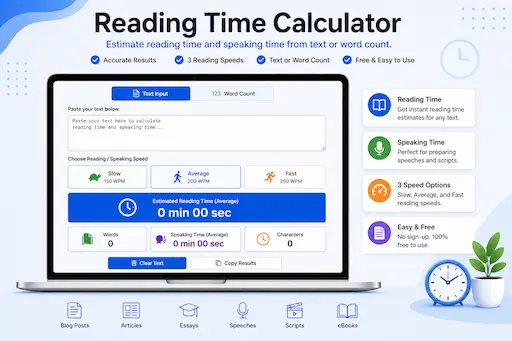
The tool gives instant results while you write or edit. You can select slow, average, or fast reading speed to better match your audience. This helps writers, bloggers, students, teachers, marketers, and content creators plan content length more accurately.
If you know only the word count, you can use the calculator to convert words to time or use it as a word to time calculator to estimate reading minutes without pasting the full text. This is useful when planning articles, essays, scripts, speeches, and other content with a known word count.
You can also work backwards. The Minutes to Words Converter below turns a time limit into a word count, and the book section estimates how long a book will take and how many pages to read each day.
How to Use This Reading Time Calculator
Paste Text or Enter Words
Paste your full content or switch tabs and enter the total word count manually.
Select or Set Reading Speed
Choose slow, average, or fast reading speed, or enter a custom WPM value for a more personalized estimate.
Check Time Instantly
Get your reading time in minutes and seconds, a slow-to-fast range, speaking time, word count, and the words per minute used.
Optional: pick a speaking pace to see how long a speech or script will run, and enter the number of images in your post to include a small allowance for them.
Best Uses for Reading Time Estimation
Blog Posts
Add estimated reading time to blog posts and improve reader expectations.
Articles
Estimate how long news articles, guides, and long-form content may take to read.
Essays
Check reading duration for school essays, college assignments, and academic writing.
Speeches
Estimate speaking time for speeches, presentations, scripts, and classroom talks.
YouTube Scripts
Plan video length by estimating how long a script may take to read aloud.
Newsletters
Estimate reading time for emails, newsletters, announcements, and updates.
How Reading Time is Calculated
Reading time is calculated by dividing total words by reading speed. For example, a 1000-word article at 200 words per minute takes about 5 minutes to read. A slower reader may take longer, while a faster reader may finish the same content sooner.
This tool uses three standard reading speed options: 150 words per minute for slower reading, 200 words per minute for average reading, and 250 words per minute for faster reading. You can also enter a custom WPM value in the calculator when you know your preferred reading speed.
As a quick reading time by word count reference, these estimates use the same standard speeds available in the tool. The main result shows minutes and seconds, and hours for long texts.
The "min read" label under the result rounds up to the next full minute, the way many blogs show reading time. Because of this, a very short text, even a single sentence, shows as 1 min read, while the main result shows the exact seconds (for example, 10 words take about 3 seconds at 200 words per minute).
The slow-to-fast range uses the 150 and 250 words per minute presets, so you can see how long the same text may take different readers.
To count words, the tool splits your text at spaces and line breaks, removes punctuation and symbols from the start and end of each piece, and counts every piece that still contains a letter or number. Hyphenated words such as "well-known" and words with apostrophes such as "don't" each count as one word, and a dash or symbol on its own is ignored. Accented letters and non-Latin scripts are counted too. Languages written without spaces, such as Chinese or Japanese, cannot be counted this way. Your text is processed in your browser and is not sent anywhere.
| Word Count | 150 WPM | 200 WPM | 250 WPM |
|---|---|---|---|
| 250 words | 2 min | 2 min | 1 min |
| 500 words | 4 min | 3 min | 2 min |
| 1,000 words | 7 min | 5 min | 4 min |
| 1,500 words | 10 min | 8 min | 6 min |
| 2,000 words | 14 min | 10 min | 8 min |
| 3,000 words | 20 min | 15 min | 12 min |
| 5,000 words | 34 min | 25 min | 20 min |
| 10,000 words | 1 hr 7 min | 50 min | 40 min |
Speaking time is usually slower than silent reading. By default this calculator estimates speaking time using about 130 words per minute, which is useful for speech planning, presentations, podcasts, voiceovers, training videos, and scripts. You can switch to a slower, faster, or script-reading pace in the speaking pace box.
Reading Time vs Speaking Time
Reading time is how long it takes to read a text silently. Speaking time is how long it takes to say the same words out loud. Speaking is slower because you have to pronounce each word, breathe, and pause. For example, 1,000 words take about 5 minutes to read silently at 200 words per minute, but about 8 minutes to speak at 130 words per minute.
Choose the speaking pace that matches your situation. These are planning figures, and published guides quote slightly different speeds, usually somewhere between 100 and 160 words per minute. If you can, read a short part of your script aloud, time yourself, and use that pace.
| Pace | Words per minute | Good for |
|---|---|---|
| Slow | 100 | Careful speech, teaching, a large room, or long pauses |
| Average | 130 | A common planning figure for presentations, podcasts, and voiceovers |
| Fast | 160 | Energetic delivery, a familiar script, or a tight time slot |
| Script | 183 | Reading a prepared text aloud (the average from a 2019 review of 77 studies) |
Real speeches also include pauses, slides, and audience reaction. If you have a fixed time slot, plan for fewer words than the maximum shown.
Minutes to Words Converter
Need to write for a set time? Enter the minutes below to see how many words a reader can read or a speaker can say in that time. This works as a word count guide for speeches, presentations, videos, and reading assignments.
Reading silently
Speaking aloud
| Time | 150 WPM | 200 WPM | 250 WPM |
|---|---|---|---|
| 1 minute | 150 words | 200 words | 250 words |
| 2 minutes | 300 words | 400 words | 500 words |
| 3 minutes | 450 words | 600 words | 750 words |
| 5 minutes | 750 words | 1,000 words | 1,250 words |
| 10 minutes | 1,500 words | 2,000 words | 2,500 words |
| 15 minutes | 2,250 words | 3,000 words | 3,750 words |
| 20 minutes | 3,000 words | 4,000 words | 5,000 words |
| 30 minutes | 4,500 words | 6,000 words | 7,500 words |
| Time | 100 WPM | 130 WPM | 160 WPM |
|---|---|---|---|
| 1 minute | 100 words | 130 words | 160 words |
| 2 minutes | 200 words | 260 words | 320 words |
| 3 minutes | 300 words | 390 words | 480 words |
| 5 minutes | 500 words | 650 words | 800 words |
| 10 minutes | 1,000 words | 1,300 words | 1,600 words |
| 15 minutes | 1,500 words | 1,950 words | 2,400 words |
| 20 minutes | 2,000 words | 2,600 words | 3,200 words |
| 30 minutes | 3,000 words | 3,900 words | 4,800 words |
How Long Does It Take to Read a Book?
To estimate book reading time, multiply the number of pages by the words on each page, then divide by your reading speed. Words per page vary a lot between books, so the calculator starts at 250 words per page, a common planning figure for a printed page. If you know the real number, change it.
| Book length | 150 WPM | 200 WPM | 250 WPM |
|---|---|---|---|
| 100 pages | 2 hr 47 min | 2 hr 5 min | 1 hr 40 min |
| 200 pages | 5 hr 34 min | 4 hr 10 min | 3 hr 20 min |
| 300 pages | 8 hr 20 min | 6 hr 15 min | 5 hr |
| 400 pages | 11 hr 7 min | 8 hr 20 min | 6 hr 40 min |
| 500 pages | 13 hr 54 min | 10 hr 25 min | 8 hr 20 min |
Page size, line length, and dense or technical writing change the real numbers, so treat these results as a planning guide.
Reading Speed: What the Research Says
A 2019 review by Marc Brysbaert in the Journal of Memory and Language combined 190 studies with 17,887 readers. It found that adults read English silently at about 238 words per minute for non-fiction and about 260 words per minute for fiction, and that they read a text aloud at about 183 words per minute.
This calculator's average setting is 200 words per minute, a little below those averages, so its estimates lean slightly long. That is usually safer when you plan content length or a time slot. If you want the research average instead, type 238 (or 260 for fiction) in the custom speed box.
Averages hide big differences. Reading speed changes with the reader, the difficulty of the text, and the reason for reading, and reading to remember details is much slower than reading for pleasure. The review looked at adults aged 17 to 60 reading languages written in the Latin alphabet, so children, older readers, and other writing systems may be different.
Reading far faster does not come for free. The same review discusses research arguing that reading more than about 1,000 words per minute is not possible without a severe loss of understanding, so this tool accepts custom speeds only up to 1,000 words per minute.
FAQs About Reading Time Calculator
What is a reading time calculator?
A reading time calculator estimates how long it takes to read text based on total word count and selected reading speed.
How many words per minute does this tool use?
For reading, you can choose 150 (slow), 200 (average), or 250 (fast) words per minute, or enter your own speed from 50 to 1,000. The average setting uses 200 words per minute. For speaking time, you can choose 100, 130, 160, or 183 words per minute, and the default is 130.
Can I calculate reading time from word count only?
Yes, you can paste full text or switch to the word count tab and enter the number of words manually.
Does this tool estimate speaking time?
Yes. By default it estimates speaking time at about 130 words per minute, which is useful for speeches, presentations, podcasts, and scripts. You can switch to 100 (slow), 160 (fast), or 183 words per minute, the research average for reading a text aloud. These are planning figures, so real speaking time depends on your delivery.
Is reading time always exact?
No, reading time is an estimate. Actual reading speed depends on the reader, content difficulty, reading purpose, and language complexity.
Why does a short text show 1 min read?
The main result shows the exact time in minutes and seconds. The "min read" label under it rounds up to the next full minute, the way many blogs show reading time, so any text with at least one word shows a minimum of 1 min read.
How does this tool count words?
It splits your text at spaces and line breaks, removes punctuation and symbols from the start and end of each piece, and counts every piece that still contains a letter or number. Hyphenated words and words with apostrophes count as one word, a dash or symbol on its own is ignored, and accented letters and non-Latin scripts are counted too.
How is reading time calculated?
Reading time is estimated by dividing the total word count by the selected reading speed in words per minute. For example, 1,000 words at 200 words per minute takes about 5 minutes.
How long does it take to read 500 words?
At 200 words per minute, 500 words takes about 3 minutes to read. A slower or faster reading speed will change the estimate.
How long does it take to read 1,000 words?
At 200 words per minute, 1,000 words takes about 5 minutes to read. The actual time varies with reading speed and content difficulty. For more detail, see our guide to how long it takes to read 1000 words.
Can I change the reading speed?
Yes. You can choose 150, 200, or 250 words per minute, or enter a custom reading speed from 50 to 1,000 WPM for a more personalized estimate.
Is this reading time calculator free?
Yes, this reading time calculator is free and works instantly in your browser without signup or installation.
How many words is a 5-minute read?
At the average setting of 200 words per minute, a 5-minute read is about 1,000 words. For slow readers (150 words per minute) it is about 750 words, and for fast readers (250 words per minute) it is about 1,250 words. Use the Minutes to Words Converter for other times.
How long does it take to read 2,000 words?
At 200 words per minute, 2,000 words takes about 10 minutes. It takes about 14 minutes at 150 words per minute and about 8 minutes at 250 words per minute.
How long does it take to read 5,000 words?
At 200 words per minute, 5,000 words takes about 25 minutes. It takes about 34 minutes at 150 words per minute and about 20 minutes at 250 words per minute.
How long does it take to read 10,000 words?
At 200 words per minute, 10,000 words takes about 50 minutes. It takes about 1 hr 7 min at 150 words per minute and about 40 minutes at 250 words per minute.
How many words can I read in 10 minutes?
At 200 words per minute you can read about 2,000 words in 10 minutes. Slow readers (150 words per minute) read about 1,500 words, and fast readers (250 words per minute) read about 2,500 words.
How long does it take to read a 300-page book?
If a page holds about 250 words (an assumption, because real books vary), a 300-page book has about 75,000 words. That takes about 6 hr 15 min at 200 words per minute, about 8 hr 20 min at 150 words per minute, and about 5 hr at 250 words per minute. Use the book section on this page to enter your own page count and words per page.
What is the difference between reading time and speaking time?
Reading time assumes you read silently. Speaking time assumes you say every word out loud. Speaking is slower because you pronounce words, breathe, and pause, so the same text takes longer to speak than to read. By default this tool uses 200 words per minute for reading and 130 words per minute for speaking.
How long does it take to read 2,000 words aloud?
At 130 words per minute, 2,000 words takes about 15 min 24 sec to say. At 183 words per minute, the research average for reading a text aloud, it takes about 10 min 56 sec. A slow pace of 100 words per minute takes 20 min, and a fast pace of 160 words per minute takes about 12 min 30 sec.
How many words is a 10-minute speech?
At the average speaking pace of 130 words per minute, a 10-minute speech is about 1,300 words. A slow pace of 100 words per minute gives about 1,000 words, and a fast pace of 160 words per minute gives about 1,600 words. Speeches include pauses, so plan for a little fewer words than the maximum.
Do images change reading time?
Yes, a little. The optional images box adds about 12 seconds for the first image, one second less for each next image, and never less than 3 seconds per image. Some publishing platforms, such as Medium, say they adjust read time for images. Our exact seconds follow a third-party description of Medium's method, so treat them as an estimate.
Is 300 words per minute a good reading speed?
300 words per minute is faster than average. A 2019 review of reading-rate research found averages of about 238 words per minute for English non-fiction and 260 for fiction. Reading much faster than your natural pace tends to reduce understanding, and research does not support claims of reading well over 1,000 words per minute with full understanding.
Does this calculator work for languages other than English?
It counts words in any language that puts spaces between words, including Urdu, Arabic, and Hindi, but the reading speeds are based on research in English and other Latin-alphabet languages, so treat the result as a rough guide. Chinese, Japanese, and Korean do not use spaces between words, so a word count is not meaningful there. Some platforms use characters per minute instead; Medium, for example, uses 500 characters per minute for these languages.
Calculate Reading Time Instantly
Paste your text or enter a word count above to see your estimated reading time and speaking time instantly.
Use Reading Time Calculator