
Reduce Word Count in an Essay: 7 Easy Ways That Work
Reduce word count in an essay without losing quality by removing unnecessary words, improving sentence clarity, and focusing on the ideas that directly support your argument. Many students struggle with essay word limits, but careful editing can make writing shorter while keeping its meaning and evidence intact.
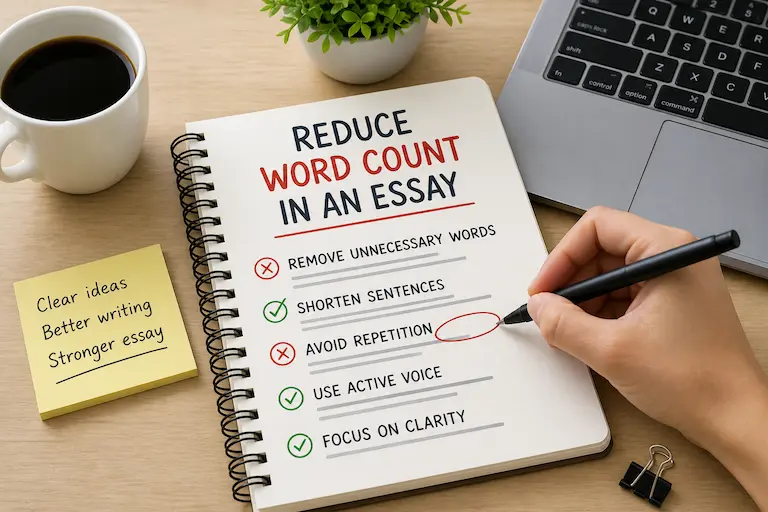
How to Reduce Word Count in an Essay Quickly
To reduce word count in an essay efficiently:
- Remove filler words and unnecessary phrases
- Replace wordy expressions with concise alternatives
- Delete repeated ideas
- Shorten sentences where meaning is preserved
- Combine closely related ideas when appropriate
- Remove background information that does not support the assignment
- Check your final word count after editing
The goal is not to delete random sentences. A better approach is to identify words, phrases, and repeated ideas that do not add useful meaning. This can make an essay more concise without weakening the argument.
If you need to know how to reduce word count without reducing content, focus first on wording that repeats an idea or adds little value rather than cutting evidence, explanation, or analysis.
When editing, protect your main argument first. Your thesis, strongest evidence, relevant examples, and necessary analysis should remain. The material to cut is usually repetition, unnecessary background, filler language, and wording that can be expressed more directly.
If your essay is substantially over the required limit, first identify the sections that contribute least to the assignment. Then work from larger sections down to individual sentences and words.
How Many Words Do You Need to Cut?
Before you edit, work out your exact target. Subtract the word limit from your current word count. The answer is the number of words to cut.
Worked example: your essay is 1,180 words and the limit is 1,000 words. 1,180 – 1,000 = 180 words to cut. To see this as a share of your draft, divide 180 by 1,180. The answer is about 0.15, so you need to cut about 15% of the essay.
The same number of words feels very different depending on the length of the essay. Cutting 100 words is about 5% of a 2,000-word essay, 10% of a 1,000-word essay, and 20% of a 500-word essay.
The more you have to cut, the bigger the pieces you should look at first. This table is a practical guide for a 1,000-word draft. It is not a fixed rule.
| Cut about | Words (1,000-word draft) | Where to look first |
|---|---|---|
| 5% | 50 | Filler words, extra “that”, and wordy phrases |
| 10% | 100 | The items above, plus repeated sentences and a shorter introduction or conclusion |
| 20% | 200 | The items above, plus weak examples, long description, and unnecessary background |
| 30% or more | 300 or more | Re-plan the essay: merge or drop a whole point or paragraph |
Swansea University’s Academic Skills Lab makes a similar point: deleting single words tightens sentences, but it is not the way to remove hundreds of words.
How to Cut 100 Words From an Essay
Here is one example plan for a 1,000-word essay. The word savings are only an illustration, and your draft will be different, but the order works for most essays.
- Remove filler words and shorten wordy phrases: about 25 words.
- Cut one sentence from the introduction that only gives general background: about 25 words.
- Delete the sentence at the end of two body paragraphs that only repeats the point: about 15 words each, so about 30 words.
- Tighten the conclusion so it does not summarize the whole essay again: about 20 words.
Count again after each step. If you reach the target early, stop. You do not need to cut more than the limit requires.
Why Word Count Matters in Academic Writing
Word limits give students a defined scope for an assignment and help instructors set expectations for the amount of work required. Staying within the stated limit can also encourage you to prioritize relevant evidence and explanation.
If an essay is substantially over the required limit, you may need to remove repetition or material that does not directly answer the assignment. However, the exact consequences of exceeding a word limit depend on the specific assignment or institution.
The ability to write concisely is useful because it helps you communicate an argument without unnecessary wording. Purdue OWL’s conciseness pages explain how to write clearly by eliminating unnecessary words and rearranging phrases.
Swansea University’s Academic Skills Lab describes a word count as a guide to the depth and scope an assignment expects. It suggests going back to the assignment guidelines to see how many words each topic deserves before you decide what to cut.
For additional guidance on understanding an assignment before editing, see the Harvard College Writing Center guide to reading assignment prompts.
When Should You Start Reducing Word Count?
In most cases, it is easier to reduce word count after you have completed a workable first draft. Writing the full argument first gives you a clearer view of which ideas are essential and which sections can be shortened or removed.
A practical editing process has two stages. First, remove larger problems such as repeated ideas, weak examples, and unnecessary background. Second, improve sentence-level issues such as filler words, wordy phrases, and unclear constructions.
When deciding how to cut words from an essay, start with sections and sentences that contribute least to your main argument before making smaller word-level edits.
This approach helps you reduce word count in an essay without cutting important information simply because you need to remove a certain number of words.
It is normal to go over the limit while you are drafting. The limit applies to the version you submit, so you can write the full argument first and cut afterwards.
How to Reduce Word Count in an Essay Step by Step
1. Remove Filler Words
Filler words can increase word count without adding useful meaning. Look for words or phrases that can be removed without changing the point of the sentence.
Before: This is very important.
After: This is important.
Do not remove every descriptive word automatically. Keep words that add precision or meaning.
A quick way to find them: press Ctrl + F (Command + F on a Mac) in your document and search for words such as very, really, and that, and for the letters ly to find adverbs. Check each result and delete the word only if the sentence still works. A University of Georgia handout suggests the same search for “that” and for adverbs that end in “ly”.
2. Replace Long Phrases
Some phrases can be replaced with shorter alternatives without changing the meaning.
- In order to → To
- Due to the fact that → Because
- At this point in time → Now
- A large number of → Many
- In the event that → If
- Has the ability to → Can
Use the shorter version when it fits the sentence naturally. Concise writing is not about making every sentence as short as possible; it is about removing wording that does unnecessary work.
3. Delete Repeated Ideas
Read each paragraph and ask whether the same point has already been made elsewhere in the essay. If two sentences communicate essentially the same idea, keep the clearer or stronger version.
A reverse outline can help you identify repeated points at the paragraph level. Harvard College Writing Center recommends using a reverse outline to examine what each paragraph contributes and whether ideas are repeated or missing. One of its questions is whether two paragraphs make the same point and, if so, whether you need both.
Read the Harvard College Writing Center guide to organizing an essay for more guidance.
4. Use More Direct Sentence Structures
Some sentences become shorter and clearer when the person or subject performing the action is placed directly in the sentence.
Before: The research was conducted by students.
After: Students conducted the research.
Active constructions are not automatically shorter in every case, so focus on clarity and concision rather than changing every passive sentence.
Sentence openings such as “There are… who” or “It is… that” can also add words.
Before: There are many students who struggle with word limits.
After: Many students struggle with word limits.
Purdue OWL notes that these openings are sometimes useful for emphasis, but overusing them makes writing wordy. For more ways to tighten sentences, read How to Write Shorter Sentences.
5. Combine Closely Related Sentences
If two short sentences express closely related ideas, combining them may reduce repetition and improve flow.
Before: The study included 100 students. The students completed a writing task.
After: The study included 100 students who completed a writing task.
Do not combine sentences simply to make them longer. Preserve readability and make sure the relationship between the ideas remains clear.
6. Remove Unnecessary Background Information
Background information can help readers understand a topic, but not every general statement needs to remain in the final essay.
Ask whether each background sentence helps answer the assignment question or supports your argument. If it does not, consider removing or shortening it.
This is particularly useful when you need to reduce a draft by a substantial number of words because removing entire low-value sections can be more effective than cutting individual words throughout the essay.
7. Check Your Word Count
After each major editing pass, check your essay’s word count. This tells you whether the changes have brought the draft within the required range.
Use the Word Counter for Essays to check your current length and measure your progress after editing.
Where the Extra Words Usually Hide
Sentence edits save a few words at a time. Extra words often collect in the same few places, so check these before you trim individual words.
| Where | What to look for | What to do |
|---|---|---|
| Introduction | A broad opening about history or “all of human life”, definitions the reader already knows, or a thesis stated twice | Start closer to your argument and keep one clear thesis |
| Description | Long stretches that only describe or summarize a source, event, or story | Keep what your argument needs and spend your words on analysis |
| Examples | Two or three examples that make the same point | Keep the strongest one |
| Transitions | A full sentence that only says what you just said or what comes next | Replace it with a short phrase such as “As discussed earlier” |
| Quotations | Long quotes where only part of the quote is needed | Quote the key phrase and explain it in your own words (quotes often count toward the limit) |
| Conclusion | A second summary of the whole essay | State your answer once, in one or two sentences |
Two points from the Swansea University guide to what to cut are worth remembering. Students more often use up their words on description than on analysis, and a short signposting phrase can do the job of a whole linking paragraph.
Need to Check Your Essay Word Count?
If you are trying to reduce your essay to a specific word limit, checking the exact count before and after editing is more useful than estimating how many words you removed.
Use the Word Counter for Essays to check your draft and see whether you have reached the required length.
If you need to understand the expected length before editing, read How Many Words Should an Essay Be?.
Common Mistakes When Reducing Word Count
- Removing important arguments
- Deleting useful evidence or examples
- Cutting sentences without checking their role in the argument
- Removing words that provide necessary precision
- Changing clear sentences simply to make them shorter
- Cutting content randomly instead of editing systematically
To reduce word count in an essay effectively, focus on removing unnecessary language rather than removing useful ideas.
What You Should Not Cut
Some parts of an essay look like easy cuts but can cost you marks. Protect these:
- Your thesis and the main point of each paragraph.
- The evidence and analysis that support your thesis. Description can often be shortened, but analysis usually cannot.
- Anything the assignment prompt asks for. Harvard College Writing Center advises checking the prompt for instructions about scope, so check it before you delete a section.
- In-text citations. Deleting a citation does not remove the idea you borrowed, and missing citations can cause academic-integrity problems.
- A short roadmap sentence in your introduction, if your course expects one. Harvard College Writing Center says some courses do.
Also avoid shortcuts that only change how the essay looks. Do not shrink the font or the margins to hide length. The limit is about the number of words, not the look of the page.
Tips to Reduce Word Count in an Essay Faster
Use these quick checks during your editing process:
- Read each paragraph and ask whether it supports your main point.
- Remove sentences that repeat information already explained.
- Replace wordy phrases with concise alternatives.
- Keep strong examples and remove weaker or repetitive ones.
- Check your word count after each major editing pass.
- Read the final version aloud to identify awkward or unnecessary wording.
These steps can make the editing process more systematic and help you reduce word count in an essay while preserving clarity.
If you are looking for how to reduce words in an essay, use these checks in order: remove repetition, shorten wordy phrases, and then review individual sentences for unnecessary wording.
For additional guidance on concise writing, see Purdue OWL’s guide to avoiding common problems in concise writing.
Best Method to Reduce Word Count
First Pass: Remove Larger Problems
Start with repeated ideas, unnecessary sections, weak examples, and background information that does not directly support the assignment.
Second Pass: Improve Sentences
Next, shorten wordy phrases, remove filler language, and revise sentences that can communicate the same idea more directly.
Third Pass: Check the Final Length
Use a word counter to confirm that the revised essay meets the required word count. Then read the final draft once more to make sure the cuts have not affected the argument.
Example of Reducing Word Count
Before:
In order to understand the importance of education, it is very necessary to look at the ways in which education helps people improve their future opportunities.
After:
To understand education’s importance, we must examine how it improves future opportunities.
The revised version removes unnecessary wording while preserving the main idea. It cuts 14 of the original 26 words.
Example 2: A Whole Paragraph (77 Words Down to 38)
Before:
In my personal opinion, I believe that the school library should definitely stay open until 6 p.m. every single day. The reason for this is that a large number of students have a lot of homework to do after classes finish, and they need a quiet place in which they can concentrate. At this point in time, the library closes at 4 p.m., which is too early for many of the students who need to use it.
After:
The school library should stay open until 6 p.m. every day. Many students have homework after class and need a quiet place to concentrate, but the library closes at 4 p.m., too early for those who need it.
What changed:
- “In my personal opinion, I believe that” and “definitely” were removed. The paragraph already shows that this is the writer’s argument.
- “Every single day” became “every day”.
- “A large number of students have a lot of homework to do” became “Many students have homework”.
- “At this point in time” was removed, and the two ideas were joined with “but”.
Example 3: An Introduction (46 Words Down to 8)
Before:
Since the beginning of time, people have wondered about many different things, and one of the most important questions that people have asked is how technology affects our daily lives. In this essay, I am going to discuss the ways in which technology affects daily life.
After:
This essay examines how technology affects daily life.
The first sentence was a broad opening that said nothing about the essay, and the second sentence announced the same topic that the first one had already named. The revised version keeps one clear statement. In a real essay, your thesis would follow it.
Example 4: A Conclusion (34 Words Down to 12)
Before:
In conclusion, to sum up everything that has been discussed in this essay, it can clearly be seen that technology has both positive and negative effects on daily life, as I have shown above.
After:
In conclusion, technology has both positive and negative effects on daily life.
Phrases such as “to sum up everything that has been discussed” and “as I have shown above” announce the conclusion instead of stating it.
Helpful Tools for Essay Editing
Different tools can support different stages of the editing process. The Word Counter for Essays is the main tool for this topic, while the other tools are optional checks after you have shortened the draft.
Word Counter for Essays
The Word Counter for Essays is the most relevant tool because the main purpose of this article is to reduce an essay to a required word count. Use it before and after editing to measure your progress.
Sentence Counter
The Sentence Counter counts the sentences in your text. After cutting words, divide your word count by your sentence count to get your average sentence length. If your sentences have become very long or very short, read Average Sentence Length in Academic Writing for a guide.
Remove Extra Spaces
The Remove Extra Spaces tool is a formatting aid. After repeated editing and copying, an essay may contain accidental double spaces. Clean these up after the content and word count are settled.
Reading Time Calculator
The Reading Time Calculator provides an estimated reading time for your revised essay. It is not a replacement for the required word count, but it can give you another perspective on the length of the finished draft.
How to Maintain Quality While Reducing Word Count in an Essay
When you reduce word count in an essay, the main goal should be clarity rather than simply deleting as many words as possible. Cutting words without considering their role can make an argument incomplete or harder to understand.
Protect your thesis, necessary evidence, important examples, and analysis. Remove repetition, unnecessary background, filler language, and phrases that do not add meaning.
It can also help to read the revised essay aloud. This may reveal awkward sentences, repeated wording, or places where a shorter construction would be clearer.
To condense an essay effectively, keep the ideas that support your argument and make the language around those ideas more direct.
For more guidance on organizing an essay and checking whether each paragraph contributes to the argument, see Harvard College Writing Center’s essay organization guide.
Manual Editing vs. Using a Word Counter
Manual editing and word-count checking serve different purposes. Manual editing helps you improve meaning, structure, clarity, and concision. A word counter helps you measure the result.
For best results, use both. First, edit the essay for clarity and relevance. Then use the Word Counter for Essays to check whether the draft is within the required limit.
If the essay is still too long, return to the sections that contribute least to your argument and continue editing rather than deleting important evidence at random.
Need to Make Your Essay Longer Instead?
If your essay is below the required length, do not add filler simply to increase the number of words. Instead, develop explanations, add relevant evidence, and expand important analysis.
Read How to Increase Word Count Without Fluff for practical ways to expand an essay while keeping the added content relevant.
Essay Over Word Limit: What to Do Right Now
An essay over word limit is a common problem, and you can usually fix it without starting again. Follow these steps in order:
- Read the exact rule in your assignment. Is the limit a hard maximum, or does it allow a margin? Also check what counts toward the limit.
- Count your draft with the Word Counter for Essays and work out how many words you need to cut.
- Cut the big pieces first: repeated ideas, weak examples, and unnecessary background.
- Tighten the sentences that are left: filler words, wordy phrases, and long openings.
- Count again. Stop when you are within the limit.
- If you are still over, ask your instructor instead of guessing which margin is acceptable.
What Happens If You Go Over the Word Limit?
It depends on the institution and often on the assignment. These four published policies show how different the rules can be:
| Institution | If you go over | What counts |
|---|---|---|
| University of Staffordshire | Up to 10% over the expected limit is the most allowed. Beyond that, marking stops at that maximum. | Counts: main text, headings, in-text citations, direct quotes, and the captions of tables and figures. Does not count: cover page, contents page, footnotes, reference list, appendices, text inside tables and figures. |
| University of Cumbria (2025/26 rules) | Up to 10% over: no penalty. 11% to 30% over: 10% of the marks are deducted, or the pass mark is given if that is higher. 31% or more over: the highest possible mark is a pass. | Counts: main text, including in-text quotations and citations. Does not count: reference list, tables, figures, appendices. |
| LSE Social Policy (online assessments) | No 10% margin. Markers only mark up to the word limit. | Counts: in-text citations. Does not count: reference list, graphs, pictures, tables. |
| University of Bristol (faculty policy) | Marks are deducted: 5 marks for up to 100 words over, 10 for up to 200, 15 for up to 300, 20 for up to 400, and 30 for more than 400. | Bibliographies do not count. Appendices, footnotes, and endnotes may count, so ask if you are unsure. |
Last checked: October 2026. These are examples from universities in the United Kingdom, not rules for every school. Your assignment brief or course handbook is the rule that applies to you. For general guidance on typical lengths, read How Many Words Should an Essay Be?.
Essay Still Over the Word Limit?
If you have followed the steps above and your essay is still too long, ask whether one smaller point can be dropped completely instead of trimmed. Removing one whole low-value point usually saves more words than rewriting every sentence. A reverse outline, with one line for the point of each paragraph, can show you which paragraph the essay can live without.
If you do leave something out on purpose, the Swansea University guide suggests stating the scope of your essay in the introduction, so the reader knows what the essay covers.
FAQs
How can I reduce word count in an essay without losing meaning?
Remove filler words, repeated ideas, unnecessary phrases, and background information that does not support the assignment. Keep your thesis, important evidence, relevant examples, and necessary analysis.
What is the fastest way to reduce word count in an essay?
Start with repeated ideas, unnecessary sections, and wordy phrases. These changes can reduce the length more efficiently than deleting individual words at random.
Should I remove examples to reduce word count?
Only remove examples that are weak, repetitive, or unrelated to your argument. Keep examples that provide important evidence or clarification.
Can a Word Counter help reduce essay length?
Yes. A Word Counter for Essays helps you track the draft’s length before and after editing so you can see whether you have reached the required limit.
How Can I Reduce Word Count Without Reducing Content?
Reduce unnecessary wording rather than removing important ideas. Cut filler, repetition, and wordy phrases while keeping your thesis, evidence, examples, and analysis intact. A simple test: delete a sentence, then ask whether the argument still makes sense and every claim still has support. If it does, the sentence was extra.
How Do I Cut Words From an Essay?
Start by removing repeated ideas and unnecessary background, then replace long phrases with concise alternatives and shorten sentences where the meaning remains clear.
How Much Can I Cut From an Essay Without Losing Substance?
There is no fixed percentage that applies to every essay. Cut until each remaining sentence contributes to the argument, evidence, explanation, or clarity, and keep essential substance even when you need to meet a strict word limit. The table in the section “How Many Words Do You Need to Cut?” gives a rough guide to what to look at when you must cut 5%, 10%, or 20%.
How Do I Cut 100 Words From an Essay?
First work out the share. 100 words is 10% of a 1,000-word essay. Then cut in this order: filler words and wordy phrases, repeated sentences, and a shorter introduction and conclusion. The example plan under “How to Cut 100 Words From an Essay” shows how the savings add up.
How Much Can You Go Over a Word Limit?
It depends on the rule for your assignment. Some institutions allow up to 10% over, some mark only up to the limit, and some deduct marks for every extra 100 words. The table above shows four published examples. If your instructions do not say, ask your instructor.
Do Quotes and References Count Toward the Word Limit?
Often in-text citations and direct quotes count, and the reference list does not, but this changes between institutions and assignments. Check your assignment brief. For more on typical essay lengths, read How Many Words Should an Essay Be?.
Is It Okay to Go Over the Word Limit While Drafting?
Yes. The limit applies to the version you submit. Many writers draft the full argument first and cut afterwards. Just leave enough time to edit.
Final Tip
To reduce word count in an essay effectively, focus on clarity and relevance. Remove unnecessary words, repeated ideas, and wordy phrases while protecting the evidence and analysis your argument needs.
Then check your final length with the Word Counter for Essays before submitting your essay. For more help with essay length and editing, browse our writing guides.