
Average Reading Speed by Age
7 Powerful Facts About Average Reading Speed by Age That Improve Learning
Understanding Average Reading Speed by Age can help parents, teachers, students, tutors, and writers interpret reading pace in the right context. Whether you are supporting a student in the United States, United Kingdom, Canada, Australia, or another English-speaking market, reading speed can provide useful information when considered alongside accuracy, fluency, comprehension, and the difficulty of the text.
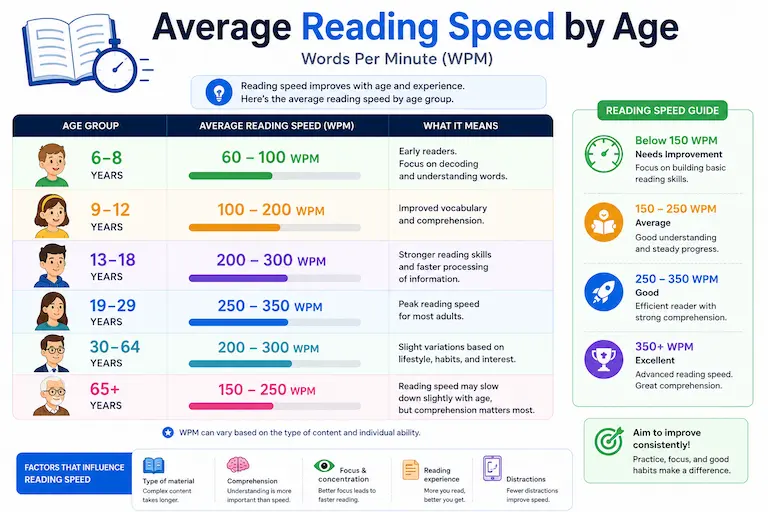
Reading speed is usually expressed in words per minute (WPM). For school-age readers, however, educators often use words correct per minute (WCPM) when assessing oral reading fluency. A useful reading assessment therefore looks at more than speed alone.
In this guide, you’ll learn how average reading speed by age should be interpreted, how grade-level fluency benchmarks work, what affects reading speed, and how to measure reading time and reading fluency more carefully.
For school-age fluency benchmarks, see the Reading Rockets Fluency Norms Chart, which presents Hasbrouck and Tindal’s 2017 oral reading fluency norms by grade, percentile, and testing period.
What Is Average Reading Speed by Age?
Average Reading Speed by Age refers to typical reading-rate patterns observed among readers of different ages or grade levels. It should be treated as a general reference rather than a fixed standard that every reader is expected to meet.
Reading rate may be measured using:
- Words Per Minute (WPM)
- Words Correct Per Minute (WCPM)
- Reading Fluency
- Comprehension
- Silent or Oral Reading Speed
For children, oral reading fluency assessments commonly measure how many words are read correctly in one minute. WCPM is calculated by subtracting reading errors from the total words read during a timed passage.
Average Reading Speed by Age Chart
The following chart provides a practical overview rather than a clinical or educational standard. School-age reading rates vary substantially, and formal fluency assessment should use grade-appropriate passages and established norms.
| Age / Stage | Typical School Context | How Reading Rate Is Commonly Interpreted |
|---|---|---|
| 6–7 years | Early elementary | Fluency is developing rapidly; grade-level oral reading norms are more useful than a single age-based WPM target. |
| 7–8 years | Elementary | Word recognition and oral reading fluency typically become more automatic with practice. |
| 8–10 years | Elementary | Reading rate generally develops alongside accuracy, vocabulary, and comprehension. |
| 10–12 years | Upper elementary | Students generally read more automatically, but text difficulty still affects reading speed. |
| 12–14 years | Middle school | Academic vocabulary and increasingly complex texts can affect reading rate. |
| 14–18 years | High school | Reading speed varies according to subject knowledge, text complexity, and reading purpose. |
| 18+ years | Adult readers | Reading rates vary widely by reader, text type, familiarity, and purpose. |
For students in grades 1–6, the Hasbrouck and Tindal 2017 norms provide more precise oral reading fluency benchmarks than a simple age-based range. For example, the end-of-year 50th-percentile WCPM values are 60 for grade 1, 100 for grade 2, 112 for grade 3, 133 for grade 4, 146 for grade 5, and 146 for grade 6. These are oral-reading fluency benchmarks, not general silent-reading speeds.
Want to estimate how long a passage takes to read?
Average Reading Speed by Age for Children
Ages 6 to 8
At this stage, many children are developing decoding, word recognition, accuracy, and reading fluency. Rather than expecting one universal WPM target, teachers typically compare oral reading performance with grade-level expectations and consider accuracy and expression as well as rate.
Ages 8 to 11
Reading usually becomes more automatic as students gain vocabulary and experience with different types of text. Reading rate can increase, but comprehension and text difficulty continue to affect performance.
Ages 11 to 13
Middle-school readers encounter increasingly complex academic vocabulary and subject-specific texts. A student’s reading rate may therefore vary significantly between familiar and unfamiliar subjects.
Average Reading Speed by Age for Teenagers
Teenagers do not all read at the same speed. Reading rate can vary according to:
- Vocabulary knowledge
- Subject familiarity
- Reading purpose
- Text complexity
- Reading fluency
- Need for detailed comprehension
A student reading a familiar novel may read at a different pace from the same student reading a dense science textbook or preparing material for an exam.
Average Reading Speed by Age for Adults
Adult reading speed varies widely. A large 2019 meta-analysis estimated an average silent reading rate of about 238 WPM for adult English non-fiction, while reading aloud was substantially slower. These figures are population averages rather than individual targets.
Reading speed can also change substantially when the material becomes technical, unfamiliar, or difficult to understand. A skilled reader may deliberately slow down when careful comprehension matters more than speed.
Why Average Reading Speed by Age Matters
Understanding average reading speed by age can help:
- Teachers monitor reading fluency
- Parents understand reading progress
- Students set realistic practice goals
- Tutors identify areas that may need further assessment
- Writers and educators estimate reading time
Reading speed should not be used alone to judge reading ability. Accuracy, expression, comprehension, vocabulary, and the difficulty of the passage all provide important context.
If you’re also interested in how reading time can influence the way visitors interact with online content, see How Reading Time Improves Blog Engagement.
Factors That Affect Reading Speed
Vocabulary Knowledge
Readers who recognize vocabulary quickly may spend less time decoding individual words, while unfamiliar terminology can slow reading.
Comprehension Level
Readers often slow down when a passage requires deeper analysis, rereading, note-taking, or careful interpretation.
Concentration
Distractions can interrupt reading and increase the total time needed to complete a passage.
Reading Practice
Regular reading practice can support fluency development, especially when readers work with appropriately challenging material and receive useful feedback.
Age and Reading Development
Reading skills develop over time, but age alone does not determine reading speed. Individual experience, instruction, vocabulary, language background, and the difficulty of the text all matter.
Average Reading Speed by Age vs Comprehension
A higher WPM is not automatically better if comprehension falls. A useful reading rate is one that allows the reader to understand the material at the level required for the task.
For school-age students, oral reading fluency assessments often combine rate and accuracy. WCPM provides one useful measure, but it should be interpreted with appropriate grade-level norms and other evidence of reading ability.
The best reading speed balances pace and understanding.
Reading speed is also useful when estimating reading time by word count. Once you know your WPM, you can estimate how long a passage of 500, 1000, or more words may take to read.
Do you want a practical comparison for a specific word count?
How Long Does It Take to Read 1000 Words?
How to Measure Your Reading Speed
- Choose a passage with a known or measured word count.
- Set a timer for one minute.
- Read the passage at a natural pace.
- Count the words read.
- For oral fluency, subtract reading errors to calculate WCPM.
- Check comprehension if your goal is to evaluate understanding as well as speed.
For formal school assessment, use the assessment procedures and norms appropriate to the student’s grade and instructional level rather than treating a website calculator as a diagnostic test.
Helpful Internal Tools
TextToolPro tools can help with the numerical side of reading-time estimates, but they do not replace a formal reading-fluency or comprehension assessment.
Reading Time Calculator
The Reading Time Calculator is the primary tool for estimating how long a passage or article may take to read.
Because the calculator supports custom WPM, you can also use your own measured reading speed instead of relying only on an age-based average. This makes it useful for converting words to time when planning reading sessions.
Word Counter for Essays
The Word Counter for Essays is a strong secondary tool because word count is useful when calculating or comparing estimated reading times.
Sentence Counter
The Sentence Counter is a moderate secondary tool for reviewing sentence structure when editing reading material for clarity and readability.
How to Improve Reading Speed at Any Age
Read Daily
Regular reading gives readers repeated exposure to vocabulary, sentence patterns, and different types of text. Consistency matters more than trying to increase speed immediately.
Expand Vocabulary
Learning unfamiliar vocabulary can make future reading more efficient because fewer words require deliberate decoding.
Use Appropriate Text
Practice is more useful when the text is challenging enough to build skill without being so difficult that the reader cannot understand it.
Focus on Accuracy and Understanding
Increasing WPM should not become the only goal. Reading fluently involves appropriate accuracy, rate, and expression while maintaining understanding.
Practice With Different Texts
Reading fiction, nonfiction, academic material, and other text types can expose readers to different vocabulary and sentence structures.
Reading Speed Benchmarks for Common Tasks
There is no single WPM range that accurately represents every type of reading. A better approach is to recognize that reading speed changes with text difficulty and reading purpose.
| Reading Task | Expected Effect on Reading Speed |
|---|---|
| Simple general-interest reading | May allow a relatively faster pace |
| Fiction | Often easier to read continuously when vocabulary is familiar |
| Academic textbooks | Often slower because of terminology and comprehension demands |
| Technical material | Often slower when concepts or vocabulary are unfamiliar |
| Detailed study reading | Slower because readers may reread, annotate, or take notes |
For writers planning article length and reader experience, learn more about Ideal Blog Post Reading Time for SEO.
Average Reading Speed by Age in Schools
Schools and educators may use oral reading fluency benchmarks to monitor reading development. In the United States, the Hasbrouck and Tindal norms are widely referenced for grades 1–6, with WCPM benchmarks reported separately for fall, winter, and spring.
Teachers and parents in the United States, United Kingdom, Canada, Australia, and elsewhere may use local curriculum expectations or assessment systems in addition to general research benchmarks. The exact benchmark used should match the student’s grade, assessment method, and educational context.
A reading-rate result may help identify a reason for further assessment, but a low WCPM score by itself does not establish a particular learning difficulty. Further assessment may be needed to understand the source of below-average fluency.
Common Myths About Reading Speed
Faster Is Always Better
Not necessarily. A faster reading rate is useful only when the reader can still understand the material at the level required by the task.
Everyone of the Same Age Reads at the Same Speed
Reading speed varies considerably between individuals of the same age. Vocabulary, reading experience, instruction, text difficulty, and reading purpose can all affect performance.
One WPM Target Works for Every Text
A speed that is comfortable for a familiar story may be inappropriate for a dense academic or technical passage. Good reading involves adjusting pace to the task.
Best Tool to Check Reading Time
If you want to estimate how long an article, report, or book chapter may take to read, the following tool is the most directly relevant option.
For supporting measurements, you can also use:
- Word Counter for Essays to verify the number of words in a passage.
- Sentence Counter to review sentence structure when assessing readability.
These tools can support content and reading-time analysis, but they should not be used as substitutes for formal educational assessment.
Final Thoughts
Average Reading Speed by Age is best understood as a set of general patterns rather than a single WPM target for every reader. Children’s reading fluency develops over time, while teenagers and adults can show substantial differences depending on text complexity, vocabulary, experience, and reading purpose.
For school-age readers, grade-level oral reading fluency norms provide a more useful benchmark than a simple age-based chart. For adults and general reading, population averages can provide a starting point, but individual reading speed remains highly variable.
Whether you’re a student, parent, teacher, tutor, blogger, or writer in the USA, UK, Canada, Australia, or elsewhere, use reading speed as one piece of information rather than the only measure of reading ability.
Check Your Reading Time Instantly
Use the Reading Time Calculator to estimate how long your text may take to read. You can then compare the result with your own timed reading performance or use it when planning articles, essays, and study materials.
FAQs About Average Reading Speed by Age
What is the Average Reading Speed by Age for adults?
There is no single adult reading speed. A 2019 meta-analysis estimated an average silent reading rate of about 238 WPM for adult English non-fiction, but individual reading rates vary substantially.
What is the Average Reading Speed by Age for a 10-year-old?
A single age-based WPM number is not a reliable universal benchmark for a 10-year-old. Grade level, reading ability, passage difficulty, and whether the assessment measures oral or silent reading all matter. For school fluency, grade-level WCPM norms are more appropriate.
How can I test Average Reading Speed by Age?
For a simple personal estimate, time yourself while reading a passage and calculate words read per minute. For school-age oral fluency assessment, use an appropriate grade-level passage and calculate words correct per minute rather than relying only on total words read.
Does Average Reading Speed by Age include comprehension?
Reading-speed figures do not automatically measure comprehension. A useful assessment should consider whether the reader understands the material as well as how quickly it is read.
What is a good Average Reading Speed by Age for teenagers?
There is no single WPM target that applies to every teenager. Reading speed varies with text difficulty, vocabulary, familiarity, reading purpose, and comprehension demands.
Which tool is best to measure Average Reading Speed by Age?
The Reading Time Calculator is useful for estimating how long a passage may take to read. For a personal reading-speed test, combine a timed passage with the actual number of words read and, when appropriate, a comprehension check.