
Ideal Blog Post Reading Time for SEO
7 Key Guidelines for Ideal Blog Post Reading Time for SEO
Ideal Blog Post Reading Time for SEO is a common question among bloggers, students, writers, affiliate marketers, and content creators who want to balance useful information with a comfortable reading experience. Whether you publish content for readers in the United States, United Kingdom, Canada, Australia, or other English-speaking markets, understanding reading time can help you plan and structure content more effectively.
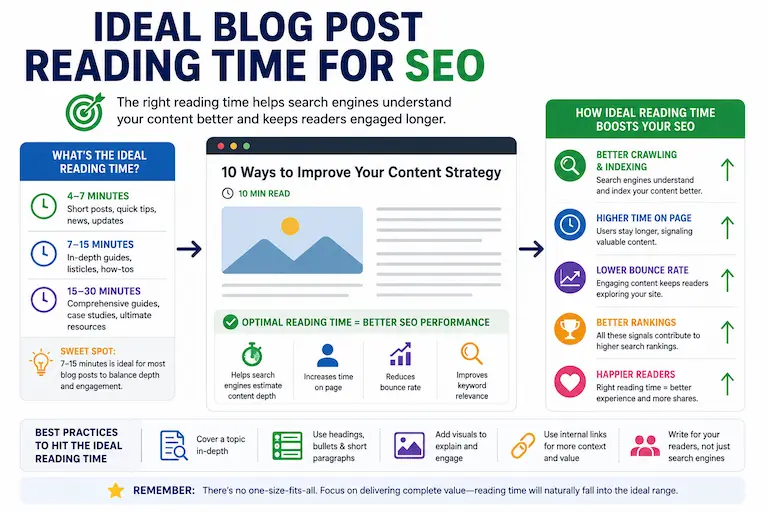
Many publishers display an estimated reading time so readers can quickly understand how long an article may take to read. This can make the expected length of a page clearer before someone starts reading.
There is no universal reading-time requirement that guarantees better search rankings. Google evaluates pages using many signals, while helpfulness, relevance, content quality, and overall page experience remain important considerations.
For practical guidance on web readability and search, see the Nielsen Norman Group’s research on writing for the web and Google Search Central’s guidance on helpful, people-first content.
What Is the Ideal Blog Post Reading Time for SEO?
There is no single Ideal Blog Post Reading Time for SEO that applies to every topic. A practical target depends on search intent, subject complexity, audience, and how much information is needed to answer the query properly.
For many standard informational blog posts, a reading time of around 5 to 7 minutes can be a useful planning range. At approximately 200–250 words per minute, that represents roughly:
- 1,000 to 1,750 words
- Enough space to explain a focused topic
- A manageable length for many general informational articles
- Room for examples, supporting details, and practical advice
These figures are practical guidelines, not SEO requirements. A shorter article can be better when the search intent is simple, while a more complex topic may require considerably more detail.
Want to check your article’s estimated reading time before publishing?
Why Ideal Blog Post Reading Time for SEO Matters
Reading time is useful primarily as a content-planning and user-experience measure. It helps writers think about how much information a reader may reasonably consume and whether the article is appropriately scoped for its topic.
Sets Reader Expectations
A visible reading-time estimate tells visitors approximately how long the article may take to read before they begin.
Supports Better Content Planning
Estimating reading time can help writers decide whether a topic needs a short answer, a standard guide, or a more detailed explanation.
Encourages Scannable Structure
When an article is several minutes long, clear headings, short paragraphs, lists, and other structural elements can make the content easier to scan and navigate.
Supports a Clearer User Experience
Transparent information about article length can help readers decide whether the content fits the time they have available.
Want to learn more about the relationship between reading time and blog engagement?
Read How Reading Time Improves Blog Engagement
Recommended Reading Time by Content Type
| Content Type | Practical Reading-Time Range | Approximate Word Count* |
|---|---|---|
| Quick Tips | 2–3 minutes | 400–750 words |
| Standard Blog Post | 5–7 minutes | 1,000–1,750 words |
| Comprehensive Guide | 8–12 minutes | 1,600–3,000 words |
| Long-Form Research | 12–20 minutes | 2,400–5,000 words |
*These word-count estimates use approximately 200–250 words per minute and are provided as practical planning ranges rather than universal SEO standards.
For most standard informational articles, 5 to 7 minutes can be a reasonable starting point, but the right length should ultimately be determined by the topic and search intent.
How Reading Time Affects Search Rankings
Reading time itself is not a published direct Google ranking factor. A longer reading time does not automatically make a page rank higher.
Instead, think of reading time as one way to evaluate whether your content is appropriately scoped and usable. Google states that its ranking systems use many signals to identify relevant and helpful content, while good page experience can also contribute to search success.
- Content should satisfy the reader’s search intent.
- The article should provide the depth the topic requires.
- Information should be easy to scan and understand.
- Important answers should not be buried under unnecessary text.
- Page experience should support comfortable reading and navigation.
Therefore, do not increase article length simply to create a longer reading time. Add information only when it helps answer the reader’s question or improves the usefulness of the page.
Ideal Blog Post Reading Time for SEO by Search Intent
Informational Queries
A practical range for many informational articles is 5–8 minutes, although the required length depends on the complexity of the question.
Examples include:
- How-to guides
- Tutorials
- Educational explanations
- Step-by-step instructions
Transactional Queries
Transactional content often benefits from being concise and focused. A shorter article may be appropriate when readers mainly need product, service, pricing, or comparison information.
Examples include:
- Product comparisons
- Service comparisons
- Buying guides
In-Depth Research
Research-heavy topics may require 8 minutes or more because readers need additional context, evidence, examples, and explanations.
Examples include:
- Comprehensive guides
- Research summaries
- Industry reports
- Detailed tutorials
Average Reading Speed and SEO
Reading speed varies from person to person, but a planning estimate of approximately 200–250 words per minute is commonly used for general online content.
A simple formula is:
Reading Time (minutes) ≈ Word Count ÷ Reading Speed
This formula can also be used to convert words to time or estimate words to minutes when planning a blog post. If you know the word count but want to estimate how long the article may take to read, divide the total words by your chosen reading speed. This is a simple word to time calculation based on the selected WPM.
For example, using 250 words per minute:
1,500 ÷ 250 = 6 minutes
So a 1,500-word article would have an estimated reading time of about 6 minutes at that reading speed.
This is also a useful way to understand reading time by word count: as the number of words increases, the estimated reading time increases at the same WPM. For example, 500, 1,000, and 1,500 words will require progressively more reading time when the reading speed stays the same.
If your audience or content type reads faster or slower than the planning estimate, you can use a custom WPM instead of relying on a fixed speed. The Reading Time Calculator supports custom reading speed so you can make the estimate more specific to your content.
To understand how reading speed varies across age groups, see Average Reading Speed by Age.
For a deeper explanation of how Medium calculates its own reading-time estimate, see this related guide:
How Medium Calculates Reading Time
Best Tools to Optimize Reading Time
You do not need every text tool to optimize an article’s reading time. The most useful tools are those that directly measure reading duration or help evaluate the content characteristics behind that estimate.
Reading Time Calculator
The Reading Time Calculator is the primary tool for this topic. Use it to estimate how long your article may take to read before publishing.
Want to check your article’s reading time quickly?
Word Counter for Essays
Because reading-time estimates depend on word count, the Word Counter for Essays is a useful secondary tool for checking the total number of words before calculating reading time.
Sentence Counter
Reading time does not tell you whether an article is easy to process. The Sentence Counter can help you review sentence structure and identify content that may contain unusually long or uneven sentence patterns.
How to Find the Ideal Blog Post Reading Time for SEO
Analyze the Search Intent
Start by determining exactly what the searcher wants to know. A simple question may need only a concise answer, while a complex topic may require a detailed guide.
Review Relevant Search Results
Review pages currently ranking for the topic to understand the level of detail, structure, and content depth that readers are being offered. Do not copy their word counts; use them as contextual evidence when deciding how much information your own article needs.
Improve Readability
Use clear headings, short paragraphs, descriptive lists, and direct language. Web users often scan content rather than reading every word, so strong structure can make longer articles easier to navigate.
Test and Refine Your Content
Review your analytics and user feedback to understand how readers interact with your content. Use those observations to improve structure, clarity, and usefulness rather than targeting an arbitrary reading-time number.
Is Longer Always Better for Ideal Blog Post Reading Time for SEO?
No. Longer content is not automatically better for SEO or readers.
A concise article can be more useful than a much longer article when it:
- Answers the question directly
- Provides the necessary information
- Uses clear formatting
- Avoids unnecessary repetition
- Matches the reader’s search intent
Likewise, a complex topic should not be shortened simply to reach a particular reading-time target. The appropriate length is the length required to provide a complete and useful answer.
Ideal Blog Post Reading Time for SEO on Mobile
Mobile readers can encounter articles in short reading sessions, so mobile-friendly structure is important regardless of the article’s total reading time.
To improve readability on mobile devices:
- Use short paragraphs
- Add descriptive headings
- Use bullet points where appropriate
- Break up dense sections
- Make important information easy to find
How to Display Reading Time on Your Blog
If you choose to display reading time, place it where readers can easily see it, such as near the article title or introduction.
For example:
1,450 words • 6 min read
This gives readers a quick indication of the expected article length without promising that every reader will take exactly six minutes.
Real Benefits of the Ideal Blog Post Reading Time for SEO
Using reading time as a content-planning measure can help you evaluate whether an article is appropriately scoped for its audience and topic.
- Clearer expectations about article length
- Better content planning
- More deliberate article structure
- Improved readability and scanning
- A clearer overall reading experience
If you also want to improve sentence structure and readability, see this related guide:
Best Sentence Length for Blog Writing
Final Thoughts
The Ideal Blog Post Reading Time for SEO is not a fixed number that guarantees better rankings. For many standard informational articles, 5 to 7 minutes can be a useful planning range, but the right length depends on search intent, topic complexity, audience needs, and the depth required to provide a complete answer.
Instead of increasing word count simply to create a longer reading time, focus on producing useful, readable, well-structured content that satisfies the searcher’s needs.
Find the Ideal Reading Time Instantly
Want to check how long your article may take to read?
For a more complete content check, you can also use:
- Word Counter for Essays to verify the total word count.
- Sentence Counter to review sentence and paragraph structure.
These tools can help you evaluate article length and readability without forcing your content into an arbitrary SEO word-count target.
FAQs About Ideal Blog Post Reading Time for SEO
What Is the Ideal Blog Post Reading Time for SEO?
There is no universal ideal reading time for SEO. For many standard informational articles, 5 to 7 minutes can be a practical planning range, but the appropriate length depends on search intent, topic complexity, and audience needs.
Does Ideal Blog Post Reading Time for SEO Affect Rankings?
Reading time itself is not a published direct Google ranking factor. A longer article or longer estimated reading time does not automatically improve rankings. Content should instead focus on relevance, usefulness, search intent, and a good overall page experience.
What Tool Helps Measure Ideal Blog Post Reading Time for SEO?
The Reading Time Calculator is the most directly relevant TextToolPro tool for estimating how long an article may take to read.
Is a 10-Minute Article Too Long for SEO?
No. A 10-minute article can be appropriate when the topic requires that level of detail. The important consideration is whether the content remains useful, focused, readable, and aligned with search intent.
How Many Words Equal the Ideal Blog Post Reading Time for SEO?
At an estimated reading speed of 200–250 words per minute, a 5- to 7-minute article would contain roughly 1,000 to 1,750 words. This is an estimate rather than an SEO requirement.
Should I Display Reading Time on Every Blog Post?
You do not have to display reading time on every article. It can be useful when giving readers an estimate of article length adds meaningful context, particularly for longer guides and educational content.