
How many words should an essay be?
How many words should an essay be? This is a common question for students writing school assignments, college essays, and university papers. The answer depends on your academic level, essay type, assignment requirements, and the depth of analysis expected.
Understanding how many words should an essay be can help you plan your assignment, divide your ideas effectively, and check your final draft against the required limit. However, there is no single word count that applies to every essay.
The most reliable rule is to follow the word count stated in your assignment instructions. The ranges in this guide are general examples to help you understand how essay length can vary.
Why Essay Word Count Is Important
Essay word counts give students a defined scope for an assignment and help instructors set expectations for the amount of work required. A word limit can also encourage you to select relevant evidence and develop your argument within a defined space.
Going substantially below the required length can leave important ideas, evidence, or analysis underdeveloped. Going substantially above the limit can create problems if the assignment has a strict maximum or can make it harder to maintain focus.
However, the consequences of exceeding or missing a word limit depend on the specific assignment. Always check your course or assignment instructions rather than assuming that every instructor uses the same policy.
For additional guidance on understanding assignment requirements, see the Harvard College Writing Center guide to reading assignment prompts.
How Many Words Should an Essay Be for Students?
The answer to how many words should an essay be depends on the level of study and the type of assignment.
A short classroom essay may be only a few hundred words, while a research-based university assignment can require several thousand words. Some assignments also specify a narrow range rather than one exact number.
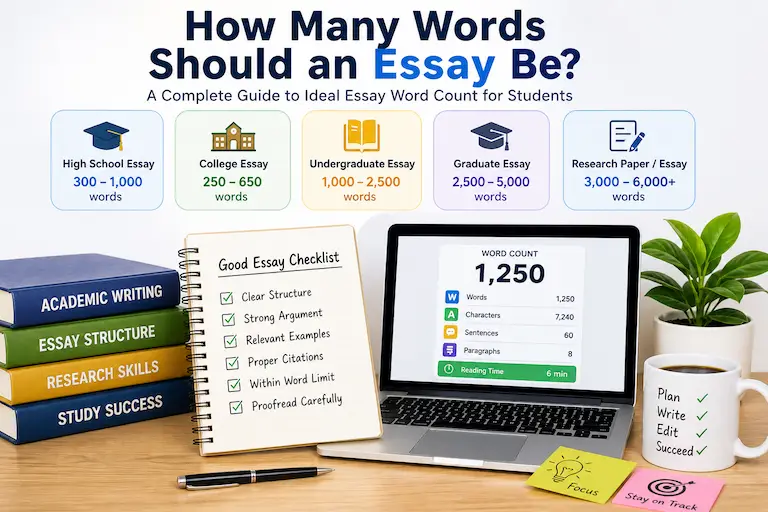
The following ranges are general examples, not universal requirements:
- Short school or classroom essays: often a few hundred words
- College assignments: commonly range from several hundred to a few thousand words
- University essays: may range from around 1,000 to several thousand words
- Research papers: can be several thousand words or more, depending on the assignment
These examples show why there is no single “ideal” essay length. Your assignment instructions should always take priority over a general range.
For more detail about essay length at different educational stages, read Average Essay Length for High School & College Students.
Essay Word Count Examples for Common Assignments
The following examples illustrate how assignment length can vary. They are not fixed academic standards; your instructor’s stated requirement should always take precedence.
| Assignment Type | Illustrative Length |
|---|---|
| Short Classroom Essay | 300–500 words |
| Standard Essay | 500–1,000 words |
| College Essay | 1,000–1,500 words |
| Research Essay | 1,500–3,000 words |
| Long Research Assignment | 2,000+ words |
These examples are useful for understanding relative essay length, but they should not replace the requirements given for your particular assignment.
Essay Word Count by Academic Level
High School Essays
High school essays often focus on developing clear ideas, organized paragraphs, appropriate evidence, and basic analysis. Some assignments may be only a few hundred words, while others can require 1,000 words or more.
At this level, the assignment instructions are more useful than a general word-count range because requirements can vary by subject and teacher.
College Essays
College assignments can vary considerably. A short response may require only several hundred words, while a longer analytical or research assignment may require 1,000 words or more.
College writing generally requires students to develop claims with appropriate explanation and evidence rather than simply reaching a particular number of words.
University Essays
University essays can be longer because assignments may require more detailed research, analysis, comparison, and evaluation. However, the required length still depends on the course and assignment.
At this level, understanding the assignment prompt is particularly important because the required task determines how much evidence and analysis you need to develop.
Essay Length by Essay Type
Essay type also affects how much writing may be required. Different assignments ask you to perform different kinds of work, so their word counts can vary.
Argumentative Essays
Argumentative essays require a clear position, supporting evidence, explanation, and analysis. A longer assignment may also require consideration of alternative viewpoints or counterarguments.
There is no universal word count for an argumentative essay. Follow the length specified by your instructor.
Descriptive Essays
Descriptive essays focus on details that help readers understand a person, place, object, or experience. The required length depends on how much description the assignment asks you to provide.
Narrative Essays
Narrative essays tell a story or describe an experience. Their length depends on the scope of the story and the assignment requirements.
Expository Essays
Expository essays explain a topic using organized information and analysis. A longer assignment may allow more evidence and explanation, but the required word count is determined by the assignment.
Factors That Affect Essay Word Count
There is no single answer to how many words should an essay be because several factors affect the appropriate length.
- Assignment requirements: Follow the stated minimum, maximum, or target range.
- Essay type: Different assignments require different types of development.
- Topic complexity: Some topics require more context, evidence, and analysis.
- Academic level: Higher-level assignments may require more developed research and reasoning.
- Purpose: The purpose of the assignment determines what needs to be explained and supported.
Harvard College Writing Center guidance emphasizes reading the assignment prompt carefully because the task, scope, and expected type of thinking determine what your paper needs to accomplish.
Best Strategy to Reach the Required Essay Word Count
The best way to manage essay length is to plan your argument before writing. A clear outline helps you decide which ideas need evidence, explanation, and analysis.
- Identify the assignment question.
- Develop a clear thesis or central argument.
- List the main points needed to support that argument.
- Decide what evidence or examples each section needs.
- Allocate enough space for development without forcing every section into an identical length.
Harvard College Writing Center recommends using your thesis and main claims to help determine the points you need to develop in the essay rather than treating paragraph or word counts as a rigid formula.
Need to Check Your Essay Word Count?
Before adding or removing material, check the actual word count against the requirement provided by your instructor. This prevents you from guessing how much content you need.
Use the Word Counter for Essays to check your current word count and confirm the final count after editing.
If your essay is too long rather than too short, read How to Reduce Word Count in an Essay for practical editing strategies.
How to Stay Within the Word Limit
Many students struggle to stay within a required limit after completing their first draft. The goal is not to remove useful information randomly, but to make the writing more focused.
- Avoid repeating the same idea.
- Remove information that does not answer the assignment question.
- Use clear and direct sentences.
- Keep evidence that directly supports your argument.
- Edit unnecessary phrases and explanations.
If your essay is substantially above the required length, see Essay Over Word Limit? 7 Easy Ways to Fix It.
How to Check Essay Word Count Accurately
Checking your essay’s word count helps you compare the draft with the assignment requirement before submission.
The Word Counter for Essays is the primary tool for this task. It can help you review the length of your draft without manually counting every word.
- Word count
- Character count
- Sentence count
- Paragraph count
- Estimated reading time
These measurements can help during editing, but the assignment’s stated word-count rule should remain your main reference.
Review Sentence Length and Essay Structure
Word count alone does not tell you whether an essay is well balanced. After checking the total length, review how your sentences and paragraphs are distributed. A section with very long sentences may need editing, while a section with very short sentences may need more explanation.
The Sentence Counter is a useful secondary tool for reviewing sentence distribution in an essay. It can help you see how many sentences your draft contains and give you another measurement to consider during editing.
Use sentence count as an editing signal rather than a target. Good academic writing does not require every paragraph or section to contain the same number of sentences.
Check Reading Time After Finalizing Your Essay
Word count tells you how much text an essay contains, while reading time provides an estimate of how long that text may take to read. This can be useful when reviewing a completed essay, presentation script, reflection, or other text where pacing matters.
Use the Reading Time Calculator after you have a reasonably complete draft to estimate its reading time. This is a secondary check, not a replacement for the assignment’s required word count.
For example, if two drafts have similar word counts but one takes noticeably longer to read, you may want to review sentence length, paragraph structure, or unnecessary wording.
Clean Extra Spacing Before Submission
After several rounds of copying, pasting, and editing, an essay can contain accidental double spaces, repeated gaps, or unwanted blank lines. These issues do not determine the required essay word count, but cleaning them can make the final text more consistent and easier to format.
The Remove Extra Spaces tool is therefore a secondary formatting aid. It can help clean copied or edited text before you prepare the final version of an essay.
Use it as a final formatting step after your content and word count are already settled.
Useful Tools for Essay Editing
These tools support different stages of the essay workflow. The Word Counter for Essays is the primary tool for checking assignment length, while the other three provide additional editing and review functions.
Word Counter for Essays
The Word Counter for Essays is the primary tool because the central purpose of this article is understanding and checking essay length.
Sentence Counter
The Sentence Counter is a moderate secondary tool for reviewing sentence distribution and identifying sections that may need further editing.
Reading Time Calculator
The Reading Time Calculator provides an estimated reading time for a completed essay. It gives you an additional way to review the overall length and pacing of your text.
Remove Extra Spaces
The Remove Extra Spaces tool is a secondary formatting aid for cleaning accidental double spaces, repeated gaps, and unwanted spacing after editing or copying text.
External Writing Resources
For additional academic writing guidance, these authoritative resources can help:
- Harvard College Writing Center — guidance on reading and understanding assignment prompts.
- Harvard College Writing Center: Tips for Organizing Your Essay — guidance on developing and organizing an essay argument.
- Purdue Online Writing Lab (OWL) — general writing and academic writing resources.
Common Mistakes Students Make With Essay Word Count
- Assuming every essay has the same ideal length.
- Ignoring the specific assignment instructions.
- Focusing on page count instead of the stated word count.
- Adding filler simply to reach a target.
- Removing useful evidence just to shorten an essay.
- Repeating ideas instead of developing them.
The best approach is to treat word count as one requirement within the larger goal of answering the assignment effectively.
Final Thoughts
So, how many words should an essay be? There is no universal answer. The appropriate length depends on your assignment, academic level, essay type, topic, and the amount of explanation and analysis required.
Instead of relying on a generic number, read the assignment instructions carefully and use the stated word count as your primary target. Then plan your argument so that the available space is used for relevant evidence, explanation, and analysis.
When your draft is complete, use the Word Counter for Essays to confirm that the final version meets the required length.
Examples of Essay Word Count for Different Topics
Understanding how many words should an essay be also depends on how much the topic needs to be developed.
A short classroom essay explaining a straightforward topic may need only a few hundred words. A research-based essay on the same broad subject could require substantially more space because it may involve multiple sources, evidence, analysis, and counterarguments.
The important point is that topic complexity can influence how much explanation you provide, but the assignment instructions still determine the required length.
What Happens If Your Essay Is Too Short or Too Long?
If your essay is too short, you may not have enough space to fully answer the question or develop your evidence and analysis.
If your essay is too long, you may need to remove repetition, unnecessary background information, or material that does not directly support the assignment.
The consequences of being above or below the stated word count depend on the assignment policy. Check the instructions rather than assuming that a particular variation will always be accepted.
Tips to Improve Essay Quality While Managing Word Count
- Use clear and direct language.
- Focus each paragraph on a meaningful point.
- Use evidence where it strengthens your argument.
- Explain how evidence supports your point.
- Avoid repeating the same information.
- Edit your essay after completing the first draft.
Managing word count should support the quality of your argument rather than become a goal that overrides relevance and clarity.
Why Students Struggle With Essay Word Count
Some students write too much because they include every idea they have, while others write too little because they do not develop their main points with enough evidence or explanation.
Understanding the required length before you begin can make planning easier. A clear target helps you decide how much space to give your introduction, body sections, evidence, analysis, and conclusion.
If you want to check your current draft, use the Word Counter for Essays.
Need to Fix an Essay That Is Over the Limit?
If your draft is longer than the required limit, do not delete important ideas at random. Start by removing repetition, unnecessary wording, and material that does not directly support your argument.
For a step-by-step approach, read Essay Over Word Limit? 7 Easy Ways to Fix It.
FAQs
How Many Words Should a 5-Paragraph Essay Be?
A five-paragraph essay does not have one universal word count. Its length depends on the assignment. The important point is to develop the introduction, body paragraphs, and conclusion enough to answer the question properly while following the stated limit.
Is 1,000 Words Enough for an Essay?
It can be enough for some assignments, but not for all. A 1,000-word requirement may be appropriate for one essay while another assignment may require 1,500, 2,000, or more words. Always follow the assignment instructions.
What Happens If I Exceed the Word Limit?
The outcome depends on the assignment policy. Some instructors or institutions may apply a penalty, while others may use a different approach. Check the instructions for your specific assignment.
How Many Words Should a 500-Word Essay Actually Contain?
If an assignment specifies 500 words, aim for the stated target unless your instructor provides a permitted range. Do not assume that a universal 10% rule applies to every institution or course.
How Can I Stay Within the Word Limit?
Plan your essay, edit carefully, and use a Word Counter for Essays to check the final length.
Can I Check Reading Time for an Essay?
Yes. A Reading Time Calculator can estimate how long the completed essay may take to read. Treat the result as an estimate rather than an academic requirement.
Can I Clean Extra Spaces From an Essay?
Yes. The Remove Extra Spaces tool can help clean accidental double spaces, repeated gaps, and unwanted spacing after copying or editing an essay.
Can Sentence Count Help With Essay Editing?
Sentence count can provide another editing measurement. The Sentence Counter can help you review sentence distribution, although there is no required number of sentences for every essay.