
How Medium Calculates Reading Time
7 Essential Facts About How Medium Calculates Reading Time
How Medium Calculates Reading Time is a common question among bloggers, writers, publishers, and content creators who want to understand how “X min read” estimates are generated. Whether you write for students, bloggers, or online readers in the United States, United Kingdom, Canada, Australia, or elsewhere, understanding Medium’s approach can help you create clearer expectations about article length.
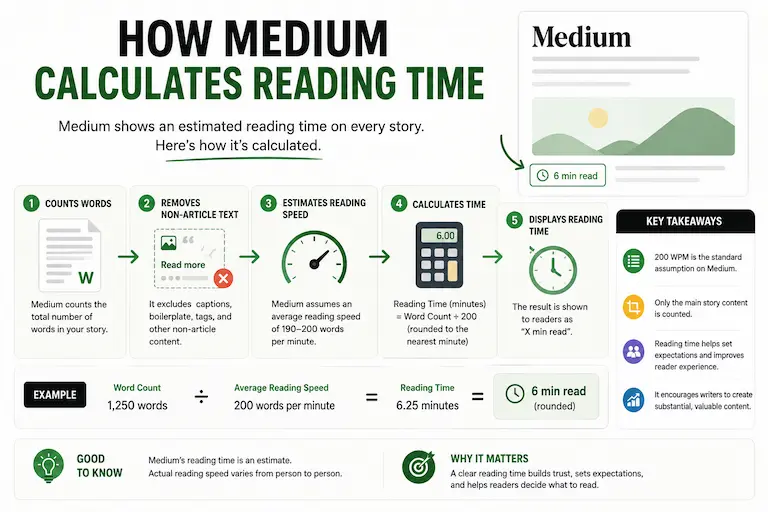
Medium provides an estimated read time for its stories, giving readers a quick indication of how long an article may take to read. The platform’s official guidance explains that its estimate is based on an average adult reading speed and also includes an adjustment for images.
In this guide, you’ll learn how Medium calculates reading time, the basic formula behind the estimate, how images affect the calculation, and how you can create similar estimates for your own content.
For additional information about Medium’s reading-time system and web-reading behavior, see the Medium Help Center and Nielsen Norman Group’s research on writing for the web.
How Medium Calculates Reading Time
The basic explanation is straightforward: Medium takes the total word count of an article and estimates reading time using an average adult reading speed of roughly 265 words per minute. Medium also makes an adjustment for images.
For a text-only estimate, the basic formula is:
Reading time ≈ Total words ÷ 265
The result provides an approximate reading time rather than a prediction of exactly how long every individual reader will spend on the article.
This basic formula is also a simple way to convert words to time or use a simple word to time calculation to estimate words to minutes when you know the total word count. For a quick estimate, divide the number of words by the reading speed you want to use.
Example of How Medium Calculates Reading Time
Suppose an article contains 1,060 words.
1,060 ÷ 265 = 4 minutes
A simple word-count calculation therefore produces an estimated reading time of approximately:
4 min read
The actual Medium estimate can also reflect image adjustments, so the final displayed time is not necessarily determined by word count alone.
Why Medium Uses 265 Words Per Minute
Medium’s official Help Center describes 265 words per minute as the approximate reading speed of an adult. This provides a consistent baseline for estimating how long an average reader may need to read an article.
However, actual reading speed varies significantly between readers and content types. Dense academic, technical, or unfamiliar material may take longer to process than straightforward general-interest writing.
If you want to compare Medium’s adult baseline with age-based reading-speed ranges, see Average Reading Speed by Age. Your own reading speed may differ from Medium’s general 265-WPM reference.
- Blog posts
- Essays
- Opinion articles
- Tutorials
- Personal stories
These examples can have very different reading speeds depending on vocabulary, sentence complexity, reader familiarity, and the amount of visual material.
Does Medium Count Images and Visual Elements?
Yes. Medium’s official guidance states that its read-time calculation includes an adjustment for images, meaning the estimate is not based solely on the article’s word count.
This matters because readers may spend additional time looking at visual material such as:
- Images
- Charts
- Illustrations
- Other visual elements
Medium does not describe its public calculation as simply “word count divided by 265” for every story; the image adjustment is part of the platform’s read-time calculation.
How Medium Calculates Reading Time for Different Word Counts
The same approach can be used to estimate reading time by word count for articles of different lengths. If you change the word count while keeping the reading speed constant, the estimated reading time changes accordingly.
| Word Count | Approximate Text-Only Reading Time |
|---|---|
| 265 words | 1 minute |
| 530 words | 2 minutes |
| 795 words | 3 minutes |
| 1,060 words | 4 minutes |
| 1,325 words | 5 minutes |
| 2,650 words | 10 minutes |
These figures show the basic 265-WPM calculation. Medium’s actual estimate may differ because its calculation also adjusts for images.
Why Reading Time Can Improve User Experience
A visible reading-time estimate gives readers another piece of information when deciding whether to start an article.
- Sets an expectation about article length
- Helps readers decide when to read the article
- Provides useful context before reading
- Can make long-form content easier to evaluate
- Supports a more transparent reading experience
However, a reading-time label does not guarantee that readers will finish an article or that engagement metrics will automatically improve.
Want to understand how reading time can be used as part of a broader content strategy?
How Reading Time Improves Blog Engagement
How Readability Can Affect Reading Time
Reading time is influenced by more than word count. Readers may take longer to process content when it contains long sentences, dense paragraphs, unfamiliar terminology, or poorly organized information.
Clear headings, consistent formatting, shorter sentences, and well-structured paragraphs can make content easier to scan and understand. As a result, two articles with the same word count may not take exactly the same amount of time for every reader.
For example, a well-structured 1,000-word article may feel easier to read than a poorly organized article with the same word count. This does not change Medium’s basic reading-time calculation, but it can affect how quickly an individual reader actually processes the content.
After estimating reading time, you can review sentence structure with the Sentence Counter to identify unusually long or uneven sentence patterns.
Want to check your sentence structure after reviewing your article’s reading time?
How to Calculate Reading Time Like Medium
You can create a basic Medium-style estimate in three steps:
- Count the total number of words.
- Divide the word count by 265.
- Use the result as an approximate reading-time estimate.
For example, consider a 2,000-word article:
2,000 ÷ 265 ≈ 7.5 minutes
A simple whole-minute estimate would be about 8 minutes, although Medium’s actual calculation can also account for images.
Best Tools to Calculate Reading Time
If you want to estimate reading time for your own articles, the most relevant TextToolPro tools are the ones that directly measure reading duration or provide the word and sentence information used during content review.
Reading Time Calculator
The Reading Time Calculator is the primary tool for this topic. It provides a quick reading-time estimate so you can review how long an article may take to read before publishing.
Because TextToolPro’s Reading Time Calculator supports custom WPM, you can also compare Medium’s 265-WPM baseline with your own measured reading speed when estimating words to time for an article.
Want to check your article’s reading time quickly?
Word Counter for Essays
Because reading-time estimates start with word count, the Word Counter for Essays is a useful secondary tool for checking the number of words in an article before estimating its reading time.
Sentence Counter
Reading speed is also influenced by how easy content is to process. The Sentence Counter can help you review sentence structure after checking reading time, especially when an article contains many long or complex sentences.
How Medium Calculates Reading Time Compared With Other Platforms
Medium
Medium states that its read-time estimate uses an average adult reading speed of roughly 265 WPM and includes an adjustment for images.
WordPress
WordPress does not have one universal reading-time calculation built into every site. Reading-time estimates can depend on the theme, plugin, or custom implementation used by the site owner.
Substack
Substack can display estimated reading time, but its calculation should not be presented as identical to Medium’s without a current official source confirming the same method.
Ghost
Ghost sites can display reading-time information through their themes or implementations. The exact calculation can vary, so it should not automatically be treated as the same algorithm used by Medium.
Benefits of Displaying Reading Time on Your Blog
Adding a reading-time label can provide useful information before a reader begins an article.
- Set expectations about article length
- Help readers plan their time
- Improve transparency
- Make long-form content easier to evaluate
- Provide useful information alongside the article title
For example:
1,500 words • 6 min read
The label gives readers a quick estimate, but it should be treated as an approximation rather than a promise about how long every person will need.
Common Mistakes When Estimating Reading Time
Using Unrealistic Reading Speeds
Using an unusually high or low reading speed can produce an estimate that does not represent the intended audience.
Ignoring Images
If your goal is to approximate Medium’s approach, remember that Medium makes an adjustment for images.
Forgetting to Update Counts
Editing an article can change its word count and therefore change the estimated reading time.
Overlooking Readability
Word count alone does not describe how difficult an article is to read. Long sentences, unfamiliar terminology, and dense paragraphs can require more processing time.
What Is a Good Reading Time for Blog Posts?
There is no universal “best” reading time for every blog post. A suitable article length depends on the topic, search intent, audience, and depth required to answer the reader’s question.
- Short posts may answer simple questions quickly.
- Standard guides may require several minutes to cover the topic properly.
- Detailed tutorials and research-based articles may take considerably longer.
Focus on answering the searcher’s question completely rather than targeting an arbitrary reading-time range.
Final Thoughts on How Medium Calculates Reading Time
Understanding How Medium Calculates Reading Time gives you a practical way to estimate how long readers may need to consume an article. Medium’s official explanation uses an average adult reading speed of roughly 265 words per minute and includes an adjustment for images.
You can use the same basic word-count calculation as a useful approximation for your own content, while remembering that individual reading speeds and content complexity vary.
For writers and content creators serving readers in the United States, United Kingdom, Canada, Australia, and other English-speaking markets, a clear reading-time estimate can help readers understand the expected length of an article before they begin.
For the most practical workflow, check your word count, estimate reading time, and then review sentence structure and readability before publishing.
Calculate Reading Time Like Medium Instantly
Want to check how long your article may take to read?
For a more complete content check, you can also use:
- Word Counter for Essays to verify total word count.
- Sentence Counter to review sentence and paragraph structure.
FAQs About How Medium Calculates Reading Time
How Medium Calculates Reading Time: What Is the Formula?
Medium states that its read-time estimate is based on an average adult reading speed of roughly 265 words per minute, with an adjustment for images. A basic text-only approximation is total word count divided by 265.
How Medium Calculates Reading Time: Does It Include Images?
Yes. Medium’s official Help Center says that its read-time calculation includes an adjustment for images, so the estimate is not based solely on word count.
How Medium Calculates Reading Time: What Reading Speed Does It Use?
Medium describes the average adult reading speed used for its estimate as roughly 265 words per minute.
How Medium Calculates Reading Time: Which Tool Can I Use?
The Reading Time Calculator is the most directly relevant TextToolPro tool for estimating reading time. A Word Counter for Essays can also help you verify the word count used in the calculation.
Why Does How Medium Calculates Reading Time Matter for SEO?
Reading time itself is not a direct ranking factor. However, displaying a useful reading-time estimate can provide helpful information before readers start an article and support a clearer content experience.
Can I Use How Medium Calculates Reading Time on My Own Blog?
You can use the basic 265-WPM calculation as an approximation for your own content, but it should not be presented as an exact reproduction of Medium’s complete algorithm because Medium also adjusts its estimate for images.