
Sentence Case vs Title Case
7 Powerful Differences Between Sentence Case vs Title Case That Improve Writing
If you have ever wondered when to capitalize major words in a heading or when to use normal sentence-style capitalization, you are not alone. Understanding Sentence Case vs Title Case helps bloggers, students, marketers, copywriters, editors, and business professionals choose a consistent format for different types of content.
Whether you are creating blog titles, email subject lines, academic papers, YouTube titles, or marketing headlines, the right capitalization style can improve consistency, readability, and presentation.
In this guide, you will learn the key difference between sentence case and title case, when to use each one, common mistakes to avoid, and how different style guides and audiences influence capitalization choices.
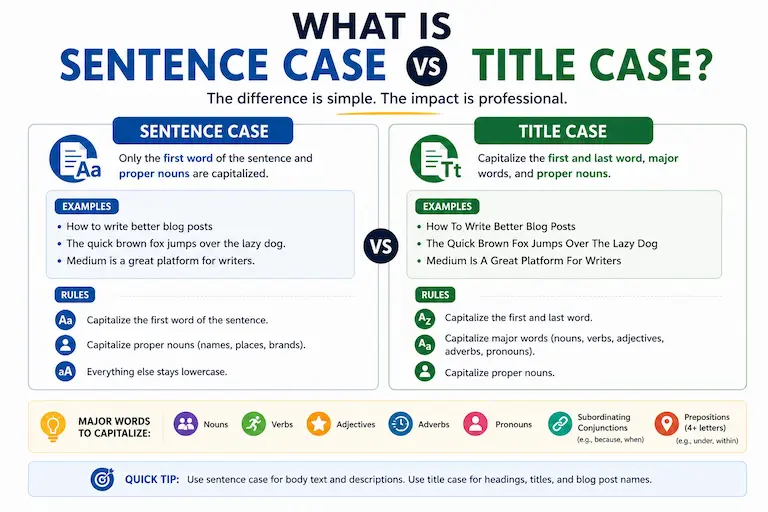
What Is Sentence Case?
Sentence case is a capitalization style in which the first word is capitalized along with proper nouns and any other words that require capitalization under the applicable style guide.
Example of Sentence Case
- The quick brown fox jumps over the lazy dog
- Why sentence case improves readability
- Best writing tips for students
This format resembles normal sentence capitalization, so it often creates a natural and conversational appearance.
When Sentence Case Is Commonly Used
Sentence case is commonly used in:
- Blog subheadings
- Email subject lines
- Mobile app interfaces
- UX writing
- Social media captions
- Some academic and professional content, depending on the style guide
- Product descriptions
Many modern digital products and brands prefer sentence case because it provides a straightforward, conversational presentation. Microsoft, for example, recommends sentence-style capitalization for headings and much of its UI content. :contentReference[oaicite:1]{index=1}
What Is Title Case?
Title case is a capitalization style in which major words are capitalized according to the relevant style guide.
Example of Title Case
- The Quick Brown Fox Jumps Over the Lazy Dog
- Why Sentence Case Improves Readability
- Best Writing Tips for Students
In many title-case systems, major words are capitalized while shorter function words such as articles, conjunctions, and prepositions may remain lowercase. The exact rules vary by style guide.
When Title Case Is Commonly Used
Title case is commonly used for:
- Blog titles
- Book titles
- Newspaper headlines
- Course names
- YouTube titles
- Marketing campaigns
- Professional presentations
Title case can give headings and titles a more formal or visually prominent appearance, depending on the publication’s style.
Sentence Case vs Title Case: The Main Difference
The primary difference between Sentence Case vs Title Case is how capitalization is applied to the words in a title, heading, or other text element.
- Sentence case: Capitalize the first word, proper nouns, and any other words required by the applicable style.
- Title case: Capitalize major words according to the applicable title-case style guide.
Quick Comparison Table
| Feature | Sentence Case | Title Case |
|---|---|---|
| Capitalization Style | First word and required proper nouns are capitalized | Major words are capitalized according to the style guide |
| Readability | Often natural and conversational | Often more visually prominent |
| Common Use | UI, UX, subheadings, and many digital contexts | Headlines, titles, and contexts that specify title case |
| SEO Impact | Capitalization itself is not a direct ranking factor | Capitalization itself is not a direct ranking factor |
| Professional Tone | Often modern and approachable | Often formal or prominent |
Want to understand another important capitalization distinction?
Learn About Uppercase vs Lowercase in Writing
Why Sentence Case vs Title Case Matters for SEO
Search engines can understand headings regardless of whether you use sentence case or title case. Capitalization itself is not a direct ranking factor, but clear and consistent headings can improve presentation and make content easier for users to scan.
Sentence Case Can Help With:
- Natural readability
- Clean digital interfaces
- Conversational presentation
- Consistent UX writing
Title Case Can Help With:
- Visual prominence
- Headline presentation
- Formal visual style
- Consistency when required by a publication’s style
The best choice depends on the publication, audience, brand style, and applicable editorial guidelines rather than a universal SEO rule.
Which Is Better: Sentence Case or Title Case?
There is no universal winner in the Sentence Case vs Title Case debate. The better choice depends on context and the style requirements of the content.
Use Sentence Case When:
- Writing conversational digital content
- Designing app interfaces
- Creating FAQ sections
- Following a style guide that specifies sentence case
- Writing UX content
Use Title Case When:
- Writing titles that follow a title-case style
- Creating advertisements where the chosen style calls for it
- Formatting titles according to a publication’s guidelines
- Naming courses when the institution uses title case
- Producing headlines in a title-case editorial style
Many websites and publications use both styles for different types of content.
APA Title Case is another important variation with its own capitalization rules.
Read the APA Title Case Rules Guide
Common Mistakes People Make
Even experienced writers can make capitalization mistakes when they switch between different style conventions.
1. Capitalizing Every Word Incorrectly
Wrong:
- How To Improve Your Writing Skills
Correct under a common title-case convention:
- How to Improve Your Writing Skills
Small connector words such as “to” are often lowercase in title case, although exact treatment depends on the style guide.
2. Mixing Styles Together
Wrong:
- Why sentence Case Improves SEO
Correct sentence case:
- Why sentence case improves SEO
Consistency matters more than choosing one capitalization style for every situation.
3. Ignoring Brand Style Guidelines
Different organizations and publications follow different capitalization rules.
For example:
- Associated Press Stylebook provides its own editorial guidance for capitalization and headlines.
- Microsoft Writing Style Guide generally uses sentence-style capitalization for headings and much of its digital content.
Sentence Case vs Title Case in Digital Marketing
Digital marketers may test different capitalization styles because headline presentation can influence how users perceive and interact with content.
Example
Sentence case:
- Best laptops for students in 2026
Title case:
- Best Laptops for Students in 2026
Neither version is universally better. The appropriate choice depends on the brand, audience, platform, and style guidelines.
When performance matters, testing different headline wording and presentation can provide more useful evidence than assuming one capitalization style always produces better results.
How to Convert Sentence Case and Title Case Easily
Manually editing capitalization can take time, especially when you are working with large amounts of content.
A dedicated text formatting tool can quickly convert text between:
- Lowercase and title case
- Sentence case and title case
- Uppercase and sentence case
For a quick way to change capitalization without retyping the text:
The tool is particularly useful when you need to apply a consistent capitalization style across headings, titles, or other text.
Other Useful Text Tools
- Use Character Counter Without Spaces when a title, heading, or short piece of copy needs a character-count check.
- Use Sentence Counter when you want to review sentence and paragraph structure after editing your content.
These tools address different editing tasks, so you can choose the one that matches the specific problem you are trying to solve.
Best Practices for Using Sentence Case vs Title Case
Keep Your Style Consistent
Do not switch capitalization formats randomly across pages or within the same content system.
Match Audience Expectations
Choose the capitalization style that matches your audience, platform, brand, or required editorial standard.
Consider Mobile Readers
Keep headings concise and easy to scan on smaller screens. Sentence case may be preferred in some interfaces, while title case may be appropriate where a publication uses it consistently.
Use Style-Appropriate Headlines
Choose sentence case or title case according to the editorial style rather than assuming that one format is always better for SEO.
Improve Content Readability
Use clear, concise headings and consistent capitalization throughout the page.
Real-World Examples
Blog Headlines
Title case:
- 10 Powerful SEO Strategies for Small Businesses
Sentence case:
- 10 powerful SEO strategies for small businesses
Either can be appropriate depending on the publisher’s editorial style.
User Interface Example
Sentence case:
- Create a new account
Title case:
- Create a New Account
Sentence case is common in modern interfaces, including Microsoft guidance for headings and UI content. :contentReference[oaicite:2]{index=2}
How Professional Editors Decide
Professional editors usually follow a style guide rather than choosing capitalization randomly.
Popular style standards include:
- AP Style
- Chicago Manual of Style
- APA Style
- MLA Style
Each guide has its own capitalization conventions. Always check the style guide required by your publication, institution, or client.
For example, Microsoft generally recommends sentence-style capitalization for headings, while other publications may use title-style capitalization. :contentReference[oaicite:3]{index=3}
The Psychology Behind Capitalization
Capitalization can influence the visual character of a heading. Title case may make a heading look more formal or prominent, while sentence case can create a more conversational appearance.
These are presentation effects rather than universal psychological rules. Reader response can vary by audience, design, context, and familiarity with the style.
This is one reason organizations choose capitalization conventions that fit their brand, interface, or editorial system and then apply them consistently.
Final Thoughts on Sentence Case vs Title Case
Understanding Sentence Case vs Title Case can help you choose a consistent capitalization style for headings, titles, interfaces, and other content.
If your publication or brand requires title case, follow its specific capitalization rules. If it uses sentence case, apply that style consistently across the relevant content.
The smartest approach is to choose the style based on context, audience, platform, and applicable editorial guidelines.
Before publishing content, always check:
- Readability
- Consistency
- Capitalization rules
- Editorial requirements
- Audience expectations
Try a Text Case Converter Tool
Want to switch between sentence case and title case without manual editing?
Use the tool to:
- Convert capitalization quickly
- Save editing time
- Improve capitalization consistency
- Prepare headings and titles efficiently
- Reduce manual formatting work
It is useful for blogs, essays, emails, headings, and marketing copy when you need to change capitalization efficiently.
FAQs About Sentence Case vs Title Case
What is the difference between Sentence Case vs Title Case?
Sentence case generally capitalizes the first word, proper nouns, and other required exceptions, while title case capitalizes major words according to the applicable style guide.
Which is better for SEO: Sentence Case vs Title Case?
Neither capitalization style is inherently better for SEO. Capitalization itself is not a direct search-ranking factor. Choose the style that fits the publication, audience, and editorial guidelines.
Is Google sensitive to Sentence Case vs Title Case?
Google does not require one capitalization style for search rankings. Clear and descriptive titles and headings matter more than whether they use sentence case or title case.
Should blog titles use sentence case or title case?
Either can work. Follow your publication or brand style and apply it consistently rather than assuming that one format is universally better.
Can I automatically convert Sentence Case vs Title Case?
Yes. A Text Case Converter can quickly switch text between sentence case, title case, lowercase, and uppercase formatting.
Why do modern apps prefer sentence case?
Sentence case is common in many modern interfaces because it provides a simple, conversational presentation and is recommended by style systems such as Microsoft’s for headings and UI content. :contentReference[oaicite:4]{index=4}