
Average Sentence Length in Academic Writing
9 Powerful Secrets About Average Sentence Length in Academic Writing for Better Grades
Understanding the average sentence length in academic writing is essential for students, researchers, bloggers, and professionals who want to improve readability and achieve better academic results. Whether you are writing essays, dissertations, journal articles, or research papers, sentence length directly affects clarity, engagement, and comprehension.
Many students in the USA, UK, Canada, and Australia struggle with overly long or extremely short sentences. Academic writing should sound professional, but it should also remain easy to understand. Finding the right sentence balance helps improve grades, readability scores, and reader engagement.
In general, the average sentence length in academic writing ranges between 15 to 25 words per sentence. This range allows writers to explain complex ideas clearly without overwhelming readers.
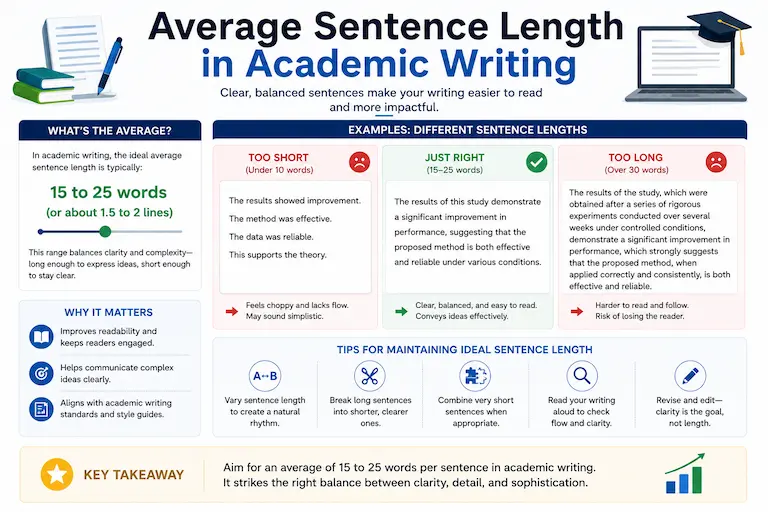
This guide explains the ideal sentence length for academic writing, common mistakes, readability strategies, and practical tips used by professional academic writers and editors.
Why Sentence Length Matters in Academic Writing
Sentence length affects:
- Readability
- Clarity
- Academic tone
- Reader comprehension
- SEO performance for online academic content
Very long sentences can confuse readers, while very short sentences may sound simplistic or disconnected.
Professional writers often use tools like the Sentence Counter and Word Counter for Essays to monitor sentence structure and improve readability.
What Is the Ideal Average Sentence Length in Academic Writing?
Most academic experts recommend:
- 15–20 words for standard academic writing
- 20–25 words for advanced analytical writing
- Shorter sentences for readability
- Longer sentences only when necessary
This range helps maintain a formal tone while ensuring the content remains understandable. There is no universal sentence-length requirement for academic writing; these ranges are practical readability guidelines rather than strict rules
Research-Based Writing Standards
Studies on readability often show that readers understand content better when sentences stay within a manageable length.
For example:
- Academic journals may use slightly longer sentences
- Undergraduate essays usually benefit from moderate-length sentences
- Online educational articles perform better with shorter academic sentences
How Average Sentence Length Affects Readability
Readability refers to how easy a text is to read and understand.
Academic readers prefer:
- Clear sentence structure
- Logical flow
- Concise explanations
- Controlled complexity
Long sentences increase cognitive load, especially for international students and non-native English speakers.
Example of Poor Academic Sentence Structure
The research conducted by multiple educational institutions across several countries demonstrates various complex outcomes regarding student engagement levels in online learning environments which may influence future educational policy development significantly.
This sentence feels overloaded.
Improved Version
Research from several educational institutions shows that online learning affects student engagement in different ways. These findings may influence future educational policies.
The second example improves clarity without losing professionalism.
Want to learn how many sentences are in a paragraph? Read this easy guide
How Many Sentences Are in a Paragraph?
Average Sentence Length by Academic Writing Type
Essays
Typical sentence length:
- 15–20 words
Essays should balance detail and readability.
Research Papers
Typical sentence length:
- 20–25 words
Research writing often includes technical explanations and evidence-based analysis.
Dissertations and Theses
Typical sentence length:
- 20–30 words
Advanced academic work may require more detailed sentence structures.
Online Academic Blogs
Typical sentence length:
- 12–18 words
Digital readers prefer shorter and more scannable content.
9 Powerful Secrets to Improve Sentence Length in Academic Writing
1. Prioritize Clarity Over Complexity
Many students believe complex writing sounds more intelligent.
In reality, clear writing demonstrates stronger academic ability.
Avoid unnecessary:
- Jargon
- Wordiness
- Repetition
- Complicated phrasing
2. Mix Short and Long Sentences
Using only long sentences creates monotony.
Using only short sentences sounds robotic.
Good academic writing combines:
- Short sentences for emphasis
- Medium sentences for explanation
- Longer sentences for analysis
This creates a natural rhythm.
3. Break Up Overly Long Sentences
If a sentence exceeds 35 words, review whether it can be divided.
Signs of overloaded sentences:
- Too many commas
- Multiple ideas
- Excessive clauses
- Difficult readability
Tools like Reading Time Calculator can help evaluate text flow and readability.
4. Eliminate Unnecessary Words
Academic writing should be concise.
Replace:
- “Due to the fact that” → “Because”
- “At this point in time” → “Now”
- “In the event that” → “If”
Concise writing improves readability and sentence efficiency.
5. Use Active Voice Whenever Possible
Active voice creates clearer and shorter sentences.
Passive Voice
The experiment was conducted by the researchers.
Active Voice
The researchers conducted the experiment.
The active version sounds stronger and more direct.
6. Improve Sentence Variety
Sentence variety keeps readers engaged.
Academic writing should avoid repetitive sentence patterns.
Use:
- Compound sentences
- Complex sentences
- Transitional phrases
- Parallel structure
7. Watch Your Paragraph Flow
Sentence length also affects paragraph readability.
Large blocks of text discourage readers.
Using tools like:
- Character Counter Without Spaces
- Remove Extra Spaces
- Text Case Converter
can improve formatting and consistency.
8. Read Academic Writing From Trusted Sources
Reading quality academic content helps develop natural sentence rhythm.
Strong examples include:
These resources demonstrate professional academic writing standards.
9. Read Your Work Aloud
Reading aloud helps identify:
- Awkward phrasing
- Overly long sentences
- Repetition
- Poor flow
If you run out of breath while reading a sentence, it is probably too long.
if sentences are too long and you want to make them short and clear? read this practical and the best guide
How to Write Shorter Sentences Clearly
Common Sentence Length Mistakes in Academic Writing
Writing Extremely Long Sentences
Long sentences often reduce comprehension.
Readers may lose track of the main point before reaching the end.
Using Too Many Short Sentences
Overly short sentences weaken academic tone.
Example:
The study was important. It had many results. The researchers learned a lot.
This sounds simplistic.
Ignoring Transitions
Transition words improve sentence flow.
Examples:
- Therefore
- However
- Furthermore
- In contrast
- Consequently
These create smoother academic writing.
Overusing Passive Voice
Passive constructions often increase sentence length unnecessarily.
Use active voice where appropriate.
How Sentence Length Impacts SEO for Educational Websites
Educational websites targeting USA and UK audiences benefit from readable content.
Search engines favor:
- Clear structure
- Readability
- User engagement
- Mobile-friendly formatting
Shorter academic sentences improve:
- Time on page
- User experience
- Content accessibility
This is especially important for educational blogs and online learning platforms.
Best Tools for Measuring Average Sentence Length
Several writing tools help analyze sentence structure.
Useful Tools
| Tool | Purpose |
|---|---|
| Sentence Counter | Count sentence length |
| Reading Time Calculator | Improve readability |
| Word Counter for Essays | Track essay length |
| Character Counter Without Spaces | Optimize formatting |
These tools improve both academic writing quality and SEO performance.
Average Sentence Length in Academic Writing vs Blog Writing
| Writing Type | Average Sentence Length |
|---|---|
| Academic essays | 15–25 words |
| Blog posts | 10–18 words |
| News articles | 12–20 words |
| Research papers | 20–30 words |
| Marketing copy | 8–15 words |
Different audiences require different writing styles.
Academic readers tolerate more complexity, but clarity still matters most.
Final Thoughts
Understanding the average sentence length in academic writing can dramatically improve your writing quality, readability, and academic performance. While there is no perfect sentence length, most academic experts recommend staying between 15 and 25 words per sentence.
Effective academic writing should:
- Be clear and concise
- Maintain logical flow
- Avoid unnecessary complexity
- Balance sentence variety
- Support reader comprehension
Whether you are writing essays, research papers, or academic blog posts, sentence structure plays a major role in how readers evaluate your work.
Mastering sentence length helps create writing that sounds both professional and easy to understand.
Improve Your Academic Writing Today
Want to instantly analyze your sentence structure and readability?
Measure sentence length, improve clarity, and review your academic writing before submission.
FAQs
What is the average sentence length in academic writing?
The average sentence length in academic writing is usually between 15 and 25 words per sentence.
Why is average sentence length in academic writing important?
Sentence length affects readability, clarity, comprehension, and academic tone.
Can academic sentences be too long?
Yes. Extremely long sentences often confuse readers and reduce clarity.
What is the best sentence length for essays?
Most essays benefit from sentence lengths between 15 and 20 words.
How can I improve average sentence length in academic writing?
You can improve sentence length by:
- Using active voice
- Removing unnecessary words
- Breaking long sentences
- Reading aloud
- Using readability tools
Which tools help measure average sentence length in academic writing?
Useful tools include: