
How to Write Shorter Sentences
11 Powerful Ways: how to Write Shorter Sentences and Avoid Common Writing Mistakes
Learning How to Write Shorter Sentences is one of the fastest ways to improve readability, communication, and writing quality. Whether you are writing blog posts, academic essays, business emails, marketing content, or reports, shorter sentences help readers understand your message quickly and clearly.
Quick answer: give each sentence one main idea. Cut filler words, split a sentence where a new idea starts (often at “and”, “but” or “which”), prefer active verbs, and aim for an average of about 15 to 20 words per sentence. You can check your average with a free Sentence Counter.
Many writers unintentionally create long, complicated sentences that confuse readers and reduce engagement. Online readers prefer content that is easy to scan and simple to understand.
Mastering How to Write Shorter Sentences improves:
- readability
- writing clarity
- reader engagement
- SEO content readability
- academic writing quality
- business communication
The good news is that writing shorter sentences is a skill anyone can learn. In this guide, you will discover practical techniques, editing strategies, and useful tools that help create concise, effective writing.
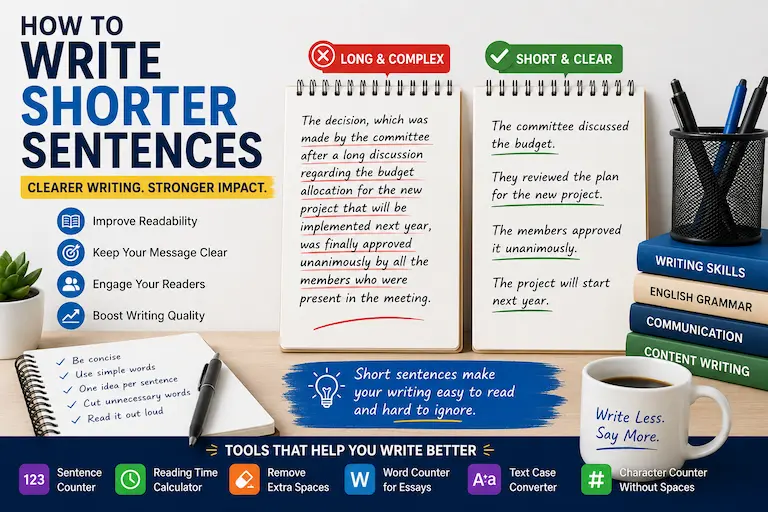
The 11 Ways at a Glance
Each way has its own section below, with an example. Use this list as a checklist when you edit.
- Give each sentence one main idea.
- Cut filler words such as “very” and “really”.
- Split compound sentences where a new idea begins.
- Use active voice.
- Turn noun phrases back into verbs.
- Avoid starting sentences with “there is” or “it is”.
- Move long lists into bullet points.
- Read the draft aloud.
- Delete repeated ideas.
- Swap wordy phrases for short ones.
- Check your average sentence length with a Sentence Counter.
Why Shorter Sentences Matter
Readers process information faster when sentences are concise.
Long sentences often:
- create confusion
- reduce readability
- increase cognitive load
- weaken key messages
Shorter sentences make content:
- easier to understand
- easier to scan
- more engaging
- more persuasive
This is especially important for online readers who typically skim content before reading in detail.
How Shorter Sentences Improve Readability
Readability measures how easy content is to understand.
When sentences become too long, readers must work harder to follow the message.
Shorter sentences improve:
- comprehension
- information retention
- reading speed
- user experience
Clear, readable content helps people understand information and supports a positive reading experience. Sentence length alone, however, does not guarantee higher search rankings.
Sentence length is also one of the two things that classic readability formulas, such as Flesch Reading Ease, measure. The other is word length. Shorter sentences are only one lever, so the section on how to improve readability further down covers the rest.
Common Reasons Writers Use Long Sentences
Many writers do not realize they are creating overly complex sentences.
Trying to Include Too Much Information
Writers often combine multiple ideas into one sentence.
Example:
Poor:
The company launched a new product that increased sales significantly while also improving customer satisfaction and helping strengthen brand loyalty.
Better:
The company launched a new product. Sales increased significantly. Customer satisfaction also improved.
Overusing Conjunctions
Words such as:
- and
- but
- because
- although
- while
can create unnecessarily long sentences when overused.
Academic Writing Habits
Students often believe longer sentences sound more intelligent.
In reality, professors and instructors usually prefer clear, concise writing.
Writing the First Draft the Way You Think
First drafts follow the order of your thoughts. An idea comes, then a second idea attached to it, then a reason, then an exception. All of it lands in one sentence because nothing made you stop.
That is normal. The fix is not to write short sentences from the first word. Write the draft, then shorten it in a separate editing pass, using the steps below.
How to Write Shorter Sentences Effectively
Focus on One Idea Per Sentence
Each sentence should communicate one primary idea.
Example:
Long:
Students who manage their time effectively and follow assignment instructions carefully are more likely to achieve higher grades and reduce academic stress.
Shorter:
Students who manage their time effectively often achieve higher grades. They also experience less academic stress.
Remove Unnecessary Words
Many sentences contain filler words.
Common examples:
- very
- really
- basically
- actually
- quite
Removing unnecessary words improves clarity instantly.
Break Up Compound Sentences
Long compound sentences often benefit from being divided into smaller sentences.
Before:
The report was completed on time, and the team submitted it successfully, but several revisions were still required.
After:
The report was completed on time. The team submitted it successfully. Several revisions were still required.
Use Active Voice
Active voice typically produces shorter and stronger sentences.
Passive:
The proposal was reviewed by the committee.
Active:
The committee reviewed the proposal.
The active version is two words shorter (5 words instead of 7), and it names who did the work first.
Passive voice is not an error. Plain English Campaign suggests keeping about 80 to 90 percent of your verbs active, and using the passive when the person doing the action is unknown or unimportant.
Want to learn the average sentence length in academic writing? Read our detailed guide.
Average Sentence Length in Academic Writing
Turn Noun Phrases Back Into Verbs
Many long sentences are long because a verb has been turned into a noun. “Make a decision” says what “decide” says, in three words instead of one. Plain English Campaign calls these nominalisations and warns that too many of them make writing heavy.
A quick way to find them: scan your draft for words ending in -tion or -ment, then ask whether a plain verb would do the same job.
| Noun phrase (before) | Verb (after) | Words saved |
|---|---|---|
| The committee made a decision to delay the vote. (9 words) | The committee decided to delay the vote. (7 words) | 2 |
| We conducted an investigation into the error. (7 words) | We investigated the error. (4 words) | 3 |
| Please provide an explanation of the delay. (7 words) | Please explain the delay. (4 words) | 3 |
Avoid Starting Sentences With “There Is” or “It Is”
Openings such as “there are” and “it is” delay the real subject. They are fine when you introduce something new, but they easily become a habit.
| Before | After | Words saved |
|---|---|---|
| There are several reasons why students miss deadlines. (8 words) | Students miss deadlines for several reasons. (6 words) | 2 |
| It is the manager who approves the budget. (8 words) | The manager approves the budget. (5 words) | 3 |
Move Long Lists Into Bullet Points
A sentence that carries five items is long even when each item is short. Put the items in a list and the sentence shrinks. Plain English Campaign recommends lists for splitting information up.
Before (27 words):
You must submit a completed form, two passport photographs, proof of address, a copy of your certificate and the application fee by the end of the month.
After (an opening line of 9 words, then a list):
By the end of the month, you must submit:
- a completed form
- two passport photographs
- proof of address
- a copy of your certificate
- the application fee
How to Shorten a Long Sentence Step by Step
This worked example uses one 48-word sentence. The same four steps work on any long sentence.
Original (48 words):
Our department, which has been working on the new grading policy for several months, decided that it would be in the best interest of all students to postpone the final submission deadline because many of them had told us that they were having difficulties with the online portal.
- Find the main idea. Ask who did what. Here it is: the department decided to postpone the deadline.
- Mark everything else. “Which has been working on the new grading policy for several months” is background the reader does not need here. “It would be in the best interest of all students to” is padding. “Because many of them had told us that they were having difficulties with the online portal” is the reason, so it stays.
- Rewrite. State the main idea first, then give the reason its own sentence. Use plain verbs: “postponed” instead of “decided to postpone”, and “reported problems” instead of “told us that they were having difficulties”.
- Check. Compare the meaning with the original and read the result aloud. Nothing the reader needs has been lost.
Result (2 sentences, 16 words):
The department postponed the final submission deadline. Many students had reported problems with the online portal.
That cuts the text from 48 words to 16, a drop of two-thirds. If the grading policy matters to your reader, give it its own sentence instead of squeezing it back in.
How to Write Shorter Sentences for SEO
Clear, readable SEO content helps readers understand information efficiently. Shorter sentences can support readability, but sentence length alone does not guarantee higher search rankings.
Benefits include:
- improved engagement
- clearer communication
- better user experience
- increased readability
Search engines prioritize content that satisfies user intent efficiently.
Keep Average Sentence Length Manageable
A common guideline is to aim for around 15–20 words per sentence when appropriate. This is not a universal rule; the best length depends on the audience, subject, and complexity of the idea.
- 15–20 words per sentence
- simple sentence structure
- direct language
Using a mix of sentence lengths and straightforward language can make content easier to follow and more accessible.
The 15 to 20 word figure comes up again and again in plain-language advice. Plain English Campaign recommends it as an average and adds that this does not mean making every sentence the same length. Canada’s Language Portal says the same and notes that a text made only of 17-word sentences would feel monotonous.
The Language Portal also gives a warning range: sentences of more than 25 words are often hard to follow on a first reading, and even experienced readers struggle with sentences longer than 30 words.
| Words in one sentence | What to do |
|---|---|
| Up to about 20 | Usually fine. Keep your average in this range. |
| 21 to 25 | Reread it. Split it if it holds two ideas. |
| 26 to 30 | Often hard on a first reading. Split it. |
| More than 30 | Even experienced readers struggle. Split it, or turn part of it into a list. |
This table is a rule of thumb built on the figures above, not an official standard.
An average can also hide a problem. Three sentences of 8, 31 and 17 words average 18.7 words, which looks fine. But the 31-word sentence is the one readers will stumble on. Check your longest sentences, not only the average.
To find your average, divide the number of words by the number of sentences. Use at least 100 words of text so that one odd sentence does not skew the result.
Improve Scannability
Online readers scan before they read.
Shorter sentences:
- increase visual appeal
- improve comprehension
- make information easier to follow
Nielsen Norman Group’s research on how people read web pages has long found that most visitors scan rather than read word for word. A sentence that carries one clear idea still makes sense when a reader catches only part of it.
Best Editing Techniques for Shorter Sentences
Read Your Content Aloud
Reading aloud quickly reveals:
- awkward wording
- run-on sentences
- unnecessary complexity
A simple test: read each sentence aloud at a normal pace. If you run out of breath, or lose track of the subject before you reach the verb, split the sentence.
Remove Repetition
Repeated ideas often create longer sentences without adding value.
Watch for pairs where the second word adds nothing. “End result” becomes “result”. “Past history” becomes “history”. “Free gift” becomes “gift”. “Completely finished” becomes “finished”. “Each and every” becomes “each”.
Simplify Complex Phrases
Many wordy phrases can be replaced with a single word. Each swap below saves two to four words.
| Replace | With | Words saved |
|---|---|---|
| due to the fact that | because | 4 |
| in order to | to | 2 |
| at this point in time | now | 4 |
| in the event that | if | 3 |
| a large number of | many | 3 |
| has the ability to | can | 3 |
These small changes significantly reduce sentence length.
One more check, from the University of California, Davis Aggie Grammar Guide on concision: underline the small linking words such as of, in, for, with and by. If a sentence has more than three, see whether some of them can go.
Common Mistakes to Avoid
Choppy Writing
Not every sentence should be extremely short.
Good writing balances:
- short sentences
- medium-length sentences
- occasional longer explanations
Here is what choppy writing looks like, and how to fix it.
Choppy (6 sentences, 23 words, about 4 words each):
We met on Monday. The meeting was long. We discussed the budget. The budget is tight. Everyone was tired. We finished at six.
Varied (2 sentences, 26 words):
We met on Monday and discussed the budget, which is tight. The meeting was long, and everyone was tired by the time we finished at six.
The second version is longer, but it reads better because the ideas are connected. Shorter sentences are a tool, not the goal.
A long sentence is also fine when it lists steps or items and the reader can follow it in one pass. Plain English Campaign makes the same point: mix short sentences with longer ones, and remember that most long sentences can be broken up in some way.
Oversimplifying Ideas
Clarity should never come at the expense of accuracy.
Removing Necessary Context
Always preserve meaning when shortening sentences.
Best Tools for Writing Shorter Sentences
Professional writers use editing tools to improve readability and efficiency.
Sentence Counter
A Sentence Counter counts sentences and paragraphs and reports average sentence length, helping you review your text and decide which sentences may need editing.
To use it for this job, paste at least 100 words of your draft and note the average sentence length. The counter reports totals and averages, so look through your text yourself for the longest sentences and shorten those first.
Reading Time Calculator
A Reading Time Calculator estimates how long your text takes to read, which helps when you check the length of an edited draft.
Remove Extra Spaces
A professional and free online Remove Extra Spaces tool helps clean formatting issues that often occur during editing.
Word Counter for Essays
A Word Counter for Essays helps students maintain assignment requirements while improving writing clarity.
Character Counter Without Spaces
A Character Counter Without Spaces is useful for titles, abstracts, summaries, and character-limited content.
Text Case Converter
A Text Case Converter helps keep headings and titles consistent throughout your document.
How Shorter Sentences Improve Academic Writing
Students frequently struggle with sentence complexity.
Professors generally value:
- clarity
- organization
- readability
- logical flow
Shorter sentences make research papers easier to understand and evaluate.
This is especially helpful for:
- essays
- dissertations
- coursework
- reports
- case studies
Shorter sentences are also a quick way to bring an essay under its word limit, because the filler words and repeated ideas that make sentences long are the first things to cut.
Over the limit? Read our guide on cutting words from an essay:
How Shorter Sentences Improve Business Communication
Business professionals often communicate through:
- emails
- reports
- proposals
- presentations
Clear communication improves:
- productivity
- understanding
- decision-making
Shorter sentences help reduce misunderstandings and improve workplace communication.
Examples of Strong Short Sentences
Instead of:
The marketing team developed a new campaign that was specifically designed to increase customer engagement while simultaneously improving conversion rates.
Try:
The marketing team developed a new campaign. It increased engagement and improved conversion rates.
Instead of:
Students who consistently proofread their assignments before submission tend to produce higher-quality work and avoid common mistakes.
Try:
Students who proofread their assignments produce higher-quality work. They also avoid common mistakes.
Instead of:
In my opinion, it is the case that social media has had a very large impact on the way in which young people communicate with one another.
Try:
Social media has changed how young people communicate.
Instead of:
I am writing to let you know that the meeting that had been scheduled for Thursday has been moved to Friday at 10:00 because a conflict came up in the calendar of our director.
Try:
Thursday’s meeting has moved to Friday at 10:00. Our director has a calendar conflict.
The first pair goes from 27 words to 8. The second goes from 34 words to 14. In both cases the meaning is the same and the reader gets there faster.
How to Improve Readability Beyond Shorter Sentences
Shorter sentences are one of several ways to improve readability. These are the levers that matter most, and what to do with each.
| Lever | What to do | Quick check |
|---|---|---|
| Sentences | Keep the average around 15 to 20 words and split the longest ones. | Divide words by sentences, or use the Sentence Counter. |
| Words | Prefer short, everyday words: “use” instead of “utilize”, “start” instead of “commence”. | Read it aloud and replace any word you would not say. |
| Paragraphs | Cover one topic per paragraph. Digital.gov advises no more than 150 words in three to eight sentences, and never more than 250 words. | Look at the page on a phone screen. Is it a wall of text? |
| Headings | Make each heading tell the reader what the section answers. | Read only the headings. Do they tell the story? |
| Verbs | Keep most verbs active. | Look for “was” or “were” followed by “by”. |
| Lists | Put a series of items in bullet points. | Any sentence with four or more items is a candidate. |
How Readability Scores Work
Readability formulas turn text into a number. Flesch Reading Ease, one of the best known, uses just two inputs: the average number of words per sentence and the average number of syllables per word. The formula is 206.835, minus 1.015 times the average sentence length, minus 84.6 times the average syllables per word. Higher scores mean easier text.
Because sentence length has its own place in the formula, shortening sentences raises the score directly. Take a text whose words average 1.5 syllables. At 25 words per sentence it scores about 54.6. At 15 words per sentence it scores about 64.7. That is a gain of roughly 10 points, or about one point for every word you cut from the average sentence.
Scores have limits. They count lengths, so they cannot tell you whether your argument is clear, your sentences are well built or your words are the right ones. Treat the number as a hint, and keep reading your text aloud.
Wondering how long a paragraph should be? Read our guide:
How Many Sentences Are in a Paragraph?
Writing Resources for Improving Sentence Clarity
Professional writers often use trusted resources to strengthen readability and communication skills.
Helpful resources include:
Purdue OWL Writing Lab
Plain Language Guidelines
These resources provide valuable advice for improving sentence structure and writing clarity.
Guidelines on this page come from these sources:
Plain English Campaign: How to write in plain English
Language Portal of Canada: Clear communication, simplify your sentences
Digital.gov: Clear and short
ReadabilityFormulas.com: Flesch Reading Ease formula
UC Davis Aggie Grammar Guide: Concision (PDF)
The Psychology Behind Shorter Sentences
Readers naturally prefer content that feels effortless to read.
Shorter sentences:
- break information into smaller units that are easier to process, according to Digital.gov’s plain-language guidance
- stop the main point from getting lost in clauses and exceptions
- are easier to follow on a first reading, which is how most online readers meet a page
Digital.gov also makes a point that is easy to miss: long, complicated sentences often mean the writer is not yet sure what they want to say. Shortening a sentence forces you to decide what the main idea is. That helps the reader, and it helps the writer too.
Final Thoughts on How to Write Shorter Sentences
Mastering How to Write Shorter Sentences can dramatically improve your writing quality, readability, and communication effectiveness.
Whether you are creating:
- blog posts
- essays
- business reports
- marketing content
- academic papers
- website copy
shorter sentences help readers understand your message faster and more clearly.
The most effective writers focus on clarity rather than complexity. By simplifying sentence structure and eliminating unnecessary words, you can create content that is easier to read, more engaging, and more persuasive.
Improve Readability Instantly With a Sentence Counter
Not sure whether your sentences are too long? Use our Sentence Counter to measure sentence count and average sentence length, then review sentences that may need shortening for better readability.
Use the results to:
- review sentence count and average sentence length
- spot text that may need manual editing
- support a readability review
- guide sentence-level revisions
- make informed editing decisions
It is one of the most useful tools for students, bloggers, marketers, editors, and professional writers.
FAQs About How to Write Shorter Sentences
How to write shorter sentences effectively?
Focus on one idea per sentence, remove unnecessary words, use active voice, and break long sentences into smaller parts.
Why is learning how to write shorter sentences important?
Shorter sentences improve readability, comprehension, engagement, and overall writing quality.
What is the ideal sentence length?
A range of 15–20 words can be a useful guideline, but it is not a universal rule. Appropriate sentence length depends on the audience, subject, and complexity of the idea.
Can shorter sentences improve SEO?
Shorter sentences can improve clarity and readability, contributing to a better reading experience. However, sentence length alone does not guarantee higher search rankings.
What tool helps improve sentence structure?
A Sentence Counter reports sentence counts and average sentence length. These statistics can help you review your writing, but the tool does not currently highlight individual long sentences.
How to write shorter sentences in academic writing?
Use clear language, avoid unnecessary complexity, remove filler words, and focus on one idea per sentence.
How many words should a short sentence have?
There is no official cut-off. Most plain-language guides aim for an average of 15 to 20 words across a text. Canada’s Language Portal notes that sentences over 25 words are often hard to follow on a first reading, so treat 25 words as a signal to check the sentence, not as a hard limit.
How do I shorten a sentence without changing its meaning?
Find the main idea (who did what), then remove anything that does not change the meaning, such as filler words, repeated ideas and padding phrases. Give any extra idea its own sentence. Finally, compare the new version with the old one and read it aloud. The step-by-step example above shows the whole process.
Should every sentence be short?
No. Writing made only of short sentences sounds choppy. Aim for a mix: mostly short and medium sentences, with an occasional longer one when the idea needs it.
What is the difference between a short sentence and a simple sentence?
A short sentence is about length. A simple sentence is a grammar term for a sentence with one main clause. A simple sentence can still be long: “The old man from the village near the river sold fresh fish at the market every Saturday morning.” has 18 words. A short sentence can be complex: “Leave if you can.”
How do I check my average sentence length?
Divide the number of words by the number of sentences, using at least 100 words of text. Or paste your text into a Sentence Counter and read the average it reports.