
How Many Sentences Are in a Paragraph
7 Powerful Rules for How Many Sentences Are in a Paragraph (Complete Writing Guide)
How many sentences are in a paragraph? This is a common writing question among students, bloggers, copywriters, and professionals in the USA, UK, Canada, and Australia. The truth is that there is no strict universal rule, but there are widely used guidelines that make paragraphs easier to read and more engaging.
A paragraph can contain 3 to 8 sentences on average, depending on the type of writing, audience, and purpose. Academic essays usually require longer paragraphs, while online content often performs better with shorter paragraphs.
Here is the quick version. Purdue OWL suggests three to five or more sentences per paragraph, with one main idea in each. For web pages, the Yoast readability check flags paragraphs that run past 150 words.
If you want to improve readability and create content people actually enjoy reading, understanding paragraph structure is essential.
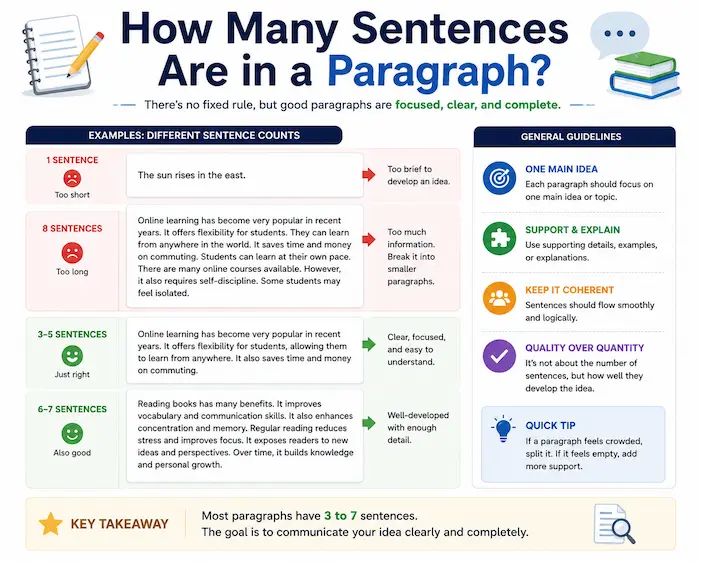
Whether you are writing an essay, blog post, email, or business report, this guide explains the ideal paragraph length, common mistakes, and expert strategies to make your writing stronger. It also shows how to count the sentences in a paragraph, how sentences turn into words, and how to split a long paragraph, with worked examples.
Why Paragraph Length Matters
Paragraph length affects:
- Readability
- User engagement
- SEO performance
- Mobile experience
- Content clarity
Large text blocks can overwhelm readers, especially on a phone. Shorter paragraphs are easier to scan.
Tools like the Sentence Counter and Reading Time Calculator can help you check your text as you edit.
Typical Sentence Range in a Paragraph
Most paragraphs contain:
| Writing Type | Average Sentences | Typical Words |
|---|---|---|
| Academic essays | 5–8 | About 100–200 |
| Blog posts | 2–4 | About 40–100 |
| News articles | 1–4 | Short |
| Business writing | 3–5 | About 75–150 |
| Creative writing | Variable | Variable |
The ideal paragraph length depends on the context. The word ranges are rules of thumb, not strict rules.
How many sentences are in a paragraph in Academic Writing
In essays and research papers, paragraphs are usually longer because they include:
- Topic sentence
- Supporting evidence
- Analysis
- Conclusion sentence
A strong academic paragraph often contains 5 to 8 sentences.
Purdue OWL gives a useful rule of thumb: make paragraphs proportional to the paper. Short papers need shorter paragraphs, and longer papers can carry longer ones.
How many sentences are in a paragraph in Blog Writing
Online readers prefer shorter paragraphs. A practical range is 2 to 4 sentences, and the Yoast readability check flags any paragraph over 150 words.
Short paragraphs are also easier to read on a phone screen.
How Many Sentences Are in a Paragraph in Creative Writing
Creative writers sometimes use one-sentence paragraphs for dramatic effect. There are fewer restrictions because storytelling focuses more on pacing and emotion.
How Many Words Should a Paragraph Have?
There is no exact rule, but most effective paragraphs contain:
- About 40 to 100 words for online content (stay under 150)
- 100 to 200 words for academic writing
Short paragraphs improve readability, especially on phones.
You can easily track paragraph size with a Word Counter for Essays tool.
How many words are in a paragraph? From sentences to words
The word count of a paragraph depends on how long its sentences are. To estimate it, multiply the number of sentences by the average number of words per sentence.
| Sentences in the Paragraph | At 15 Words per Sentence | At 20 Words per Sentence | At 25 Words per Sentence |
|---|---|---|---|
| 3 | 45 | 60 | 75 |
| 4 | 60 | 80 | 100 |
| 5 | 75 | 100 | 125 |
| 6 | 90 | 120 | 150 |
| 8 | 120 | 160 | 200 |
For example, a paragraph of 5 sentences that average 20 words each is about 100 words. A paragraph of 6 sentences at 25 words each already reaches 150 words, which is the limit Yoast suggests for web paragraphs.
These sentence lengths are only examples. Want to know how many words a sentence should have? Read our detailed guide
Average Sentence Length in Academic Writing
How Many Paragraphs Is 250 Words?
To find out how many paragraphs a text needs, divide the total word count by the number of words you want in each paragraph. The table uses three common paragraph sizes.
| Total Words | Short Online Paragraphs (about 50 words) | Medium Paragraphs (about 100 words) | Longer Essay Paragraphs (about 150 words) |
|---|---|---|---|
| 250 | 5 | 2 to 3 | About 2 |
| 500 | 10 | 5 | About 3 |
| 1,000 | 20 | 10 | About 7 |
| 1,500 | 30 | 15 | 10 |
| 2,000 | 40 | 20 | About 13 |
So 250 words is usually 2 to 3 medium paragraphs, or about 5 short online ones. A five-paragraph essay of 500 words works out to about 100 words per paragraph.
Treat these numbers as a starting point. A paragraph should end where its idea ends, not where the maths says so. For typed pages, Purdue OWL offers another rule of thumb: about three paragraphs per page.
How to Count the Sentences in a Paragraph
Counting sentences sounds easy, but a few small things can throw off your total. Follow these steps:
- Find the end of each sentence. It usually ends with a period, a question mark, or an exclamation mark.
- Skip periods that do not end a sentence. Abbreviations such as Dr. and e.g., and decimal numbers such as 2.5, contain periods but do not finish a sentence.
- Count each sentence once, however long it is. A sentence with many commas or a list inside it is still one sentence.
- Check your total with a tool. Paste the paragraph into the Sentence Counter and compare. Automatic counters can still miscount unusual punctuation, so look again at any result that seems wrong.
Try the steps on this practice paragraph:
Dr. Lee’s report covers three topics. Which one matters most? The first, because it affects every reader. It also costs only $2.5 million to fix. The other two can wait.
The paragraph has 6 periods and 1 question mark, so 7 end marks. Two of the periods belong to “Dr.” and “$2.5”, and they do not end a sentence. That leaves 7 − 2 = 5 sentences.
7 Powerful Rules for Writing Better Paragraphs
1. Focus on One Main Idea
Each paragraph should discuss one clear idea only.
If you introduce a new concept, start a new paragraph.
This improves clarity and helps readers follow your argument more easily.
Example
Bad paragraph:
Social media marketing is effective. Businesses use email marketing too. SEO is also important.
Good paragraph:
Social media marketing helps businesses increase brand awareness and connect with audiences in real time.
2. Use Shorter Paragraphs Online
Online readers scan content quickly.
Large text blocks are harder to scan. Nielsen Norman Group’s research found that most people scan web pages instead of reading every word, and its 2008 analysis estimated that users have time to read at most about 28% of the words on an average page (How Little Do Users Read?).
For blogs and website content:
- Keep paragraphs between 2–4 sentences
- Use whitespace effectively
- Break complex ideas into smaller sections
This approach is common in online publishing and is reflected in readability-focused content from sites such as HubSpot and Grammarly.
3. Start With a Strong Topic Sentence
The first sentence should introduce the paragraph clearly.
Readers should immediately understand what the paragraph discusses.
Example
Effective paragraph structure improves readability and increases reader engagement.
This instantly communicates the paragraph’s purpose.
A clear first sentence matters even more online. In a Nielsen Norman Group study, several participants who were scanning a page read only the first sentence of each paragraph (Concise, SCANNABLE, and Objective: How to Write for the Web).
4. Maintain Logical Flow
Every sentence should connect naturally to the next.
Avoid random transitions or unrelated ideas.
Good paragraph structure creates:
- Better comprehension
- Improved writing quality
- Stronger SEO readability signals
5. Adjust Paragraph Length Based on Content
Some topics require more explanation than others.
Technical and academic subjects often need longer paragraphs, while marketing content benefits from shorter sections.
Always prioritize clarity over word count.
6. Avoid Extremely Long Paragraphs
Long paragraphs create visual fatigue.
Readers may skip content entirely if it looks overwhelming.
Signs your paragraph is too long:
- It contains multiple unrelated ideas.
- It is difficult to scan quickly.
- The main point becomes difficult to identify.
- Several sentences could be separated into clearer sections.
Use tools like:
These tools help you check and tidy your text while you edit.
7. Read Your Paragraph Out Loud
One of the oldest professional editing techniques is reading aloud.
If a paragraph feels confusing, repetitive, or too long when spoken, it likely needs revision.
This method improves:
- Sentence flow
- Grammar
- Clarity
- Reader experience
Best Paragraph Length for SEO
Paragraph length is not a magic ranking number. It matters because of how people read: a page that is easy to scan and easy to read is easier to use.
Shorter, scannable paragraphs help because they:
- Make key points easier to find
- Fit small phone screens better
- Give readers a short pause to take in each idea
- Help you pass readability checks such as Yoast’s
Yoast’s readability analysis, a popular writing check for WordPress sites, looks at:
- Paragraph length (it advises keeping paragraphs under 150 words)
- Sentence length
- Subheading distribution, so no long stretch of text goes without a heading
- Transition words
Using formatting tools like a Text Case Converter can also help keep headings consistent.
Common Paragraph Writing Mistakes
Making Paragraphs Too Long
Huge paragraphs discourage readers.
Break them into smaller sections for better readability.
Using Only One-Sentence Paragraphs
While occasional short paragraphs add emphasis, excessive use can weaken content quality.
Balance is important.
Mixing Multiple Ideas
Every paragraph should focus on one central point.
Combining unrelated topics confuses readers.
Ignoring Transitions
Transition words improve flow.
Examples include:
- However
- Therefore
- In addition
- For example
- Meanwhile
These help paragraphs connect smoothly.
Paragraph Examples
Example of a Strong Academic Paragraph
A well-structured paragraph improves both readability and communication. In academic writing, each paragraph should focus on one central argument supported by evidence and explanation. Clear topic sentences help readers understand the main point quickly, while supporting details strengthen credibility and logical flow.
Example of a Strong Blog Paragraph
Short paragraphs are easier to read online. Most readers scan content instead of reading every word carefully. Using shorter paragraphs improves engagement and helps visitors stay on the page longer.
Before and After: Splitting a Long Paragraph
A paragraph can be too long even when its word count looks fine. The real test is whether it holds one idea. Here is a paragraph that holds two.
Before (8 sentences, 82 words):
Long paragraphs are hard to read on a phone because the text fills the whole screen. Many readers scan instead of reading every word. A long block gives them nothing to hold on to, so they may leave the page. Splitting is easy once you know the trick. First, find the sentence where the idea changes. Then start a new paragraph there. Finally, check that each new paragraph begins with a clear topic sentence. This usually takes only a minute per page.
The first three sentences explain why short paragraphs help. The last five explain how to split one. These are two different ideas, so the break goes after sentence 3.
After (two paragraphs, 3 sentences and 5 sentences):
Long paragraphs are hard to read on a phone because the text fills the whole screen. Many readers scan instead of reading every word. A long block gives them nothing to hold on to, so they may leave the page.
Splitting is easy once you know the trick. First, find the sentence where the idea changes. Then start a new paragraph there. Finally, check that each new paragraph begins with a clear topic sentence. This usually takes only a minute per page.
Notice that the original was well under Yoast’s 150-word limit. Splitting still helped, because each paragraph now makes one point and opens with a clear topic sentence.
How Teachers Usually Grade Paragraphs
In schools and universities, teachers often evaluate:
- Clarity
- Structure
- Supporting evidence
- Coherence
- Grammar
Many instructors suggest about three to five sentences or more per paragraph, which matches the rule of thumb from Purdue OWL. Expectations differ between courses, though. If your assignment, instructor, or style guide gives a number, follow that number first.
However, quality matters more than strict sentence count. The UNC Writing Center puts it this way: a paragraph is a sentence or a group of sentences that supports one main idea, and a paragraph can even be a single sentence.
How Paragraph Length Changes Across Countries
There is no official sentence count for the USA, UK, Canada, or Australia. What changes from place to place is the school, the instructor, or the style guide, not the country.
Most writing guides, wherever they come from, ask for the same things: one main idea per paragraph, enough detail to develop it, and a clear link to the paragraphs around it. A paragraph can be shorter when it makes one focused point and longer when it presents evidence and analysis. If you are unsure, check the assignment instructions or the style guide you have been given.
Final Thoughts
So, how many sentences are in a paragraph? The most practical answer is:
A paragraph usually contains 3 to 8 sentences depending on the writing style and purpose.
For online writing, shorter paragraphs are easier to scan and read. For academic writing, longer paragraphs provide deeper explanation and analysis.
The key is not following a strict sentence count but ensuring every paragraph:
- Focuses on one idea
- Flows logically
- Supports readability
- Matches audience expectations
Professional writers continuously refine paragraph structure to improve engagement, communication, and readability.
Improve Your Writing Instantly
Want to check your paragraph structure before publishing?
Try these free tools to count, tidy, and check your text before you publish your content.
- Sentence Counter
- Reading Time Calculator
- Remove Extra Spaces
- Character Counter Without Spaces
- Word Counter for Essays
- Text Case Converter
FAQs
How many sentences are in a paragraph for an essay?
Most essay paragraphs contain 5 to 8 sentences because they include explanation, evidence, and analysis.
How many sentences are in a paragraph online?
Online paragraphs usually contain 2 to 4 sentences, which keeps them easy to read on a phone or a laptop.
Can a paragraph have one sentence?
Yes, especially in creative writing or digital content. However, using too many one-sentence paragraphs may weaken structure.
Is a two-sentence paragraph okay?
Sometimes, for a transition or for emphasis. In an essay, though, a very short paragraph often means an idea needs more detail, or that the paragraph could join its neighbor. Purdue OWL suggests checking for exactly that.
What is the ideal paragraph length?
The ideal paragraph length depends on the content type. A common rule of thumb is about 40 to 100 words for online content and 100 to 200 words for academic writing.
How many words are in a paragraph?
It depends on how long the sentences are. Multiply the number of sentences by the average words per sentence: 5 sentences of 20 words each make about 100 words.
How many paragraphs is 250 words?
About 2 to 3 paragraphs if each has around 100 words, or about 5 short paragraphs of 50 words each.
How many sentences are in a paragraph for students?
Students are commonly taught to aim for three to five sentences, or more when an idea needs it, so the point is developed properly.