
How many words should an essay be?
How many words should an essay be? This is a common question for students writing school assignments, college essays, and university papers. The answer depends on your academic level, essay type, assignment requirements, and the depth of analysis expected.
Understanding how many words should an essay be can help you plan your assignment, divide your ideas effectively, and check your final draft against the required limit. However, there is no single word count that applies to every essay.
The most reliable rule is to follow the word count stated in your assignment instructions. The ranges in this guide are general examples to help you understand how essay length can vary.
Quick answer: the word count written in your assignment is the answer. If it gives a range, land inside it. If it says “maximum”, stay under it. If it gives no number at all, ask your instructor before you start. The examples table below shows how far typical lengths can vary, from a few hundred words to several thousand.
Why Essay Word Count Is Important
Essay word counts give students a defined scope for an assignment and help instructors set expectations for the amount of work required. A word limit can also encourage you to select relevant evidence and develop your argument within a defined space.
Going substantially below the required length can leave important ideas, evidence, or analysis underdeveloped. Going substantially above the limit can create problems if the assignment has a strict maximum or can make it harder to maintain focus.
However, the consequences of exceeding or missing a word limit depend on the specific assignment. Always check your course or assignment instructions rather than assuming that every instructor uses the same policy.
For additional guidance on understanding assignment requirements, see the Harvard College Writing Center guide to reading assignment prompts.
How Many Words Should an Essay Be for Students?
The answer to how many words should an essay be depends on the level of study and the type of assignment.
A short classroom essay may be only a few hundred words, while a research-based university assignment can require several thousand words. Some assignments also specify a narrow range rather than one exact number.
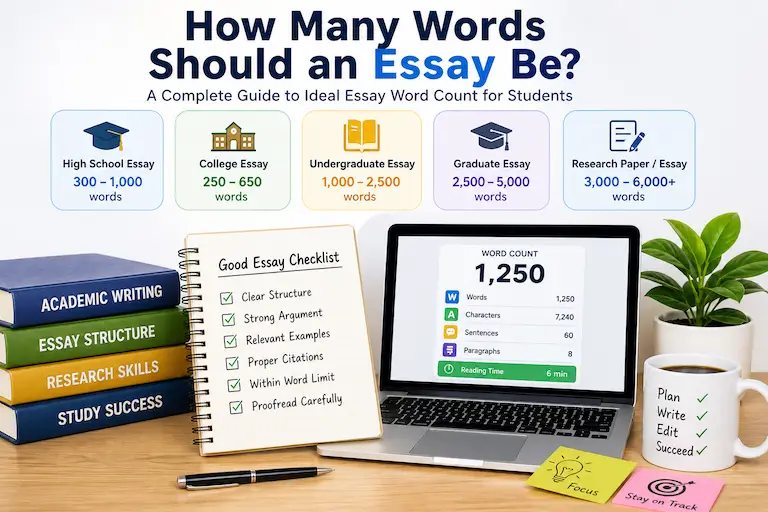
The following ranges are general examples, not universal requirements:
- Short school or classroom essays: often a few hundred words
- College assignments: commonly range from several hundred to a few thousand words
- University essays: may range from around 1,000 to several thousand words
- Research papers: can be several thousand words or more, depending on the assignment
These examples show why there is no single “ideal” essay length. Your assignment instructions should always take priority over a general range.
For more detail about essay length at different educational stages, read Average Essay Length for High School & College Students.
Essay Word Count Examples for Common Assignments
The following examples illustrate how assignment length can vary. They are not fixed academic standards; your instructor’s stated requirement should always take precedence.
| Assignment Type | Illustrative Length |
|---|---|
| Short Classroom Essay | 300–500 words |
| Standard Essay | 500–1,000 words |
| College Essay | 1,000–1,500 words |
| Research Essay | 1,500–3,000 words |
| Long Research Assignment | 2,000+ words |
These examples are useful for understanding relative essay length, but they should not replace the requirements given for your particular assignment.
Hard Limit, Target Range or Guideline? How to Read Your Word Count
Two assignments can both mention “1,000 words” and mean different things. Before you plan anything, work out which kind of instruction you have been given.
| What the brief says | What it usually means | What to do |
|---|---|---|
| “Maximum 1,000 words” or “no more than 1,000” | A ceiling. Going over may be penalised or, in an online form, may be cut off. | Finish under it, and ask whether any margin is allowed. |
| “800–1,000 words” | A target range. | Land inside the range. You do not need to reach the top number if your argument is complete. |
| “About 1,000 words” | An approximate target. | Stay close to it and ask your instructor how much difference is acceptable. |
| “Minimum 250 words” | A floor. The IELTS Writing Task 2 instructions, for example, ask for at least 250 words. | Reach it with developed ideas, not filler. |
| “3–4 pages” | The length is given in pages, not words. | Font size, line spacing and margins change how many words fit, so convert carefully. |
Margins differ a lot between institutions. One University of Warwick department allows a penalty-free margin of up to 10% over or under the stated length. The Australian National University’s College of Arts and Social Sciences does not penalise the first 10% of excess words but applies a penalty after that. A University of Manchester faculty handbook calls its limit an absolute maximum with no 10% leeway. Do not assume a margin exists unless your brief says so.
Online application forms can also enforce limits automatically. The Common App personal essay, for example, is set at 250 to 650 words (see the current Common App essay prompts), so write in a word processor first and check the count again after you paste. Last checked: October 2026.
What Counts Toward the Essay Word Count?
Whether quotations, footnotes, headings and reference lists count depends on the institution. The same essay can be under the limit under one policy and over it under another. The three policies linked above show how much the rules differ:
| Policy | Counted | Not counted | Margin |
|---|---|---|---|
| University of Warwick, English department MA handbook | Quotations and footnotes | Bibliography | Up to 10% over or under, with no penalty |
| Australian National University, College of Arts and Social Sciences | The main text (the policy lists only what is excluded) | Bibliographies, footnotes and endnotes | First 10% of excess words not penalised, then a 10% penalty |
| University of Manchester, a faculty handbook (2019–20 edition) | Footnotes and endnotes, in-text references, quotations, captions and headings | The main document title and the bibliography | None: the limit is an absolute maximum |
These are examples of how rules differ, not rules for your school. Policies last checked: October 2026.
The practical lesson is simple: before you finalize your count, find out whether your instructor counts quotations, footnotes, headings and references, and whether any margin is allowed. If the brief does not say, ask.
Essay Word Count by Academic Level
High School Essays
High school essays often focus on developing clear ideas, organized paragraphs, appropriate evidence, and basic analysis. Some assignments may be only a few hundred words, while others can require 1,000 words or more.
At this level, the assignment instructions are more useful than a general word-count range because requirements can vary by subject and teacher.
College Essays
College assignments can vary considerably. A short response may require only several hundred words, while a longer analytical or research assignment may require 1,000 words or more.
College writing generally requires students to develop claims with appropriate explanation and evidence rather than simply reaching a particular number of words.
University Essays
University essays can be longer because assignments may require more detailed research, analysis, comparison, and evaluation. However, the required length still depends on the course and assignment.
At this level, understanding the assignment prompt is particularly important because the required task determines how much evidence and analysis you need to develop.
Essay Length by Essay Type
Essay type also affects how much writing may be required. Different assignments ask you to perform different kinds of work, so their word counts can vary.
Argumentative Essays
Argumentative essays require a clear position, supporting evidence, explanation, and analysis. A longer assignment may also require consideration of alternative viewpoints or counterarguments.
There is no universal word count for an argumentative essay. Follow the length specified by your instructor.
Descriptive Essays
Descriptive essays focus on details that help readers understand a person, place, object, or experience. The required length depends on how much description the assignment asks you to provide.
Narrative Essays
Narrative essays tell a story or describe an experience. Their length depends on the scope of the story and the assignment requirements.
Expository Essays
Expository essays explain a topic using organized information and analysis. A longer assignment may allow more evidence and explanation, but the required word count is determined by the assignment.
Factors That Affect Essay Word Count
There is no single answer to how many words should an essay be because several factors affect the appropriate length.
- Assignment requirements: Follow the stated minimum, maximum, or target range.
- Essay type: Different assignments require different types of development.
- Topic complexity: Some topics require more context, evidence, and analysis.
- Academic level: Higher-level assignments may require more developed research and reasoning.
- Purpose: The purpose of the assignment determines what needs to be explained and supported.
Harvard College Writing Center guidance emphasizes reading the assignment prompt carefully because the task, scope, and expected type of thinking determine what your paper needs to accomplish.
Best Strategy to Reach the Required Essay Word Count
The best way to manage essay length is to plan your argument before writing. A clear outline helps you decide which ideas need evidence, explanation, and analysis.
- Identify the assignment question.
- Develop a clear thesis or central argument.
- List the main points needed to support that argument.
- Decide what evidence or examples each section needs.
- Allocate enough space for development without forcing every section into an identical length.
Harvard College Writing Center recommends using your thesis and main claims to help determine the points you need to develop in the essay rather than treating paragraph or word counts as a rigid formula.
Sample Word Budgets for Common Targets
Once you know your target, turn it into a rough plan. The budgets below are examples for planning, not rules, and a real essay may need a different balance. In each one, the introduction and conclusion take roughly 10–15% of the total each, and the rest is shared between your main points.
| Target | Introduction | Main points | Conclusion |
|---|---|---|---|
| 500 words | about 70 | 3 points × about 120 | about 70 |
| 1,000 words | about 100 | 4 points × about 200 | about 100 |
| 1,500 words | about 150 | 4 points × about 300 | about 150 |
| 2,000 words | about 200 | 5 points × about 320 | about 200 |
Check your progress as you draft. In the 1,000-word plan, you should be near 500 words after your second main point (100 + 200 + 200). If you are already at 700, you know that about 200 words need to go, and you can fix it now instead of at the end.
For help deciding how long each paragraph should be, see How Many Sentences Are in a Paragraph?
Examples of Essay Word Count for Different Topics
Understanding how many words should an essay be also depends on how much the topic needs to be developed.
A short classroom essay explaining a straightforward topic may need only a few hundred words. A research-based essay on the same broad subject could require substantially more space because it may involve multiple sources, evidence, analysis, and counterarguments.
Here is one question, “Should schools start later in the morning?”, shown at three lengths. This is an illustration of scope, not a standard:
| Length | What fits in the space |
|---|---|
| About 400 words | One clear position, two reasons with a short example for each, and a brief conclusion. |
| About 1,000 words | Three or four reasons with evidence for each, one counterargument answered, and a conclusion that says why the position matters. |
| About 2,500 words | Several sources compared, counterarguments developed in detail, and a discussion of what the evidence cannot prove. |
The important point is that topic complexity can influence how much explanation you provide, but the assignment instructions still determine the required length.
What to Do If Your Assignment Gives No Word Count
Sometimes the prompt gives no length at all. Work through these steps in order:
- Check the syllabus, the grading rubric and the assignment page. Length is often listed there instead of in the prompt.
- Look for a page count. If you find one, see 250 Words Is How Many Pages? to convert it into words.
- Ask your instructor. A short question is enough: “Is there a target length or range for this essay, and do references and quotations count toward it?”
- If you cannot ask, use the examples table earlier on this page as a starting guess. Plan the points your prompt requires first, and let the answer decide the length.
Need to Check Your Essay Word Count?
Before adding or removing material, check the actual word count against the requirement provided by your instructor. This prevents you from guessing how much content you need.
Use the Word Counter for Essays to check your current word count and confirm the final count after editing.
How to Stay Within the Word Limit
Many students struggle to stay within a required limit after completing their first draft. The goal is not to remove useful information randomly, but to make the writing more focused.
If You Are Over the Limit
- Avoid repeating the same idea.
- Remove information that does not answer the assignment question.
- Use clear and direct sentences.
- Keep evidence that directly supports your argument.
- Edit unnecessary phrases and explanations.
Before (23 words): Due to the fact that many students have part-time jobs, it is often the case that they have less time available for studying.
After (13 words): Many students have part-time jobs, so they often have less time for studying.
The idea is the same, and one edit saved 10 words. For a full step-by-step cutting process, read How to Reduce Word Count in an Essay.
If You Are Under the Minimum
- Check that you have answered every part of the prompt.
- Add evidence or an example wherever a claim is thin.
- Explain why each piece of evidence matters to your point.
- Address a likely counterargument if the assignment allows it.
For ways to add useful content instead of filler, read How to Increase Word Count Without Fluff.
How to Check Essay Word Count Accurately
Checking your essay’s word count helps you compare the draft with the assignment requirement before submission.
The Word Counter for Essays lets you review the length of your draft without manually counting every word.
- Word count
- Character count
- Sentence count
- Paragraph count
- Estimated reading time
These measurements can help during editing, but the assignment’s stated word-count rule should remain your main reference.
Why Two Word Counts Can Disagree
- Decide what counts first. Quotations, footnotes, headings and references are treated differently by different institutions (see the table above).
- Check Word’s setting. In Microsoft Word, open Review > Word Count. The box has a checkbox called “Include textboxes, footnotes and endnotes”, and ticking or unticking it changes the total. Sussex IT Services explains the setting.
- Programs count differently. A University of Liverpool guide compares how Word, Google Docs, SpeedGrader and Turnitin handle text boxes and footnotes. The Manchester policy linked above notes that automatic counts can differ slightly and names the Word count it treats as official.
- Count again after pasting. If you paste your essay into a form or learning platform, check the count shown there too.
Review Sentence Length and Essay Structure
Word count alone does not tell you whether an essay is well balanced. After checking the total length, review how your sentences and paragraphs are distributed. A section with very long sentences may need editing, while a section with very short sentences may need more explanation.
The Sentence Counter shows how many sentences your draft contains, which gives you another measurement to consider while editing.
Use sentence count as an editing signal rather than a target. Good academic writing does not require every paragraph or section to contain the same number of sentences.
Check Reading Time After Finalizing Your Essay
Word count tells you how much text an essay contains, while reading time provides an estimate of how long that text may take to read. This can be useful when reviewing a completed essay, presentation script, reflection, or other text where pacing matters.
Use the Reading Time Calculator once you have a reasonably complete draft. It is a secondary check and does not replace the assignment’s required word count.
For example, if two drafts have similar word counts but one takes noticeably longer to read, you may want to review sentence length, paragraph structure, or unnecessary wording.
Clean Extra Spacing Before Submission
After several rounds of copying, pasting, and editing, an essay can contain accidental double spaces, repeated gaps, or unwanted blank lines. These issues do not determine the required essay word count, but cleaning them can make the final text more consistent and easier to format.
The Remove Extra Spaces tool can clean copied or edited text before you prepare the final version of an essay.
Use it as a final formatting step after your content and word count are already settled.
External Writing Resources
For additional academic writing guidance, these authoritative resources can help:
- Harvard College Writing Center — guidance on reading and understanding assignment prompts.
- Harvard College Writing Center: Tips for Organizing Your Essay — guidance on developing and organizing an essay argument.
- Purdue Online Writing Lab (OWL) — general writing and academic writing resources.
Common Mistakes Students Make With Essay Word Count
- Assuming every essay has the same ideal length.
- Ignoring the specific assignment instructions.
- Focusing on page count instead of the stated word count.
- Adding filler simply to reach a target.
- Removing useful evidence just to shorten an essay.
- Repeating ideas instead of developing them.
- Counting quotations, footnotes or references differently from your instructor.
- Assuming a 10% margin is always allowed.
The best approach is to treat word count as one requirement within the larger goal of answering the assignment effectively.
What Happens If Your Essay Is Too Short or Too Long?
If your essay is too short, you may not have enough space to fully answer the question or develop your evidence and analysis.
If your essay is too long, you may need to remove repetition, unnecessary background information, or material that does not directly support the assignment.
The consequences of being above or below the stated word count depend on the assignment policy. Check the instructions rather than assuming that a particular variation will always be accepted.
Final Thoughts
So, how many words should an essay be? There is no universal answer. The appropriate length depends on your assignment, academic level, essay type, topic, and the amount of explanation and analysis required.
Instead of relying on a generic number, read the assignment instructions carefully and use the stated word count as your primary target. Then plan your argument so that the available space is used for relevant evidence, explanation, and analysis.
When your draft is complete, use the Word Counter for Essays to confirm that the final version meets the required length.
FAQs
How Many Words Should a 5-Paragraph Essay Be?
A five-paragraph essay does not have one universal word count. Its length depends on the assignment. The important point is to develop the introduction, body paragraphs, and conclusion enough to answer the question properly while following the stated limit. As a planning example, the 500-word budget above splits into an introduction of about 70 words, three body paragraphs of about 120 words each, and a conclusion of about 70 words.
Is 1,000 Words Enough for an Essay?
It can be enough for some assignments, but not for all. A 1,000-word requirement may be appropriate for one essay while another assignment may require 1,500, 2,000, or more words. Always follow the assignment instructions.
What Happens If I Exceed the Word Limit?
The outcome depends on the assignment policy. Some instructors or institutions may apply a penalty, while others may use a different approach. In the published policies compared above, the result ranged from no penalty within a 10% margin to marks deducted for any excess. Check the instructions for your specific assignment.
How Many Words Should a 500-Word Essay Actually Contain?
If an assignment specifies 500 words, aim for the stated target unless your instructor provides a permitted range. Do not assume that a universal 10% rule applies to every institution or course.
How Can I Stay Within the Word Limit?
Plan your essay, edit carefully, and use a Word Counter for Essays to check the final length.
Do Quotes and References Count Toward the Word Count?
It depends on the institution. In the three policies compared above, quotations were counted at Warwick and Manchester, footnotes and endnotes were excluded at ANU, and the bibliography was excluded at all three. Check your own brief, and ask your instructor if it does not say.
What If My Assignment Gives No Word Count?
Check the syllabus and rubric, look for a page count, and ask your instructor. If you cannot ask, plan the points the prompt requires and use the examples table on this page as a starting guess.
How Many Pages Is a 1,000-Word Essay?
It depends on font size, line spacing and margins. With typical typed, double-spaced formatting, 1,000 words usually comes to roughly 3 to 4 pages (QuillBot’s essay-length guide puts a 500–1,000-word essay at about 2 to 4 pages). For more conversions, see 250 Words Is How Many Pages?