
Average Essay Length for High School & College Students (Complete 2026 Guide)
One of the most common questions students ask before starting an assignment is: What is the average essay length?
Whether you are studying in the USA, UK, Canada, or Australia, the appropriate essay length depends on your grade level, subject, assignment type, and the instructions provided by your teacher or institution. A word count is a planning guideline, not a universal rule for every essay.
Teachers and professors set word limits to help define the scope of an assignment. Staying within the required range can help you focus your argument, develop your ideas appropriately, and avoid unnecessary repetition.
For planning purposes, an essay word limit can be useful when estimating how much space you have to develop your ideas. The appropriate word count for an essay depends on the grade level, subject, assignment type, and specific instructions.
Quick answer: published guides commonly describe a high school essay as roughly 300 to 1,000 words, an undergraduate essay as roughly 1,500 to 5,000 words, and a graduate school essay as roughly 2,500 to 6,000 words. Those are averages for planning, not rules. If your assignment gives a number or a range, that number replaces every average on this page. (Source: ClimbTheLadder’s typical word counts by type. Last checked: October 2026.)
In this guide, you will learn:
- Typical essay-length ranges by academic level
- Common high school and college essay lengths
- Typical lengths for graduate essays, applications and exams
- How assignment type affects word count
- Why there is no universal average essay length
- How to turn an average into a word plan for your own essay
- How to stay within a required word limit
- Common essay-length mistakes
- Tools that can help you check and edit your essay
Why Essay Length Matters
Essay length is not simply about reaching a particular number of words. A useful word limit gives you enough space to develop the ideas required by the assignment while encouraging you to remain focused.
- Stay organized
- Develop arguments with appropriate detail
- Support important points with evidence
- Avoid unnecessary repetition
- Meet the assignment requirements
Going substantially below a required word count can leave important ideas underdeveloped, while going substantially over a limit can make it harder to stay focused. The effect depends on the assignment and the instructions provided by the instructor.
If you want to monitor your essay length while drafting, use the Word Counter for Essays.
For another perspective on assignment length, including how to read a word limit, what counts toward it and how institutions handle going over, see our guide to How Many Words Should an Essay Be?.
Average Essay Length for High School Students
The average essay length for high school students varies by grade, subject, assignment type, and school requirements. There is no single word count that applies to every high school essay.
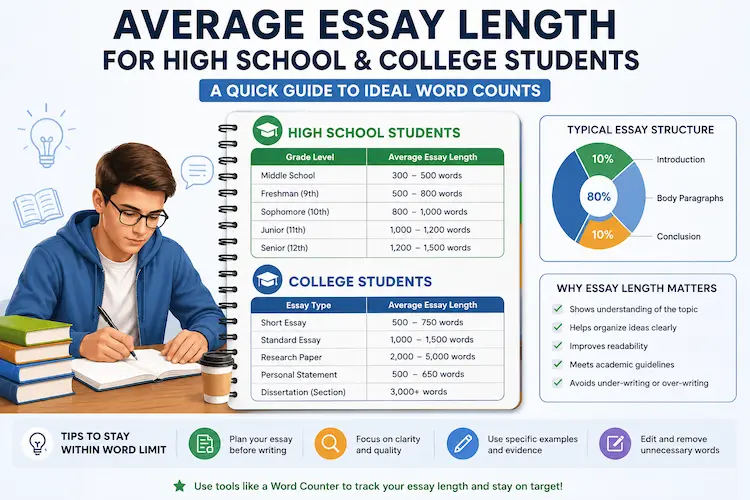
As a general planning guide, students may encounter ranges such as these:
| Academic Level | Common Planning Range |
|---|---|
| Middle School | 300–500 words |
| Early High School | 500–800 words |
| Upper High School | 800–1,500 words |
These ranges are estimates for planning purposes, not universal academic standards. A specific assignment may require considerably fewer or more words.
You will also see slightly different ranges in other guides. Some put the typical high school essay nearer 300 to 1,000 words, as in the quick answer above, while the upper end here allows for longer research-style assignments. The difference is a good reminder that the average is only a starting point.
Narrative Essays
Narrative essays focus on storytelling, experiences, or events. They may be relatively short when the assignment asks students to focus on a specific experience rather than develop an extended argument.
Argumentative Essays
Argumentative essays often require more space because students need to present a claim, explain their reasoning, and support their position with relevant evidence.
Research Essays
Research-based assignments can be substantially longer when students are expected to examine multiple sources, develop an argument, and provide detailed analysis.
Average Essay Length for College Students
The average college essay length also varies considerably. University assignments are often longer than short school responses because some courses require deeper analysis, evidence, and engagement with sources.
Common planning ranges may look like this:
| Assignment Type | Possible Word-Count Range |
|---|---|
| Short academic response | 500–750 words |
| Standard academic essay | 1,000–1,500 words |
| Longer research assignment | 2,000–5,000+ words |
| Application essay | Depends on the application |
These figures should not be treated as universal college standards. Your course syllabus, assignment prompt, department, instructor, or application instructions should take priority.
For example, the Common Application’s first-year personal essay currently has a maximum of 650 words. That is an application-specific requirement rather than a general rule for college essays. Check the current Common App essay prompts.
Average Essay Length for Graduate Students and Applications
Graduate-level writing is usually longer and more detailed than undergraduate coursework, but application essays go the other way. The two are very different kinds of writing, so they should not share one average.
| Type of writing | Commonly quoted range | Note |
|---|---|---|
| Graduate school essay | about 2,500–6,000 words | A general figure. Your syllabus sets the real length. |
| Graduate school admission essay | about 500–1,000 words | Programs usually state their own limit, so look for it in the application. |
| Undergraduate admission essay (Common App) | 250–650 words | A 650-word maximum and a 250-word minimum are reported for the 2026–27 cycle. |
Sources: ClimbTheLadder for the graduate ranges, and Cognito’s Common App 2026–27 summary for the Common App figures. Last checked: October 2026. Because application rules can change each year, confirm the limit on the application itself before you finalize your essay.
Theses and dissertations are a different category again. They are measured by program rules, usually in the thousands or tens of thousands of words, so check your department handbook instead of using an essay average.
Minimum Word Counts in Exams: The IELTS Example
Some tests set a minimum rather than a maximum. In IELTS Writing, Task 1 asks for at least 150 words and Task 2 asks for at least 250 words (IELTS General Training writing format). Last checked: October 2026.
A minimum is a floor, not a target. Since an exam has a time limit, a very long answer can leave you short of time to check your work, so aim to cover the task fully rather than to write as much as possible. Check the official test instructions for the exact test you are taking.
How Long Should an Essay Be?
Many students want a quick estimate of appropriate essay length. In practice, the required length depends on several factors:
- Academic level
- Subject requirements
- Assignment instructions
- Essay type
- Research requirements
- Instructor expectations
A common planning approach is to divide the available words between the introduction, body, and conclusion. However, the exact balance should follow the needs of the argument rather than a rigid percentage.
There is no universal essay word limit that applies to every assignment. If your prompt gives a minimum, maximum, or target range, that requirement should take priority over a general average.
For example, in a 1,200-word essay, you might reserve roughly 100–150 words for the introduction, use most of the remaining words for the main argument and evidence, and finish with a concise conclusion.
Harvard’s Writing Center similarly emphasizes that essay structure should be shaped by the argument and the connections between ideas rather than by a fixed paragraph formula. See Harvard’s guidance on organizing an essay.
Worked Example: Turning an Average Into a Plan
Suppose your assignment says “about 1,200 words” and you have three main points to make. One possible plan, which is an illustration and not a rule, looks like this:
| Part of the essay | Words | Running total |
|---|---|---|
| Introduction | 120 | 120 |
| Main point 1 | 320 | 440 |
| Main point 2 | 320 | 760 |
| Main point 3 | 320 | 1,080 |
| Conclusion | 120 | 1,200 |
The running total is the useful part. If your draft reaches 760 words after two main points, you are on plan. If it is already at 900, you know early that point 3 and the conclusion will not fit, and you can tighten now instead of cutting at the end. One published guide puts a typical essay paragraph at about 150 to 250 words (QuillBot’s essay-length guide), so a 320-word point would normally be split into two paragraphs. For more on paragraph size, see How Many Sentences Are in a Paragraph?
Average Essay Length Standards in Different Countries
Students in the USA, UK, Canada, and Australia may encounter different assignment requirements. However, it is not accurate to assign one universal essay length to an entire country.
USA
Schools and colleges in the USA use different word-count requirements depending on the course, assignment, and institution. Application essays may also have separate limits, such as the current Common App personal essay maximum.
UK
UK university assignments commonly emphasize critical analysis, evidence, and appropriate academic referencing. The required word count is set by the individual course or assignment rather than by a single national standard.
Canada
Canadian students can encounter a wide range of essay requirements across schools, colleges, and universities. The assignment instructions should be used to determine the required length.
Australia
Australian students also encounter different requirements depending on the institution, course, and assessment. Research depth and assignment instructions generally matter more than a country-wide word-count rule.
If you are studying internationally, always check the specific assignment brief instead of relying on a country-wide estimate.
Even inside one country, institutions differ on what happens at the limit. For example, the Australian National University’s College of Arts and Social Sciences does not penalise the first 10% of excess words, while a University of Manchester faculty handbook calls its limit an absolute maximum with no 10% leeway. These are two examples, not national rules. Last checked: October 2026. We compare more of these policies in How Many Words Should an Essay Be?
Average Essay Length in Pages
Some assignments give a page count instead of a word count. A common rough rule for typed, double-spaced text is about 300 words per page (QuillBot’s essay-length guide uses the same estimate), which means pages ≈ words ÷ 300. For example, a 1,200-word essay comes to about 4 pages (1,200 ÷ 300). Font size, line spacing and margins change this, so treat it as an estimate and ask your instructor if the difference matters.
For a closer conversion, read 250 Words Is How Many Pages?
What Happens If Your Essay Is Too Short?
Writing substantially below the required word count can make it difficult to develop all the ideas an assignment expects.
Weak Arguments
A short essay may not leave enough room to explain claims, provide evidence, or develop the reasoning behind an argument.
Incomplete Analysis
Important explanations or examples may be missing when too little space is given to the central ideas.
Insufficient Development
A very short response may address the topic without developing it to the level required by the assignment.
If your draft is below the required length, read How to Increase Word Count Without Fluff for ways to add useful explanation instead of filler.
You can also use the Sentence Counter to review sentence distribution while editing a short essay.
What Happens If Your Essay Is Too Long?
A longer essay is not automatically a stronger essay. If you exceed a required limit, the extra material may include repetition, unnecessary explanation, or ideas that are outside the assignment’s scope.
- Repetition
- Weak organization
- Less focused arguments
- Unnecessary background information
- Difficulty meeting the required limit
Before submitting an essay, review the assignment instructions and remove material that does not contribute to your argument or answer the prompt.
If your draft exceeds the stated limit, focus on removing repetition and unnecessary wording while keeping evidence and analysis that directly support your argument.
If your essay is over the assigned limit, read How to Reduce Word Count in an Essay.
You can also clean accidental spacing problems with the Remove Extra Spaces tool before checking your final draft.
Best Ways to Reach the Ideal Essay Length Naturally
If your essay needs more words, the goal should be stronger development rather than filler. Harvard’s Writing Center recommends organizing an essay around the development of its argument and using paragraphs to move the reader through that argument. See Harvard’s guidance on effective body paragraphs.
When an assignment requires a longer essay, add relevant evidence, examples, explanation, or analysis rather than repeating the same point. See How to Increase Word Count Without Fluff for practical ways to develop a draft.
Add Better Examples
Use relevant examples, evidence, or specific details when they genuinely support your argument.
Expand Your Analysis
Do not simply state a fact. Explain its significance and connect it to the main point of your paragraph.
Thin: Many students work part time. This affects their studies.
Developed: Many students work part time. This affects their studies because the hours they spend at work are hours they cannot spend reading or revising, so assignments are often finished closer to the deadline.
The second version adds a reason and a consequence, so the extra words carry meaning. That is the difference between expanding an idea and padding it.
Improve Topic Sentences
A clear topic sentence helps readers understand the purpose of each paragraph and keeps the discussion focused.
Use Clear Transitions
Transitions can help connect related ideas and make the progression of an argument easier to follow.
- However
- In addition
- Therefore
- As a result
Edit Carefully
Good editing removes unnecessary repetition while preserving useful explanation and evidence.
Use the Word Counter for Essays during editing to see whether your draft remains within the required range.
Common Essay Length Mistakes Students Make
Essay-length problems are often caused by planning and editing mistakes rather than by an inability to write.
Ignoring Assignment Instructions
Always check the required word count, permitted range, formatting rules, and other instructions before writing.
Treating an Average as a Requirement
An average describes what is common, not what is required. If your assignment says 800 words, an average of 1,000 from a website does not change it.
Writing Without an Outline
A simple outline can help you decide how much space each major point deserves and reduce unnecessary repetition.
Adding Fluff
Adding words without adding useful meaning can make an essay less focused. Expand ideas through evidence and analysis instead.
If a draft is too long, remove repetition and unnecessary wording while preserving useful evidence and explanation. See How to Reduce Word Count in an Essay for practical editing techniques.
Poor Time Management
Leaving all writing and editing until the deadline can make it harder to identify sections that need expansion or trimming.
You can also estimate how long your finished essay may take to read with a Reading Time Calculator.
Helpful Academic Writing Resources
For additional guidance on essay structure and academic writing, these resources are useful starting points:
- Purdue Online Writing Lab (OWL) — writing, research, citation, and academic-style resources.
- Harvard College Writing Center — guidance on thesis statements, introductions, paragraphs, organization, and conclusions.
- Common App Essay Prompts — current first-year application essay prompts and requirements.
Use the resource that matches your specific task rather than assuming that one general essay-length rule applies to every assignment.
Quick Essay Length Checklist
Before submitting your essay, check the following:
- Is the essay within the required word-count range?
- Do you know whether quotations, footnotes and references count toward the limit?
- Does the introduction establish the topic and purpose clearly?
- Are the body paragraphs focused and sufficiently developed?
- Does the evidence support the main argument?
- Is the conclusion appropriate for the assignment?
- Have grammar, spelling, spacing, and formatting issues been corrected?
Use the Word Counter for Essays for a final word-count check before submission.
Final Thoughts
Understanding the average essay length can help students plan their assignments, but there is no single word count that is correct for every essay.
The appropriate length depends on your academic level, subject, assignment type, research requirements, and—most importantly—the instructions provided by your teacher, professor, institution, or application.
Whether you are writing a high school assignment in the USA, a university essay in the UK, or an academic paper in Canada or Australia, focus on meeting the specific requirement rather than trying to reach a generic target.
If you are comparing different assignment lengths, you may also find these guides useful:
Try Our Free Essay Word Counter
If you already have a draft, use the Word Counter for Essays to check its length before submission.
It can help you:
- Check the number of words
- Monitor an assignment word limit
- Compare your draft with the required range
- Review your essay before submission
FAQs About Average Essay Length
What Should I Do If I Am Over the Essay Word Limit?
First, check whether the assignment has a strict maximum or allows a small margin. If you need to reduce the word count, remove repetition and unnecessary wording while preserving the evidence and analysis that support your main argument. See How to Reduce Word Count in an Essay for more detailed strategies.
How Do You Increase Word Count Without Fluff?
Increase word count by developing ideas that are already relevant to your argument. Add specific evidence, examples, explanation, or analysis instead of repeating points. For more techniques, see How to Increase Word Count Without Fluff.
How Much Can I Cut From an Essay Without Losing Substance?
There is no universal percentage that can be cut safely. Review each sentence for repetition, unnecessary wording, and material that does not support the assignment. Keep evidence, explanation, and analysis that contribute directly to your main argument.
What Is the Average Essay Length for High School Students?
The average essay length for high school students varies by grade, subject, and assignment. A short assignment may be a few hundred words, while more developed essays can reach 1,000 words or more. Always follow the specific requirement provided by your school or teacher.
What Is the Average Essay Length for College Students?
The average essay length for college students varies widely. Short responses may be around 500 words, while standard academic assignments may require 1,000–1,500 words or more. The assignment instructions should determine your target.
How Long Should a 5-Paragraph Essay Be?
A five-paragraph structure does not have one mandatory word count. The appropriate length depends on the assignment and how much explanation and evidence each point requires.
Why Is Average Essay Length Important?
The average essay length is useful as a planning reference, but the required word count for your specific assignment is more important. Meeting the stated requirement helps you understand the expected scope of the task.
Can I Exceed the Required Essay Length?
Do not assume that a specific percentage, such as 10%, is always acceptable. Some instructors allow a small margin while others enforce a strict limit. Check the assignment instructions or ask your instructor before exceeding the stated word count.
Which Tool Is Best for Checking Essay Length?
A Word Counter for Essays is the most directly relevant tool for checking whether your essay meets a required word count.
What Is the Average Length of a Graduate School Essay?
It depends on what kind of essay it is. Published guides commonly quote about 2,500 to 6,000 words for graduate school essays and about 500 to 1,000 words for graduate admission essays. Your syllabus or the program’s application instructions should decide.
How Many Words Should an IELTS Essay Be?
IELTS Writing Task 2 asks for at least 250 words, and Task 1 asks for at least 150 words. These are minimums, so check the official instructions for your test type.
Do Quotes, Footnotes and References Count Toward the Essay Length?
It depends on the institution and the assignment brief. Some count quotations and footnotes and leave out the bibliography; others differ. We compare several real policies in How Many Words Should an Essay Be? If your brief does not say, ask your instructor.
How Many Pages Is the Average Essay?
As a rough guide for typed, double-spaced text, divide the word count by about 300. A 1,200-word essay is about 4 pages. The result changes with font, spacing and margins.