
How Reading Time Improves Blog Engagement
7 Powerful Ways: How Reading Time Improves Blog Engagement
How Reading Time Improves Blog Engagement is a useful topic for bloggers, SEO specialists, writers, and content marketers who want to make article length clearer to readers. Whether you publish content for readers in the United States, United Kingdom, Canada, Australia, or other English-speaking markets, displaying an estimated reading time can help visitors understand the time commitment before they begin.
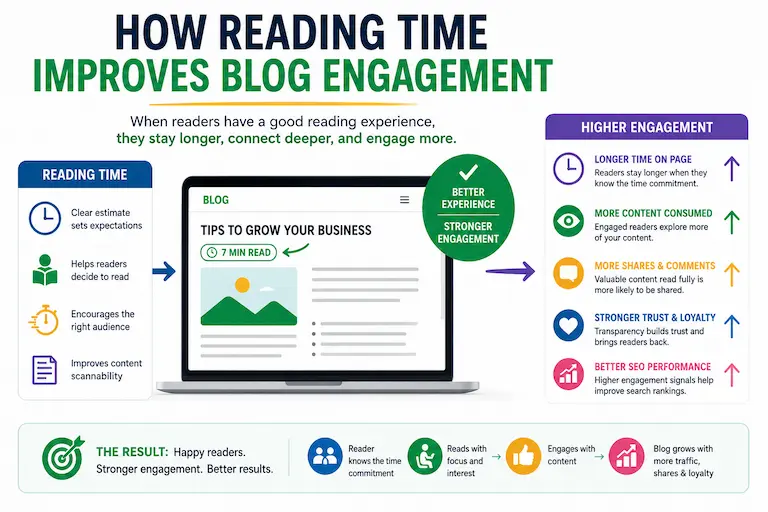
When readers see a label such as “5 min read” near the beginning of an article, they can quickly estimate how much time they may need. This simple information can reduce uncertainty and help readers decide whether the article fits their available time.
Medium displays estimated read time on its stories, while research from the Nielsen Norman Group shows that people commonly scan web content rather than reading every word. These ideas make clear content structure and expectations useful parts of the reading experience.
For additional guidance, see the Medium Help Center’s explanation of read time and the Nielsen Norman Group’s research on how users read on the web.
What Does Reading Time Mean?
Reading time is an estimate of how long an average reader may need to read an article from beginning to end.
A reading-time estimate commonly depends on:
- Total word count
- Estimated reading speed
- Content complexity
- Visual elements, depending on the calculation method
Reading speed varies from person to person, so a displayed reading time should be treated as an estimate rather than an exact prediction.
For example, a 1,000-word article may take around 4–5 minutes to read at approximately 200–250 words per minute, while a technical article with the same word count may take longer to process.
How Reading Time Improves Blog Engagement
The value of displaying reading time comes mainly from giving readers useful information before they commit to an article. It can support a clearer reading experience without guaranteeing that every visitor will read to the end.
Builds Reader Trust
A visible reading-time estimate sets a clear expectation about article length. Readers can decide whether the content fits the amount of time they currently have available.
Reduces Uncertainty
Knowing that an article takes approximately two, five, or ten minutes to read gives visitors useful context before they start.
Supports Content Completion
A clear time estimate can help readers decide whether they have enough time to begin and continue an article. It should be viewed as a helpful planning cue rather than a guarantee of completion.
Helps Readers on Mobile Devices
Mobile readers often consume content in shorter sessions. A visible reading-time estimate can help them judge whether an article is suitable for the time available.
Makes Long-Form Content Easier to Evaluate
A reading-time label gives readers immediate context when an article is several minutes long, making the expected commitment easier to understand.
Want to check your own article’s estimated reading time?
Why Reading Time Matters for SEO
Reading time should not be treated as a direct Google ranking factor. Google does not publish a required reading-time target or preferred article length for ranking pages.
Instead, reading time can be used as a content-planning and user-experience measure. A useful article should match the searcher’s intent, provide the necessary information, and remain easy to read and navigate.
- Match the reader’s search intent.
- Provide enough detail to answer the question properly.
- Use clear headings and concise paragraphs.
- Avoid unnecessary repetition.
- Make important information easy to find.
Google’s guidance specifically advises creators not to write to a particular word count simply because they believe Google has a preferred length. The same principle applies to reading time: focus on satisfying the reader rather than chasing a particular number.
For a deeper look at recommended article length and reading time, see Ideal Blog Post Reading Time for SEO.
Psychological Benefits of Displaying Reading Time
Removes Uncertainty
Readers can make a more informed decision when they know approximately how long an article may take to read.
Creates a Manageable Starting Point
A short label such as “4 min read” can make the time commitment easier to understand before a reader starts.
Provides Useful Context
Reading time gives readers another way to evaluate an article alongside its title, topic, and introduction.
Reading time is also useful for converting words to time and estimating words to minutes when planning an article. If you know the total word count and an estimated reading speed, you can use the calculation to predict the approximate time a reader may need.
Supports Reader Decision-Making
Readers can choose shorter or longer content according to the amount of time they have available.
How Reading Time Improves Blog Engagement on Mobile
Mobile users may read during short breaks or between other activities. A reading-time label gives them a quick indication of the expected length.
- 2 min read – quick tip
- 5 min read – detailed article
- 10 min read – in-depth guide
These labels do not guarantee higher engagement, but they provide useful information that can make the reading experience more predictable.
Reading Time and Word Count
| Word Count | Estimated Reading Time* |
|---|---|
| 300 words | 1–2 minutes |
| 600 words | 2–3 minutes |
| 1,000 words | 4–5 minutes |
| 1,500 words | 6–8 minutes |
| 2,000 words | 8–10 minutes |
| 3,000 words | 12–15 minutes |
*These are approximate planning estimates based on roughly 200–250 words per minute. Actual reading time varies by reader and content complexity.
This table is a practical example of reading time by word count. The same number of words can produce different estimates when the assumed reading speed changes, so these figures should be treated as planning estimates rather than fixed engagement targets.
Which Content Benefits Most from Reading Time?
Reading-time labels can be particularly useful for content where readers need to understand the expected length before beginning.
- Blog posts
- Tutorials
- Case studies
- Product reviews
- Educational content
- Long-form guides
There is no rule that every article over 500 words must display reading time. The decision should depend on whether the estimate provides useful context for the intended audience.
How to Calculate Reading Time
A simple reading-time formula is:
Reading Time (minutes) ≈ Total Words ÷ Reading Speed
For example, using an estimated reading speed of 250 words per minute:
1,250 ÷ 250 = 5 minutes
The estimated reading time would therefore be approximately 5 minutes. Some platforms use a different reading speed or additional adjustments. For example, Medium states that its own estimate uses roughly 265 WPM and includes an adjustment for images.
If you know your own reading speed, a custom WPM setting can make the estimate more personalized. This is useful when converting word to time for your own audience or planning a specific reading session.
Learn more about that calculation in How Medium Calculates Reading Time.
Best Tools to Optimize Blog Engagement
You do not need every text tool to review reading time and engagement-related content. The most relevant tools are those that directly measure article length or help you review sentence structure.
Reading Time Calculator
The Reading Time Calculator is the primary tool for this topic. Use it to estimate how long your article may take to read and to create a clear reading-time label for your content.
The calculator supports custom WPM as well as preset reading speeds, so you can compare a general estimate with a reading speed that better matches your intended audience.
For another perspective on reading speed by age, see Average Reading Speed by Age.
Word Counter for Essays
Because reading-time estimates depend on word count, the Word Counter for Essays is a strong secondary tool for checking the total number of words before estimating reading time.
Sentence Counter
Reading time does not tell you whether an article is easy to process. The Sentence Counter can help you review sentence structure and identify unusually long or uneven sentence patterns that may affect readability.
How Reading Time Improves Blog Engagement for Different Audiences
Bloggers
Bloggers can use reading-time labels to give visitors clearer expectations about the length of posts and guides.
SEO Professionals
SEO professionals can treat reading time as a useful content and user-experience metric rather than as a direct ranking target.
Students and Writers
Students and writers can use reading-time estimates to understand the approximate length of essays, guides, and other educational content.
Businesses
Businesses can use reading-time labels when publishing detailed product information, educational resources, and long-form guides.
Best Practices for Displaying Reading Time
- Place the estimate near the article title or introduction.
- Use a simple and recognizable format.
- Base the estimate on a consistent reading-speed assumption.
- Update the estimate when the article changes substantially.
- Consider showing word count alongside reading time when useful.
Example:
1,450 words • 6 min read
Common Mistakes to Avoid
Using Inaccurate Word Counts
Verify the total word count before calculating or displaying reading time. The Word Counter for Essays can help you check the count quickly.
Ignoring Complex Content
Technical, academic, or unfamiliar content may take longer to process than simple general-interest writing, even when the word count is identical.
Hiding Reading Time
If you display reading time, place it somewhere readers can find easily, such as near the title or introduction.
Treating Reading Time as a Ranking Target
Do not increase article length simply to create a longer reading-time estimate. The content should be as detailed as necessary to satisfy the reader’s search intent.
What Reading Time Can and Cannot Tell You
Reading time can tell readers approximately how long an article may take to consume, but it cannot predict exactly how every person will behave on the page.
- It can provide a useful estimate of article length.
- It can help readers decide when to start reading.
- It can support clearer content presentation.
- It cannot guarantee article completion.
- It cannot guarantee lower bounce rates or higher rankings.
- It cannot replace analysis of actual user behavior.
Final Thoughts
How Reading Time Improves Blog Engagement comes down to a simple idea: giving readers useful information about article length can make the reading experience more predictable.
A reading-time label can help readers decide whether an article fits their available time, but it should not be presented as a guaranteed way to increase engagement, reduce bounce rate, or improve search rankings.
For blogs serving readers in the United States, United Kingdom, Canada, Australia, and other English-speaking markets, a clear reading-time estimate can be a useful addition when the article is long enough for the time commitment to matter.
Boost Blog Engagement with the Reading Time Calculator
Want to estimate how long your article may take to read?
For a more complete content check, you can also use:
- Word Counter for Essays to verify the total word count.
- Sentence Counter to review sentence and paragraph structure.
Using these tools together can help you review article length and readability before publishing.
FAQs About How Reading Time Improves Blog Engagement
How Reading Time Improves Blog Engagement for SEO?
Reading time can support a clearer user experience by showing readers approximately how long an article may take to read. It is not, however, a direct Google ranking factor or a guarantee of higher search performance.
Does reading time improve blog engagement on mobile devices?
A reading-time label can help mobile readers decide whether an article fits the time they have available. It does not guarantee that they will continue reading or complete the article.
Which tool best supports How Reading Time Improves Blog Engagement?
The Reading Time Calculator is the most directly relevant tool for generating an estimated reading-time label. The Word Counter for Essays and Sentence Counter can support the wider content-review process.
How accurate is reading time?
Reading time is an estimate. It depends on the reading speed used by the calculation and can vary according to the reader, content complexity, and the calculation method used by the platform or tool.
Should every article display reading time?
No. Reading time is most useful when the expected time commitment gives readers meaningful context, particularly for longer guides, tutorials, and educational articles.
How Reading Time Improves Blog Engagement for long-form content?
For long-form content, a reading-time label can help readers understand the approximate commitment before starting. This can make a long article easier to evaluate without promising a specific engagement outcome.