
Average Sentence Length in Academic Writing
9 Powerful Secrets About Average Sentence Length in Academic Writing for Better Grades
Understanding the average sentence length in academic writing is essential for students, researchers, bloggers, and professionals who want to improve readability and achieve better academic results. Whether you are writing essays, dissertations, journal articles, or research papers, sentence length directly affects clarity, engagement, and comprehension.
Many students struggle with overly long or extremely short sentences. Academic writing should sound professional, but it should also remain easy to understand. Finding the right sentence balance makes your work easier to read and easier to assess.
In general, the average sentence length in academic writing ranges between 15 to 25 words per sentence. This range allows writers to explain complex ideas clearly without overwhelming readers.
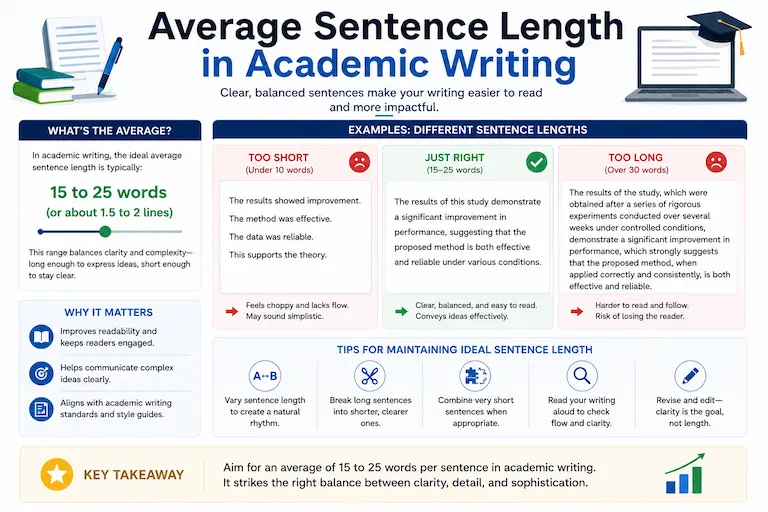
This guide explains the ideal sentence length for academic writing, how to work out your own average, common mistakes, readability strategies, and practical tips for editing your own sentences.
Quick answer:
- Typical average: about 15–20 words per sentence, according to the University of Oxford’s academic writing guidance. Many scholars try to keep single sentences under 25 words.
- In real journals: averages are often higher. One study of 100 education research articles found an average of 24.7 words.
- It is an average, not a limit: a good paragraph mixes short and long sentences.
- To check your own draft: divide your total words by your total sentences. A worked example is below.
Why Sentence Length Matters in Academic Writing
Sentence length affects:
- Readability
- Clarity
- Academic tone
- Reader comprehension
- Reader experience on online academic content
Very long sentences can confuse readers, while very short sentences may sound simplistic or disconnected.
You do not need special software to check this. The Sentence Counter and Word Counter for Essays give you the two numbers you need to work out your own average. The method is explained below.
What Is the Ideal Average Sentence Length in Academic Writing?
Style guides and university writing centres usually suggest:
- 15–20 words for standard academic writing
- 20–25 words for advanced analytical writing
- Shorter sentences for readability
- Longer sentences only when necessary
This range helps maintain a formal tone while ensuring the content remains understandable. There is no universal sentence-length requirement for academic writing; these ranges are practical readability guidelines rather than strict rules. Oxford’s own guidance says the same: there is no hard and fast maximum.
Research-Based Writing Standards
The table below separates what writing guides recommend from what researchers have actually measured in published papers.
| Source | What it reports |
|---|---|
| University of Oxford, academic writing guidance (advice) | The typical average is 15–20 words. Many scholars keep sentences under 25 words. There is no hard and fast maximum. |
| RMIT University (advice) | Guides often cite 15–20 words as the best length for academic writing. The average English sentence is 10–15 words. |
| AJE, a journal editing service (advice) | Saying that shorter is always better is an oversimplification. An average of 20–25 words can work if you still mix long and short sentences. |
| US Office of Personnel Management, plain language (advice for general readers) | Sentence length should average 15–20 words. |
| Deveci, 2019 (measured) | The average was 24.7 words in 100 education research articles. Sentences were longer in the Discussion (26.24) and Literature Review (26.10) sections. |
| arXiv analysis of scientific manuscripts (measured) | Most manuscripts averaged more than 25 words per sentence (28.2 and 26.9 in two author groups). |
Notice the gap. Writing advice points to 15–20 words, but published journal articles often run longer. That is why this guide treats 15–25 words as a working range for an average, and why you should always check your own subject’s style guide.
How to Calculate Average Sentence Length
The formula is simple: average sentence length = total words ÷ total sentences.
- Choose your sample. A full section or your whole essay gives a more reliable average than one paragraph. Leave out the title, headings and reference list so only your own sentences are counted.
- Count the words. Paste the sample into the Word Counter for Essays to get the total.
- Count the sentences. Use the Sentence Counter to get the number of sentences in the same sample.
- Divide. Words divided by sentences is your average.
- Look at the range too. Find your shortest and longest sentences. An average of 16 can hide a 4-word sentence and a 45-word sentence.
Worked Example
Here is a sample paragraph written for this guide:
Peer review is the process by which independent experts evaluate a manuscript before a journal decides whether to publish it. Reviewers check the method, the evidence and the strength of the conclusions, and they often ask the authors to revise unclear sections. This process is slow. However, it remains a widely used way for journals to filter out weak or misleading studies before readers see them.
| Sentence | Words |
|---|---|
| 1. Peer review is the process… | 20 |
| 2. Reviewers check the method… | 22 |
| 3. This process is slow. | 4 |
| 4. However, it remains a widely used way… | 20 |
| Total | 66 words in 4 sentences |
| Average | 66 ÷ 4 = 16.5 words |
The average, 16.5 words, sits inside the typical 15–20 range. The shortest sentence has 4 words and the longest has 22. That mix of lengths is what a good academic paragraph looks like, and the average alone would not show it.
Check It in Microsoft Word
Word can show words per sentence for you. Menu names differ slightly between versions, but the steps are similar:
- On Windows, open File > Options > Proofing. On a Mac, open Word > Preferences > Spelling & Grammar.
- Tick Check grammar with spelling and Show readability statistics, then click OK.
- Go to Review > Spelling & Grammar and finish the check.
- A box appears with counts and averages, including Words per Sentence.
How to Read Your Result
Use this table as a guide, not a set of rules. Your subject, your teacher and your assignment brief come first.
| Your average | What it usually means | What to try |
|---|---|---|
| Under about 12 words | Your writing may sound choppy or simplistic. | Join related short sentences with words like because, although or however. |
| 15–20 words | Typical for essays and clear academic prose. | Keep it, and make sure you still vary the lengths. |
| 20–25 words | Common in research papers and analytical writing. | Check the longest sentences and trim wordy phrases. |
| Over 25 words | Seen in published journal articles, but heavy for readers. | Find the longest sentences first and split them where a new idea begins. |
Oxford’s guidance suggests wrapping up sentences over 20 words at the nearest sensible point, and notes that readers retain less from sentences longer than 25 words.
How Average Sentence Length Affects Readability
Readability refers to how easy a text is to read and understand.
Academic readers prefer:
- Clear sentence structure
- Logical flow
- Concise explanations
- Controlled complexity
Long sentences are harder to understand and place a heavier cognitive load on readers, according to the Australian Government Style Manual.
How Readability Formulas Use Sentence Length
Common readability scores are built from two measurements: average sentence length (ASL) and average syllables per word (ASW). Microsoft Word uses these two formulas:
- Flesch Reading Ease = 206.835 − (1.015 × ASL) − (84.6 × ASW)
- Flesch-Kincaid Grade Level = (0.39 × ASL) + (11.8 × ASW) − 15.59
You can see the effect of sentence length with a quick example. Suppose a text averages 1.6 syllables per word (an example figure, not a rule). At 25 words per sentence, the Flesch-Kincaid grade level is about 13.0 and the Reading Ease score is about 46. Cut the average to 18 words and the grade level falls to about 10.3, while the Reading Ease score rises to about 53. If word length stays the same, every word you take off your average sentence lowers the grade level by 0.39.
These scores measure only length, not meaning, so use them to check a draft rather than as a target to chase. Academic writing can reasonably score as harder than everyday writing because it deals with specialist ideas.
A widely cited American Press Institute study, as reported by Siteimprove and Wylie Communications, found that readers understood more than 90% of text when the average sentence was 14 words, and less than 10% at 43 words. The study was about newspaper readers, not journal readers, so treat it as a sign of direction, not a rule for your essay.
Example of Poor Academic Sentence Structure
The research conducted by multiple educational institutions across several countries demonstrates various complex outcomes regarding student engagement levels in online learning environments which may influence future educational policy development significantly.
This sentence feels overloaded. At 30 words, it carries three ideas at once: who did the research, what it found, and what it might change.
Improved Version
Research from several educational institutions shows that online learning affects student engagement in different ways. These findings may influence future educational policies.
The second example improves clarity without losing professionalism. The two sentences have 15 and 7 words, so this short passage averages 11. In a full paragraph you would mix in longer analytical sentences so the overall average sits closer to 15–25 words.
Want to learn how many sentences are in a paragraph? Read this easy guide.
How Many Sentences Are in a Paragraph?
Average Sentence Length by Academic Writing Type
The ranges below are practical working targets, not published standards. Measured averages in journal articles can run higher, as the table earlier in this guide shows.
Essays
Typical sentence length:
- 15–20 words
Essays should balance detail and readability.
Research Papers
Typical sentence length:
- 20–25 words
Research writing often includes technical explanations and evidence-based analysis.
Dissertations and Theses
Typical sentence length:
- 20–30 words
Advanced academic work may require more detailed sentence structures.
Online Academic Blogs
Typical sentence length:
- 12–18 words
Digital readers prefer shorter and more scannable content.
Differences Between Subjects
Your subject changes what is normal. Oxford’s writing guidance observes longer sentences in the humanities and social sciences than in the medical and natural sciences. The reason it gives is that science writing tends to use simple sentences with one main clause, while humanities writing moves between simple and more complex constructions.
In practice, a history essay and a lab report will not have the same typical average. Check your department’s style guide and any marked examples before you decide what to aim for.
9 Powerful Secrets to Improve Sentence Length in Academic Writing
1. Prioritize Clarity Over Complexity
Many students believe complex writing sounds more intelligent.
In reality, clear writing demonstrates stronger academic ability.
Avoid unnecessary:
- Jargon
- Wordiness
- Repetition
- Complicated phrasing
2. Mix Short and Long Sentences
Using only long sentences creates monotony.
Using only short sentences sounds robotic.
Good academic writing combines:
- Short sentences for emphasis
- Medium sentences for explanation
- Longer sentences for analysis
This creates a natural rhythm. The sample paragraph in the worked example above does exactly this: a 4-word sentence sits between sentences of 20 and 22 words.
3. Break Up Overly Long Sentences
If a sentence exceeds 35 words, review whether it can be divided.
Signs of overloaded sentences:
- Too many commas
- Multiple ideas
- Excessive clauses
- Difficult readability
Here is a before and after example. The original has 37 words and three separate points.
Before (37 words): Although several participants who had completed the survey reported high satisfaction, the results, which were gathered over three months in two cities, were difficult to compare because the wording of the questions changed after the first month.
After (9, 7 and 21 words): Several participants who completed the survey reported high satisfaction. However, the results are difficult to compare. The data were gathered over three months in two cities, and the wording of the questions changed after the first month.
Each sentence now carries one main point, and the reader meets the main verb sooner. To check how long a sentence really is, paste just that sentence into the Word Counter for Essays.
4. Eliminate Unnecessary Words
Academic writing should be concise.
Replace:
- “Due to the fact that” → “Because”
- “At this point in time” → “Now”
- “In the event that” → “If”
- “In order to” → “To”
- “A large number of” → “Many”
- “It is important to note that” → delete it
Here is how this works in a full sentence:
Before (25 words): It is important to note that the survey results appear to suggest that a large number of students are in agreement with the new policy.
After (10 words): The survey suggests that many students support the new policy.
Concise writing improves readability and sentence efficiency. Cutting words lowers your average, so make sure you are cutting filler and not meaning.
5. Use Active Voice Whenever Possible
Active voice creates clearer and shorter sentences.
Passive Voice
The experiment was conducted by the researchers.
Active Voice
The researchers conducted the experiment.
The active version sounds stronger and more direct.
6. Improve Sentence Variety
Sentence variety keeps readers engaged.
Academic writing should avoid repetitive sentence patterns.
Use:
- Compound sentences
- Complex sentences
- Transitional phrases
- Parallel structure
7. Watch Your Paragraph Flow
Sentence length also affects paragraph readability.
Large blocks of text discourage readers. A paragraph made of five sentences of 30 words each is a wall of text, even if every sentence is correct.
Mix the lengths inside each paragraph. Put a short sentence after a long one when you want the reader to stop and take in a key point. For how many sentences a paragraph needs, see the paragraph guide linked earlier in this article.
8. Read Academic Writing From Trusted Sources
Reading quality academic content helps develop natural sentence rhythm.
Strong examples include:
These resources demonstrate professional academic writing standards.
9. Read Your Work Aloud
Reading aloud helps identify:
- Awkward phrasing
- Overly long sentences
- Repetition
- Poor flow
If you run out of breath while reading a sentence, it is probably too long.
If sentences are too long and you want to make them short and clear, read this practical and the best guide.
How to Write Shorter Sentences Clearly
Common Sentence Length Mistakes in Academic Writing
Writing Extremely Long Sentences
Long sentences often reduce comprehension.
Readers may lose track of the main point before reaching the end.
Using Too Many Short Sentences
Overly short sentences weaken academic tone.
Example:
The study was important. It had many results. The researchers learned a lot.
This sounds simplistic. Three sentences share 13 words, and the reader has to guess how the ideas connect. Joining them fixes both problems:
The study was important because its many results taught the researchers a great deal.
Ignoring Transitions
Transition words improve sentence flow.
Examples:
- Therefore
- However
- Furthermore
- In contrast
- Consequently
These create smoother academic writing.
Overusing Passive Voice
Passive constructions often increase sentence length unnecessarily.
Use active voice where appropriate.
Treating Every Long Sentence as a Mistake
Long does not always mean bad. Editors note that lists, asides and statistical details sometimes make a long sentence unavoidable. What matters is that the sentence carries one clear idea and the reader meets the subject and main verb early.
The committee reviewed applications from forty-two departments, compared each one with the published funding criteria, and recommended eleven projects because their budgets were realistic and their timelines were clearly justified.
This sentence has 30 words, but it works. The subject and verb come first, and the three actions follow in a clear series. Splitting it into three short sentences would add repetition without adding clarity.
How Sentence Length Impacts SEO for Educational Websites
Sentence length is not a direct Google ranking factor. Search Engine Journal reports that Google’s John Mueller confirmed in a 2018 hangout that reading level is not used for ranking. A Portent study of 756,297 pieces of ranking content also found no correlation between ranking and reading level.
What Google does ask for is helpful, reliable, people-first content. Clear sentences matter because they help readers understand your page, not because a tool gives them a score. So write for your readers first:
- Keep one main idea in each sentence.
- Use short paragraphs and clear headings so mobile readers can scan.
- Do not edit your sentences just to hit a number.
Last checked: October 2026.
Best Tools for Measuring Average Sentence Length
You only need two numbers: how many words and how many sentences. These tools can help you get them.
Useful Tools
| Tool | Purpose |
|---|---|
| Sentence Counter | Counts the sentences in your text. This is the second number in the formula. |
| Word Counter for Essays | Counts the words in your text. This is the first number in the formula. |
| Reading Time Calculator | Estimates how long a finished draft takes to read. It does not measure sentence length. |
| Microsoft Word readability statistics | Shows words per sentence in its built-in grammar check (see the steps above). |
The tools give you the counts. Improving the writing is still your job, so use the numbers to check your draft and then edit it.
Average Sentence Length in Academic Writing vs Blog Writing
| Writing Type | Average Sentence Length |
|---|---|
| Academic essays | 15–20 words (working target) |
| Research papers | 20–25 words (working target). Measured averages in journals are often 25 or more. |
| Blog posts | 12–18 words (working target) |
Different audiences require different writing styles.
Academic readers tolerate more complexity, but clarity still matters most.
Final Thoughts
Understanding the average sentence length in academic writing can improve your writing quality, readability, and academic performance. While there is no perfect sentence length, published guidance usually points to an average of between 15 and 25 words per sentence.
Effective academic writing should:
- Be clear and concise
- Maintain logical flow
- Avoid unnecessary complexity
- Balance sentence variety
- Support reader comprehension
Whether you are writing essays, research papers, or academic blog posts, sentence structure plays a major role in how readers evaluate your work.
Mastering sentence length helps create writing that sounds both professional and easy to understand.
Improve Your Academic Writing Today
Want to find the average sentence length of your own draft? Start by getting your total word count.
Then divide the word count by your number of sentences, as shown in the worked example, and review your academic writing before submission.
FAQs
What is the average sentence length in academic writing?
The average sentence length in academic writing is usually between 15 and 25 words per sentence. The University of Oxford’s guidance gives 15–20 words as the typical average, while measured averages in journal articles are often around 25 words or higher.
Why is average sentence length in academic writing important?
Sentence length affects readability, clarity, comprehension, and academic tone.
Can academic sentences be too long?
Yes. Extremely long sentences often confuse readers and reduce clarity.
What is the best sentence length for essays?
Most essays benefit from sentence lengths between 15 and 20 words.
How can I improve average sentence length in academic writing?
You can improve sentence length by:
- Using active voice
- Removing unnecessary words
- Breaking long sentences
- Reading aloud
- Using readability tools
Which tools help measure average sentence length in academic writing?
Useful tools include:
- Sentence Counter
- Word Counter for Essays
- Microsoft Word readability statistics
How do you calculate average sentence length?
Divide the total number of words by the total number of sentences. For example, a paragraph with 66 words in 4 sentences has an average of 66 ÷ 4 = 16.5 words per sentence.
Is 40 words too long for a sentence in academic writing?
Usually, yes. Oxford’s guidance notes that readers retain less from sentences longer than 25 words, and Enago Academy suggests splitting sentences of around 40–50 words. An exception is a clearly structured list or series, where the sentence stays easy to follow.
Should every sentence be the same length?
No. An average is only an average. Even writers who aim for 20 to 25 words on average should mix long and short sentences to keep readers interested.
Do in-text citations count when I calculate the average?
A counter counts whatever text you paste in, so citations such as (Smith, 2020) add words. Choose one method, with or without citations, and use it every time so your results can be compared.
Does sentence length affect SEO?
Not directly. Reading level is not a Google ranking factor, but clear sentences help readers, and Google asks for helpful, people-first content.
Sources and Further Reading
Sources last checked: October 2026.
- University of Oxford, Lifelong Learning: Sentence Length
- Deveci (2019): Sentence length in education research articles
- arXiv: Examining Scientific Writing Styles from the Perspective of Linguistic Complexity
- AJE: Editing Tip: Sentence Length
- RMIT University: Sentence structure
- US Office of Personnel Management: Plain Language
- Australian Government Style Manual: Quick guide to plain language
- Microsoft Support: Get your document’s readability and level statistics
- Siteimprove: Readability, why are long sentences over 20 words?
- Wylie Communications: Why use short sentences
- Enago Academy: Top 6 Tips to Optimize Sentence Length in Your Research Paper
- Search Engine Journal: Is Reading Level a Google Ranking Factor?
- Portent: Study on how content readability affects SEO and rankings
- Google Search Central: Creating helpful, reliable, people-first content